49 works in this view — arrow keys or swipe to move between them.
Dance in Art
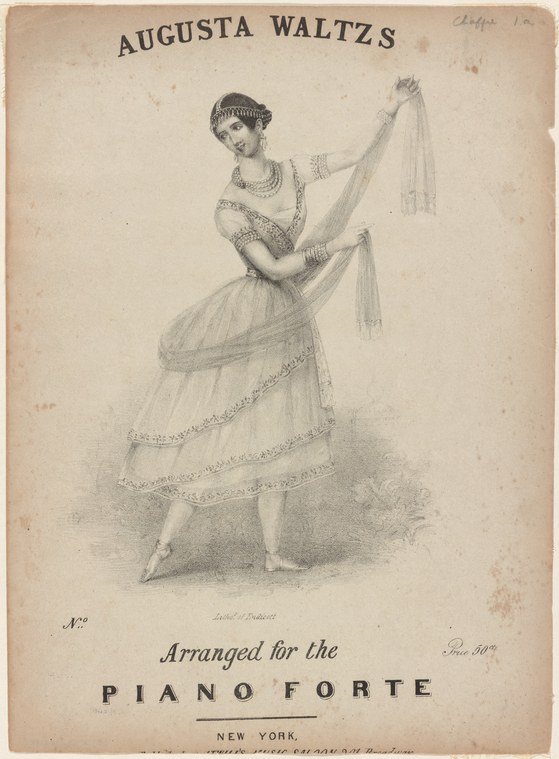
Augusta waltzs arranged for the piano forte
Unknown artist
- Collection:
- Prints depicting dance
- Source:
- New York Public Library
- Rights:
- Public domain — free to use, share and adapt.
- Recorded as:
- Public Domain
Sheet music covers like this are rare visual evidence of how social dances were actually executed and taught in the early 19th century, before photography. The engraved image standardized and circulated a specific ideal of waltz technique and presentation to thousands of dancers far from major ballroom centers. For historians of dance and dress, this is primary documentation of Regency-era ballroom practice and the aesthetics that dancers aspired to embody.
What you are looking at
A single female dancer in Regency-era ballroom dress dominates the composition, captured mid-movement against a plain background. She wears a high-waisted white muslin gown with decorative trim along the hem, short puffed sleeves, and a jeweled tiara or headpiece. Her right arm extends upward, holding what appears to be a long scarf or gauzy fabric that billows dramatically above her head and to the side—a signature flourish of the waltz era. Her left arm curves gracefully downward. She stands on pointe or demi-pointe, her weight appearing to shift as though caught in a turning motion, her posture upright and elegant. The figure is rendered in fine engraving with careful attention to the fall of fabric and the delicate articulation of limbs. The image is framed by the printed title "AUGUSTA WALTZS" at the top and "Arranged for the Piano Forte" at the bottom, identifying this as the cover or title page of a published musical arrangement.
The dancing
A single dancer, portrayed with classical ballroom posture—upright torso, elongated neck, and arms in an expressive but controlled frame. The raised right arm and the sweeping gesture with the scarf suggest rotation or a turning movement, while the left arm's downward curve maintains an open, flowing line. The position of the feet (en pointe or demi-pointe) and the apparent shift of weight imply the dancer is executing a waltz turn rather than standing still. The body demonstrates the refined, weightless quality prized in early-19th-century ballroom dance.
The dance depicted
This is unambiguously a waltz arrangement, as stated in the title. The image captures the essential aesthetic of Regency-era waltz performance: a solo female dancer shown as though mid-turn, with the characteristic upright posture, raised arm, and flowing fabric that became iconic of the form. The scarf or shawl held aloft was a common accessory in waltz performance of this period, both for visual drama and as a practical element that extended the line of the body. The 'Augusta Waltzs' likely refers to a composed or arranged waltz piece dedicated to or named for a specific performer or patron of that name, a common practice in the era. The musical arrangement for piano forte indicates this was a published piece for amateur musicians to perform or dance to in domestic or ballroom settings.
How it was made
This is a fine line engraving, printed in black ink on paper. The technique allowed for sharp detail, fine shading through parallel hatching lines, and precise reproduction—crucial for a published sheet music cover intended for wide distribution among middle and upper-class households. The engraving's clarity and regularity of line suggest professional execution by a skilled printmaker. As the cover to a published piano arrangement, this image served both as advertisement and as instruction to dancers, establishing the proper posture and movement style for anyone attempting the 'Augusta Waltzs' in their drawing room.
About this work
This engraved sheet music cover depicts a Regency-era waltz through the figure of a single dancing woman, captured at the moment of a turn with her characteristic costume and accessories intact. It dates from the period when the waltz was becoming the dominant social dance of European ballrooms, still considered somewhat daring for its close partnering and rotational movement. The work sits at the intersection of dance practice and commercial print culture—it is both documentation of how the waltz was performed and marketed, and a record of how dance was taught and learned outside the ballroom, through published music and instructional images in the home.
How to look at it
Note the moment the artist has chosen: not a static pose but an active turn, with weight shifted and fabric in motion. The dancer's arm position and posture demonstrate the 'rise and fall' characteristic of Regency waltz—the elongated line through the body and extended arm create the weightless, balletic quality that distinguished the waltz from earlier couple dances. The billowing scarf is not incidental detail; it serves the same function it did in performance, extending the visual line of the movement and emphasizing the turn. The frontality of the pose and the careful symmetry of the composition make this image work both as a visual record and as a mirror for someone learning the dance.
The period
The waltz emerged in Vienna in the late 18th century and spread rapidly across European ballrooms in the early 19th century, despite moral objections from conservative critics alarmed by the dance's rotational momentum, close partnering, and relative informality. By the 1820s–1830s, when this print was likely produced, the waltz had become thoroughly established in fashionable society. Published waltz arrangements flooded the market—thousands of titled pieces composed for piano, many named after fashionable dancers, patrons, or cities. New York's growing ballroom culture, suggested by the imprint, was importing and adopting these European dances with enthusiasm. The engraved sheet music cover was a standard medium for marketing these pieces and establishing visual standards for how they should be danced.
Where it lives
This engraved sheet music cover is held by the New York Public Library's collection of dance-related prints. It is an example of the thousands of titled waltz arrangements published in New York during the early 19th century, when the city was establishing itself as a center of ballroom dancing culture and commercial print production.
Dance in this work
Questions about this work
Was the waltz really performed by a single dancer, or is this image just showing the basic steps?
The waltz was fundamentally a couples dance, performed by two partners in a close frame. This image shows a solo dancer, likely a professional dancer or teacher demonstrating proper technique, posture, and style for the benefit of the print's viewers. Sheet music covers often used solo figures to display the ideal form—readers would have understood how to adapt the shown movement to partnered performance.
What is that fabric the dancer is holding?
That is most likely a long scarf or gauze shawl, a common accessory in Regency-era ballroom dress and waltz performance. It served both aesthetic and practical purposes: it extended the visual line of the body during turns, created a more dramatic silhouette, and helped the dancer balance the asymmetry of rotational movement. Scarves and shawls were standard elements of the professional dancer's costume.
Who was 'Augusta'?
The record does not identify the specific 'Augusta' for whom this waltz was named or dedicated. It was common practice to name dances after fashionable dancers, aristocratic patrons, or cities. Without further documentation, we cannot determine whether this refers to a celebrated performer of the era or a member of the patron class.
Where and when would this music have been used?
This sheet music was intended for domestic and commercial ballroom use in New York and elsewhere in early-19th-century America. Families with access to pianos would purchase such arrangements to play for dancing at home, while dancing masters would use the printed image as an instructional reference. Professional ballrooms would perform the same music for their patrons.
More dance artwork





