49 works in this view — arrow keys or swipe to move between them.
Dance in Art
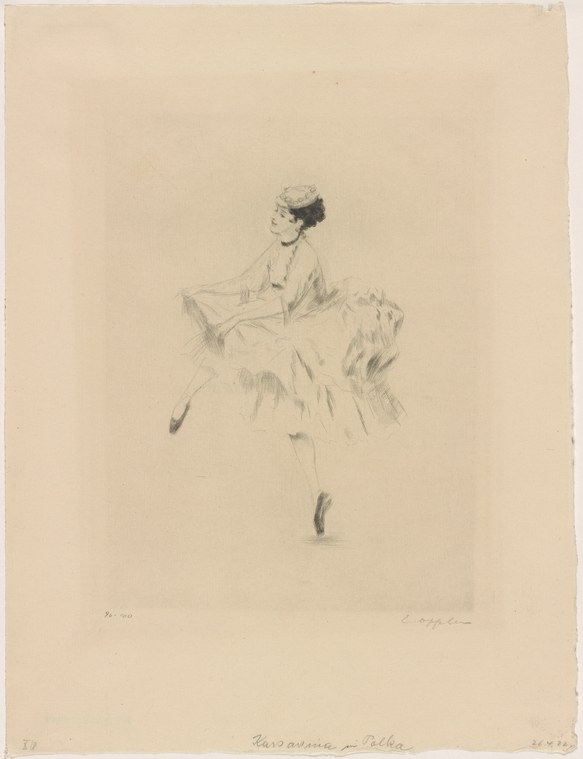
Karsavina in Polka
Unknown artist
- Collection:
- Prints depicting dance
- Source:
- New York Public Library
- Rights:
- Public domain — free to use, share and adapt.
- Recorded as:
- Public Domain
Karsavina was one of the defining ballerinas of early modernism, and images that document her appearance and the roles she embodied are primary sources for understanding early 20th-century ballet aesthetics and the visual culture of the Ballets Russes. The drawing's technique and approach—a study of a dancer at rest rather than in flight—reveals the different registers in which dance was depicted in this period: performance photography, action studies, and portraiture each served different audiences and purposes.
What you are looking at
A young woman in an early 20th-century dress sits at ease, her weight shifted to one side in a relaxed, graceful pose. She wears a light, flowing garment with delicate shading that suggests the soft fabrics of the Edwardian era. Her posture is slightly reclined, one leg extended, and her gaze is turned away from the viewer in a moment of quiet introspection rather than active performance. The drawing is executed in light graphite with selective shading concentrated on the drapery and the figure's upper body, leaving much of the composition spare and unfinished. The background is blank, focusing all attention on the sitter's elegant silhouette and the sensitive rendering of fabric.
The dancing
A single female figure occupies the composition, seated or semi-reclined with weight distributed asymmetrically. The upper body is upright but relaxed, the arms loosely held, one leg extended. The posture suggests ease rather than tension or formal alignment; there is no rigid frame or closed hold, and the figure appears contemplative rather than in active motion. The artist has given careful attention to how the body settles into rest, with particular emphasis on the graceful fall of fabric around the torso and legs.
The dance depicted
The catalogue identifies this as 'Karsavina in Polka,' referring almost certainly to Tamara Karsavina, the celebrated Russian prima ballerina of the Ballets Russes. However, the pose shown here bears little resemblance to the vigorous, quick-stepping character of a polka. The drawing instead captures a moment of stillness—a portrait study rather than a dance captured mid-motion. If this depicts a role or costume worn by Karsavina, it may be a scene from a theatrical work, or the title may conflate the subject with a particular ballet or character she performed. The image as it stands does not clearly illustrate the dance itself.
How it was made
This is a graphite drawing on paper, executed with a light, selective hand. The artist has used fine linear work for contour and suggestion, with concentrated shading in the fabric folds and face, allowing much of the paper to remain blank. The technique suggests a quick sketch or studio study—economical in means but assured in line quality. The handling is characteristic of portraiture or theatrical costume studies from the early 20th century, created for circulation among dance professionals or patrons rather than as a finished exhibition work.
About this work
This is a portrait study of the Russian ballerina Tamara Karsavina, one of the most celebrated dancers of the early 20th century and a key figure in Serge Diaghilev's Ballets Russes. The drawing captures her in a moment of rest or in a costume associated with a particular role, rendered with the fluid, economical line work typical of theatrical portraiture of the period. The work belongs to a large category of dance documentation from this era: intimate, often quickly executed studies made by artists who worked within or around the dance world, intended to capture not the spectacle of performance but the presence and bearing of the dancer herself.
How to look at it
The drawing asks you to attend to the economy of line and the artist's choice of what to render precisely and what to leave undefined. The face and upper body receive careful attention, while the lower body dissolves into suggestion. This is not a dance photograph; it is an act of interpretation in which the artist has selected a pose that conveys Karsavina's bearing and elegance without needing to show virtuosity or spectacle. The blank background and the figure's inward gaze remove her from narrative context and present her as an object of study—a body at rest, observed with respect and attention.
The artist
The artist is not recorded in the catalogue, and the signature on the print, if present, is not legible in the image. The style and approach are consistent with early 20th-century European portraiture and theatrical studies, and the work may be by a photographer or graphic artist working in London or Paris. The presence of the work in the New York Public Library's dance collection suggests it was either created for commercial distribution or acquired as part of a larger archive of dance-related imagery.
The period
This drawing dates to the height of the Ballets Russes era (c. 1909–1929), when Russian ballet was at the forefront of European artistic innovation and when the cult of the individual dancer reached new heights of visibility and prestige. Karsavina was one of the company's longest-serving principals, celebrated equally in Russia, Paris, and London. During this period, portraiture and photographic documentation of dancers became a significant cultural practice, circulated through postcards, illustrated magazines, and theatrical publications. The sketch tradition also reflects the influence of late 19th-century life-drawing practice in academic and theatrical contexts.
Where it lives
The work is held by the New York Public Library's Prints collection under the umbrella of materials depicting dance. The catalogue record is sparse and the artist unidentified, suggesting the work may have entered the collection as part of a larger donation or acquisition of theatrical ephemera. Its format and technique are consistent with studio prints and studies that circulated widely in the early 20th century.
Dance in this work
Questions about this work
Is this a photograph or a drawing?
It is a drawing in graphite (pencil), not a photograph. The artist has used selective shading and fine line work to create the image, leaving much of the paper blank. The technique is typical of portrait or costume studies from the early 20th century.
What is Karsavina doing in this image?
She is resting or posed in a moment of stillness, not actively dancing. The drawing captures her in a graceful, relaxed position—sitting or semi-reclining with her weight shifted to one side. This appears to be a character study or costume portrait rather than an action sketch.
Why does the title say 'Polka' when the pose doesn't look like a polka?
The title may refer to a polka that Karsavina performed or a character she played in a theatrical work called 'Polka,' rather than attempting to depict the polka dance itself. Alternatively, the catalogue record may be incomplete or incorrect. The image alone does not clarify the connection.
Who was Tamara Karsavina?
She was a Russian prima ballerina (1885–1978) and one of the most celebrated dancers of the early 20th century. She was a principal dancer with the Ballets Russes and performed leading roles in many of Serge Diaghilev's most famous productions. She was also known for her acting ability and for bringing character and narrative depth to her roles.
More dance artwork





