49 works in this view — arrow keys or swipe to move between them.
Dance in Art
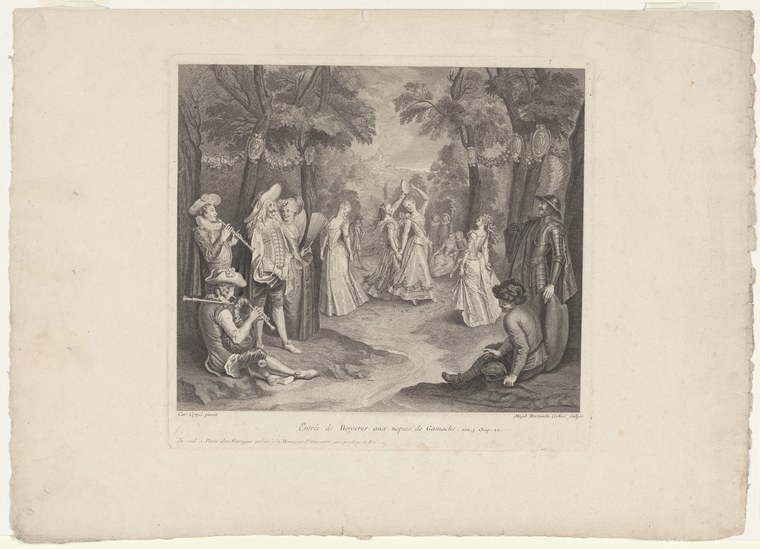
Entrée de bergeres aux noyces de Gamache, tom. 3 chap. 22
Unknown artist
- Collection:
- Prints depicting dance
- Source:
- New York Public Library
- Rights:
- Public domain — free to use, share and adapt.
- Recorded as:
- Public Domain
This engraving is evidence of how pastoral entertainment and ceremonial procession were understood and depicted in early modern visual culture. For historians of dance and spectacle, it documents both the form of such occasions—the processional arrangement, the costume, the presence of musicians—and the way they were rendered for a reading public. The illustration preserves details of how courtly entertainment married music, costume, landscape, and formal gesture in a single theatrical moment.
What you are looking at
This engraving depicts a pastoral wedding feast or ceremony set in a wooded landscape. A procession of figures in classical and pastoral dress moves through tall trees toward the center of the composition, where a gathering of people stands in a clearing. The foreground shows seated musicians and observers on either side—on the left, figures in elaborate Renaissance costume; on the right, cherubs or putti recline among the vegetation. The scene is lit with the diffused, romantic glow characteristic of 17th-century printmaking, with deep shadows beneath the trees framing the sunlit central action. The composition has the theatrical depth and narrative focus of a court spectacle or a scene from a literary work, with careful attention to the hierarchical arrangement of figures and the framing of landscape elements.
The dancing
The figures in the procession move in a loose, informal arrangement rather than in rigid formation. Those nearest the center appear to be turning or pausing mid-step, with arms raised or extended in gestures suggesting music and celebration. Several women wear long, flowing gowns with high waistlines characteristic of early modern dress; men are in doublets and hose. The poses suggest a slow, stately procession—the weight appears to be on planted feet rather than in active travel. The scattered positions and the inclusion of reclining cherubs suggest this is a moment of gathering and greeting rather than coordinated group movement.
The dance depicted
This engraving illustrates a scene from Don Quixote, Part 2, Chapter 22—the title refers to the "Entrada de bergeres" (entry of shepherdesses) at the wedding of Gamache. The scene depicts a pastoral entertainment, a type of courtly spectacle popular in Renaissance and early modern courts where aristocrats or their entertainers performed as idealized shepherds and shepherdesses. The formal procession and the emphasis on costume and landscape over technical movement suggest this is a processional or ceremonial entertainment rather than a dance in the modern sense, though music and rhythmic movement are clearly part of the occasion. The presence of musicians and the arrangement of figures implies music accompanied the action.
How it was made
This is an engraving, executed with fine lines and careful cross-hatching to create tonal depth and atmospheric perspective. The technique allows for the detailed rendering of costume, facial expression, and landscape detail visible here. The circulation of Don Quixote in illustrated editions across Europe in the 17th and 18th centuries means this engraving was likely produced as part of a series illustrating the novel, making it a reproductive print aimed at a broad reading public rather than a unique work. The print's formal composition and legible narrative content suit this function as a book illustration.
About this work
This engraving documents a pastoral spectacle from Cervantes' Don Quixote, showing the ceremonial entry of shepherdesses at a wedding feast. It captures a moment in the history of courtly entertainment and the literary imagination of the Renaissance, when court dances and processions were staged as pastoral scenes. The work belongs in a gallery of dance imagery both because it depicts a formal, musically accompanied ceremonial action and because it preserves a record of how Renaissance spectacle was visualized and circulated through print culture. The scene shows the intersection of literary narrative, courtly performance, and the visual conventions used to represent such occasions.
How to look at it
Attend to the arrangement of figures in space: notice how the artist has staged the procession to move toward the center, with the tallest trees framing the action like the architectural frame of a stage. The careful positioning of musicians on the left and the symbolic cherubs on the right creates a balanced, theatrical composition. The gestures of the figures—raised arms, turned heads, paused steps—are restrained and formal, suggesting the stately pace of a ceremonial procession rather than vigorous dancing. This is a moment of arrival and gathering, not of active performance.
The period
This engraving dates to the era of Don Quixote's publication and circulation in illustrated editions (early 17th century through the 18th century). Pastoral entertainment was a dominant form in Renaissance and early modern courtly culture across Europe, influenced by classical models and literary works like Montemayor's Diana. Such spectacles combined dance, music, poetry, and elaborate costume in celebrations of aristocratic life. The formal, narrative approach to printmaking visible here—the careful composition and legible storytelling—reflects the conventions of book illustration in this period, when prints were key to disseminating literature and the visual culture it inspired.
Where it lives
This engraving is part of the New York Public Library's collection of prints depicting dance. It is identified in the catalogue as an illustration to Don Quixote, Part 2, Chapter 22, but the printmaker, engraver, and precise date of publication are not recorded in the available metadata.
Dance in this work
Questions about this work
Is this a dance or a procession?
The scene depicts a ceremonial entry or procession accompanied by music—a common form of courtly entertainment in the Renaissance. While not a structured dance, such occasions involved rhythmic, choreographed movement and were central to court culture. The distinction between procession and dance was less rigid in this period than in later eras.
What is a pastoral entertainment?
A pastoral entertainment was a courtly spectacle in which aristocrats or professional performers dressed as idealized shepherds and shepherdesses and performed in a theatrical landscape setting. These events combined music, poetry, costume, and movement, often based on literary models. They were popular across Europe from the Renaissance through the 18th century.
Why are there cherubs in the image?
The cherubs (putti) are symbolic figures common in Renaissance and baroque art. Their presence elevates the scene and signals its connection to divine or allegorical meaning—here, celebrating the union of Gamache and his bride. They were a conventional embellishment in courtly spectacle imagery.
What does this tell us about how Don Quixote was circulated?
Don Quixote was published in illustrated editions that circulated widely across Europe. This engraving is one of many visual interpretations of scenes from the novel, showing how literature and visual culture were intertwined. Readers would encounter the novel both through text and through such illustrations.
More dance artwork





