49 works in this view — arrow keys or swipe to move between them.
Dance in Art
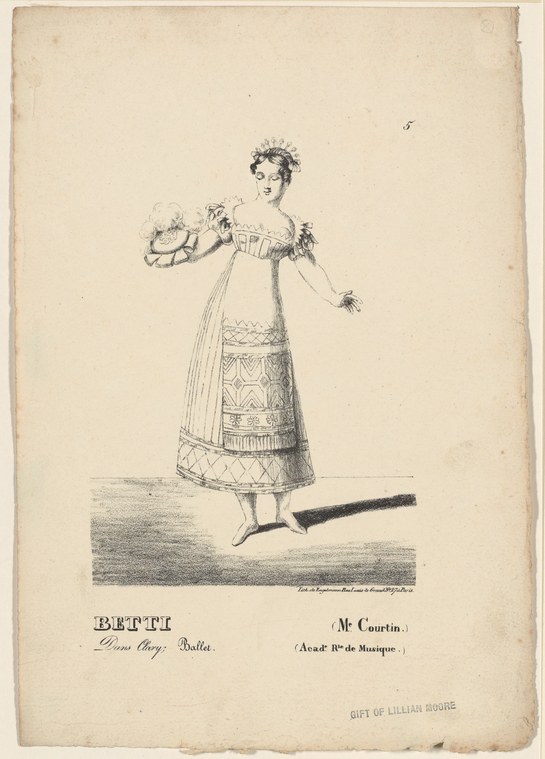
Betti (Me. Courtin.) Dans Clary; ballet
Unknown artist
- Collection:
- Prints depicting dance
- Source:
- New York Public Library
- Rights:
- Public domain — free to use, share and adapt.
- Recorded as:
- Public Domain
This is evidence of how early 19th-century ballet was promoted, distributed, and remembered—not through notation or description, but through the image of the star performer in costume. For historians trying to understand what dancers wore, how they were positioned, and how they were marketed, such prints are primary sources. The work also documents a performer and production from the gap between the late 18th-century Parisian ballet and the emergence of Romanticism.
What you are looking at
A single female dancer stands in three-quarter view against a plain background, wearing early 19th-century dress consisting of a high-waisted white muslin gown with a deep decorative border at the hem, puffed short sleeves trimmed with flowers, and a draped shawl or overskirt in a contrasting patterned fabric. Her dark hair is styled up and adorned with flowers. She holds a large feathered hat in her raised left hand and gestures expressively with her right arm extended downward, her body weight shifted onto her right leg in an attitude of posed elegance. The composition is a portrait-format theatrical image, clearly a costume study or character sketch rather than an action scene. The print quality and the inscription beneath suggest this is a named performer in a specific role.
The dancing
The dancer's posture is upright and statuesque, with the weight settled on the back leg, the free leg bent and held close. Both arms are active: the left raised to shoulder height holding the accessory, the right extended in a graceful downward curve. The frame is open rather than closed, the body turned to present the silhouette of the costume. This is a portrait attitude of repose rather than a captured moment of active dancing—the kind of pose a performer would hold for the print maker, or a signature position within a theatrical scene.
The dance depicted
This is most likely a character from a French theatrical ballet or danced comedy of the early Regency period, performed by Mlle. Courtin (as the inscription indicates) in a work called *Clary* or *Dans Clary* (In Clary). The print appears to be a costume portrait documenting a specific performer in a named role—a standard practice for publicizing theater works of this era. The style of dress, the posed presentation, and the theatrical conventions suggest this is a figure from a light or comic ballet rather than a serious tragic work. Without access to records of the production, the precise choreographic content cannot be determined, but the genre is clearly theatrical dance intended for a paying Paris audience.
How it was made
This is an engraving or etching, rendered in line with fine cross-hatching to create tone, printed on laid paper. The technique allows crisp definition of the costume's embroidered details and the feather work of the hat, and suggests a commercial theatrical print—one of many issued to promote specific works and star dancers to the theater-going public. The inscription in script at the bottom is integral to the print, identifying both performer and role. This mode of production and distribution was standard for Parisian theater publicity from the 1790s through the 1820s.
About this work
This is a theatrical costume portrait engraving documenting a female dancer in a named role from an early 19th-century French ballet or danced comedy. The work belongs to a large body of printed ephemera that served to advertise theatrical performances and star performers to the paying public, making it both a document of dance history and an artifact of commercial entertainment culture. The figure's costume, pose, and the inscription all work together to identify a specific moment in a specific performer's career—in this case, Mlle. Courtin in the role of a character in *Clary*, a work of which little now survives except these images.
How to look at it
Attend to the costume as the primary subject: the engraver has lavished care on the muslin, the embroidered hem, the flowers in the hair and at the sleeve, and especially the elaborate feathered hat. The pose is calculated to show the garment from a flattering angle while also suggesting the lightness and grace expected of a theatrical dancer. The downward curve of the extended arm and the tilt of the head create a sense of elegant repose rather than exertion—this is how the performer wished to be remembered and how her audience imagined her: as a creature of grace and refinement, not athletic effort.
The period
This print was made during the early Regency or late Napoleonic period in France, when Paris remained a center of theatrical innovation despite political disruption. Theatrical prints of dancers and singers were a major form of public entertainment publicity and fan culture—audiences would collect them, and performers' popularity was partly measured by the circulation of their images. The costume style and the production values of the print itself suggest a work aimed at a fashionable, urban audience. This was the era immediately preceding the explosion of Romantic ballet in the 1830s–1840s, but within a living tradition of danced comedy and light theatrical works that stretches back through the 18th century.
Where it lives
This print comes from the New York Public Library's collection of prints depicting dance, indicating it was preserved as a document of dance history or costume history. It is typical of the theatrical publicity prints produced in Paris and other European theater cities during the early 19th century.
Dance in this work
Questions about this work
Who was Mlle. Courtin?
The print identifies her as the performer of the role, but her biographical details are not recorded in standard dance histories. She was a working theater dancer in Paris during the early 19th century, notable enough to have her image circulated in print form. Beyond what the print itself tells us—her name, her role, and her costume—little survives.
What was the ballet *Clary*?
No detailed records of this work appear in surviving histories of early 19th-century French ballet. It was likely a short comedy or divertissement rather than a full-length serious ballet, given the lightness of the costume and the character type. The work exists now primarily through images like this one.
How were these prints used?
Theatrical prints were sold as souvenirs at the theater or through print shops, allowing fans to own an image of their favorite performers. They were also collected in albums, pasted into scrapbooks, and used to publicize upcoming performances. In an era without photography or mass media, these prints were how performers' images circulated and how dance was documented for a general audience.
Is this a painting or a print?
This is a print—an engraving or etching made from a metal plate. It was designed to be reproduced and sold in multiple copies, which is why it has survived. The technique allows for fine detail in rendering the costume and makes the work affordable to produce and distribute widely.
More dance artwork





