49 works in this view — arrow keys or swipe to move between them.
Dance in Art
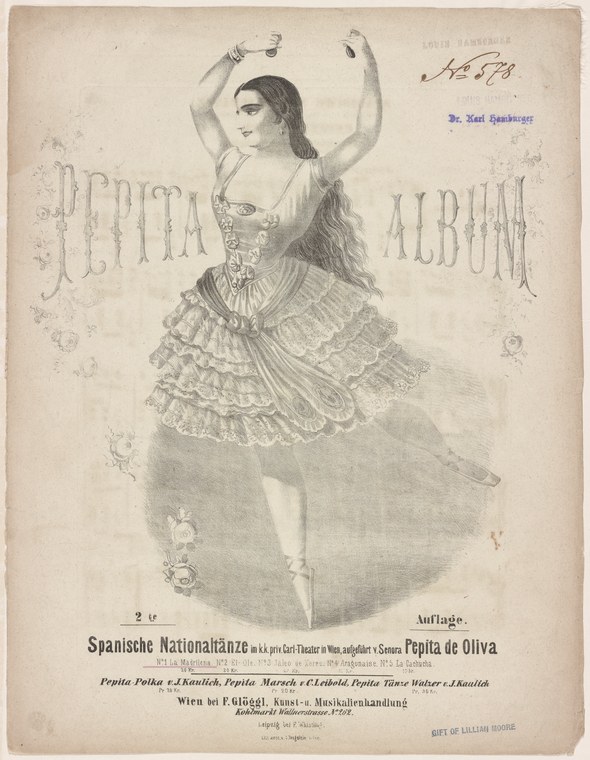
Pepita Album. Spanische Nationaltänze im k.k. priv. Carl-Theater in Wien, aufgeführt v. Senora Pepita de Oliva
Unknown artist
- Collection:
- Prints depicting dance
- Source:
- New York Public Library
- Rights:
- Public domain — free to use, share and adapt.
- Recorded as:
- Public Domain
This image documents a specific historical moment in the globalization of dance and the marketing of national identity through performance. Pepita de Oliva was a real, celebrated performer, and this lithograph is material evidence of how Spanish dance was packaged and promoted to Vienna's theater-going public—revealing both genuine cultural exchange and the Romantic-era tendency to exoticize and aestheticize 'national' dance forms through the lens of ballet.
What you are looking at
A lithographic cover for a Spanish dance album features a single female dancer in a three-quarter standing pose against a plain background. She wears a white corseted bodice with a dramatically ruffled skirt composed of multiple tiers of lace and pleated fabric that extends to mid-calf, beneath which her legs are bare above ankle boots. Her long dark hair falls loose down her back, and her arms are raised in a graceful overhead frame with forearms extended. The composition is vertically oriented with the title "PEPITA ALBUM" arched above the figure in decorative lettering, and below it the full subtitle in German and Spanish describing Spanish national dances performed at the Carl-Theater in Vienna by Señora Pepita de Oliva. At the bottom, publication information and a catalogue number are printed.
The dancing
The single dancer is captured in a balletic, lifted pose with arms raised symmetrically and slightly forward, elbows bent at roughly 90 degrees in a classical frame. Her weight appears centered, with legs straight and together, suggesting stability rather than mid-motion. The silhouette emphasizes verticality and grace. Her posture and arm carriage follow academic ballet conventions rather than the sharp, grounded hip articulations characteristic of flamenco.
The dance depicted
The title explicitly identifies this as a performance of Spanish national dances ('Spanische Nationaltänze'), yet the dancer's pose and costuming present a hybrid: the balletic arm frame and upright carriage belong to academic dance, while the corseted bodice, tiered ruffled skirt, and bare legs reference Spanish and theatrical-Spanish costume conventions of the mid-19th century. The image does not depict a specific moment of dance technique—footwork is invisible and weight is static—but rather presents an idealized portrait of the dancer as a performer of Spanish repertoire. Whether Pepita de Oliva performed actual flamenco, regional Spanish folk dance, or a romanticized theatrical version remains unresolved by the image alone.
How it was made
This is a lithographic print, evident from the stone-ground texture and the characteristic tonal modeling of the figure against the pale background. Lithography allowed for broad circulation and affordable reproduction, making this a commercial product intended for promotion and souvenir purposes. The technique is capable of fine detail—visible in the intricate rendering of the lace and pleating—and the print appears to be hand-colored or tinted, with subtle shading that gives dimension to the fabric and skin. The quality and fineness suggest a professional Vienna-based print house, consistent with the theatrical context (Carl-Theater).
About this work
This is a promotional lithograph for a Spanish dance performance at a major Viennese theater, circa mid-19th century, featuring the celebrated dancer Pepita de Oliva. The image sits at the intersection of two dance worlds: the academic ballet aesthetic of body carriage and arm frame, and the costume and cultural identity of Spanish dance as it was understood and marketed to Central European audiences of the Romantic era. It functions simultaneously as portraiture, costume documentation, and advertisement—a common and economically important genre in 19th-century dance promotion. The work reveals how Spanish dance was visualized for European consumption: not as folk practice but as a theatrical, feminized, and balletically-inflected spectacle.
How to look at it
Observe the tension between the dancer's balletic upper body—the lifted, symmetrical arm frame and upright carriage—and the explicitly Spanish costume with its deep corseting and layered ruffles. This collision of vocabularies is intentional and tells you how Spanish dance was understood in Vienna: not as a distinctive technical or kinetic practice with its own logic, but as a costume and aesthetic mood grafted onto European (especially balletic) movement values. Notice also that the dancer is not shown in motion: her pose is a portrait stance, not a moment of technique. This was conventional for promotional lithographs, which prioritized recognizable image of the performer over documentation of actual choreography.
The artist
The artist is not recorded. The print was produced by F. Floegel, a Vienna-based music and theater publisher and print dealer whose firm was active in the mid-19th century. Floegel's output was commercial and varied, serving the Viennese entertainment industry with playbills, album covers, and portraits of popular performers. This work is typical of his theatrical advertising practice.
The period
The mid-19th century saw intense European fascination with 'national' dances and exoticized performance, especially as Romanticism elevated folk and non-Western cultures as sources of authenticity and sensibility. Spanish dance, in particular, held particular appeal for Central European audiences, often presented through the lens of literary Orientalism (the 'Moor' and the 'gypsy'). The rise of lithography enabled the rapid, affordable production of theatrical ephemera—costume portraits, playbills, album covers—that fueled the star system and the souvenir economy around famous performers. The Carl-Theater in Vienna was a major commercial venue for this kind of entertainment, and albums like this one capitalized on audience appetite for taking home images of celebrated dancers.
Where it lives
The print is held by the New York Public Library in its collection of dance imagery (noted in the source record). It is a commercial theatrical print produced in Vienna, likely as both promotional material for the performance and as a souvenir for purchase by theatergoers—a common practice in 19th-century entertainment culture.
Dance in this work
Questions about this work
Was Pepita de Oliva a real dancer?
Yes. She was a celebrated Spanish dancer who performed across Europe in the mid-19th century, including at the Carl-Theater in Vienna. This lithograph is evidence of her star status and the commercial machinery that surrounded famous performers of the era.
Is this flamenco?
The title identifies it as 'Spanish national dances' without specifying flamenco. The image shows a theatrical, balletically-influenced pose rather than flamenco technique. What Pepita de Oliva actually performed—whether regional Spanish folk dance, flamenco, or a hybrid theatrical form—cannot be determined from the lithograph alone.
Why does she look like a ballet dancer if she performed Spanish dance?
This reflects 19th-century European practice: Spanish dance (like many non-European forms) was often reframed through balletic aesthetics when presented to metropolitan audiences. The image shows the Romantic-era tendency to exoticize national traditions while fitting them into existing European movement vocabularies.
What was an 'album' in this context?
A theatrical album was a souvenir collection of lithographic portraits and scenes from a popular performance or performer. These were marketed to theatergoers and sold as affordable keepsakes, functioning much like modern playbill merchandise.
More dance artwork





