49 works in this view — arrow keys or swipe to move between them.
Dance in Art
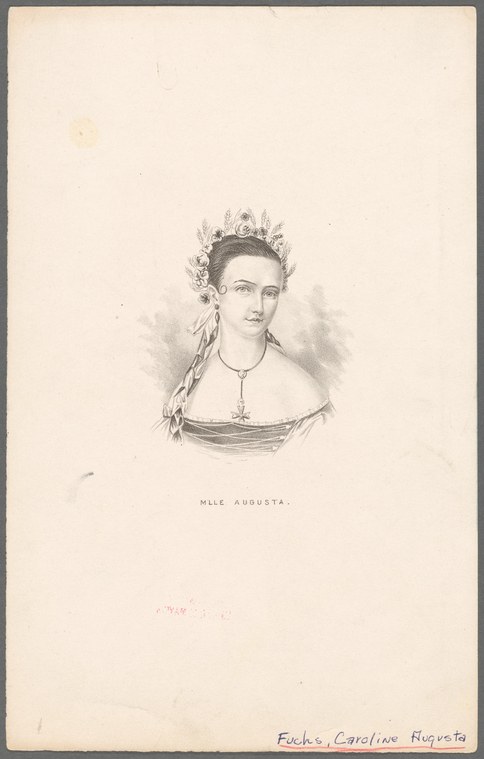
Mlle. Augusta
Unknown artist
- Collection:
- Prints depicting dance
- Source:
- New York Public Library
- Rights:
- Public domain — free to use, share and adapt.
- Recorded as:
- Public Domain
This is primary evidence of who danced in the mid-19th century and how dancers were publicly presented and valorized. For historians, it is a dated portrait of a named performer—a rarity before photography—showing the costume and styling conventions of the era. For dancers and costume makers, it provides concrete detail about the dress, headdress, and jewellery worn by professional ballet dancers of the Romantic period.
What you are looking at
A three-quarter-length portrait of a young woman, identified as Mlle. Augusta, rendered as a finely detailed engraving. She is shown from the shoulders up, turned slightly to the left, with her face serene and direct. Her dark hair is styled with a long braid and crowned with an ornamental tiara or wreath of flowers and jewels that catches light delicately. She wears an off-shoulder garment—a sheer or semi-transparent dress or tulle with a horizontal neckline that drapes from her shoulders. A small pendant or ornament hangs at her throat. The background is softly shaded and undefined, directing all attention to the figure. The work displays the refined technique of 19th-century portraiture engraving, with careful cross-hatching used to model the face, neck, and fabric.
The dancing
The figure is static and frontal, posed for formal portraiture rather than captured in movement or dance. Her posture is upright and dignified, with shoulders relaxed. The costume and styling—the elaborate headdress, the delicate draping of the neckline, the refined jewellery—suggest a dancer of status, likely a principal dancer at a major opera house or court ballet. There is no indication of active dancing: this is a portrait of a dancer when not performing.
The dance depicted
Mlle. Augusta is identified in the handwritten annotation as a performer, though the engraving itself shows no movement or dance gesture. The refined costume and formal presentation suggest a dancer from the Romantic era (mid-19th century), when principal female dancers were celebrated as stars and their portraits circulated widely. Without additional context or signature, the specific identity of this performer cannot be confirmed from the image alone, but the styling is consistent with a ballerina of standing during the 1840s–1860s.
How it was made
This is a steel or copper engraving, a process that allowed fine detail and could be printed in quantity. The technique creates the soft tonal transitions visible in the face and fabric through careful parallel lines and cross-hatching; the signature at the bottom (partially visible) suggests a professional engraver working from a sketch or earlier portrait. Engravings of this type were the primary medium for circulating images of celebrated dancers before photography became widespread, making them key documents of 19th-century performance culture.
About this work
This is a portrait engraving of a 19th-century professional dancer, Mlle. Augusta, whose performances were celebrated enough to warrant formal publication in print. The work belongs to a rich visual archive of Romantic-era dancers preserved in engraved form. It documents not the moment of performance but the identity and status of the dancer—her presentation as an artist worthy of attention and commemoration. The engraving exemplifies how theatre and dance stars were marketed and remembered before film or mass reproduction, through the circulation of fine-art prints to subscribers, theatregoers, and collectors.
How to look at it
Attend to the costume and styling as documents of period practice: the way the dress is cut and draped, the design of the headdress, the presence and placement of jewellery, the arrangement of the hair. This is not a dance pose but a dancer's public portrait, and the choices made—the formality, the refinement, the focus on the face and upper body—reflect how principal dancers were presented to the public. The soft modeling of the face and the careful rendering of fabric textures show the engraver's skill in conveying both likeness and status.
The artist
The engraver is not recorded in the catalogue. The inscription at the lower left suggests a professional signature, but it is not fully legible in the image. The technique and style are consistent with commercial portraiture engraving of the mid-19th century, a thriving trade in which prints of celebrated performers—dancers, singers, actors—were produced and sold to feed public appetite for images of stage celebrities.
The period
This engraving dates to the Romantic era in ballet (approximately 1830–1870), when female dancers became the primary focus of the art form and the ballerina was celebrated as an almost ethereal figure. The costume shown here—the off-shoulder neckline, the simple draped fabric, the ornamental headdress—is consistent with the Romantic tutu and styling of the period. Engraved portraits of celebrated performers were a major industry in this era; theatres produced them, artists collected them, and theatregoers purchased them as souvenirs and tokens of fandom. The formal presentation and refined execution of this print indicate that Mlle. Augusta was a significant enough performer to warrant professional portraiture.
Where it lives
The work is held in the New York Public Library's collection of prints depicting dance. The handwritten annotation at the lower right identifies the subject as 'Facile, Caroline Rigveda' or similar (the handwriting is unclear); this may be an alternate name or a later cataloguer's note. The print's source and circulation history are not recorded.
Dance in this work
Questions about this work
Who was Mlle. Augusta?
The engraving identifies her by that stage name, a common practice for dancers of the period. Without additional documentation, her full identity and career details cannot be confirmed from the image alone. The refined presentation and quality of the engraving suggest she was a principal dancer of some standing, likely performing in Paris or another major European opera house during the mid-19th century.
Why does she have a tiara and jewels if this is a dance portrait?
Romantic-era dancers, especially principals, wore elaborate headdresses and jewellery as part of their stage costume. These ornaments were also status symbols, signalling the dancer's rank and celebrity. Portraits of dancers often included these costly elements to emphasize their importance and appeal.
Is this a photograph or a drawing?
This is a steel or copper engraving, a printmaking technique that was the standard medium for circulating images of performers before photography became widespread. The fine detail and soft tonal modeling are achieved through careful engraving rather than photography, and the print could be reproduced many times from a single metal plate.
More dance artwork





