49 works in this view — arrow keys or swipe to move between them.
Dance in Art
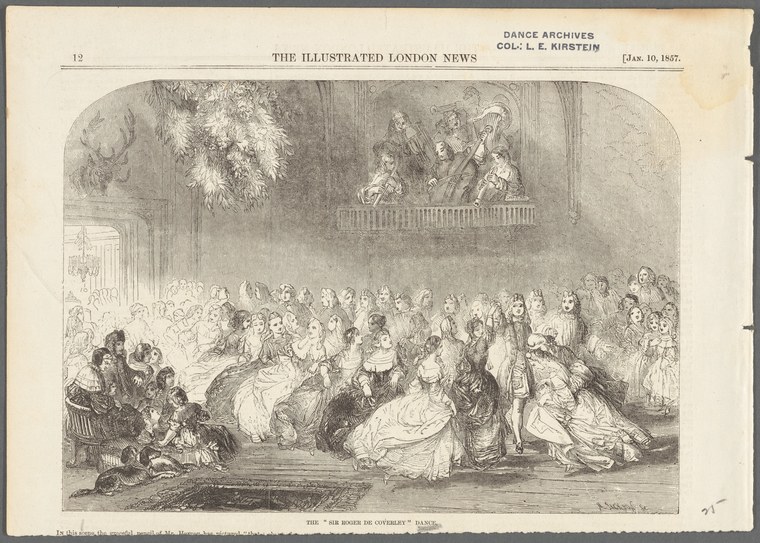
The "Sir Roger de Coverley" dance
Unknown artist
- Collection:
- Prints depicting dance
- Source:
- New York Public Library
- Rights:
- Public domain — free to use, share and adapt.
- Recorded as:
- Public Domain
This image is rare documentary evidence of how a canonical English country dance was actually performed and staged in its period of peak popularity. For historians of social dance and material culture, it shows not only the structure of the Sir Roger de Coverley but the full ceremonial and architectural context in which it took place—something a bare dance notation cannot convey. For dancers learning historical repertory, it offers proof of posture, costume, spacing, and social protocol that text alone cannot provide.
What you are looking at
A crowded ballroom or assembly room in the Regency era, rendered in fine engraving. The space is elegant and formal, with high ceilings, classical architectural details, and a chandelier visible above. Multiple couples occupy the floor and the margins of the scene, dressed in the high-waisted gowns and tailcoats characteristic of the early 19th century. In the foreground, a couple performs the Sir Roger de Coverley—a woman in a full white gown with her partner in dark coat and breeches. The woman's skirt billows around her as she moves, capturing a moment of animated motion. Spectators line the walls and fill the background, watching intently. A small group of musicians occupies a raised platform or gallery at the top of the composition. The overall impression is of a formal social occasion—possibly a private house ball or public assembly—where this country dance was the featured entertainment. The engraving technique allows fine detail in the architecture, fabrics, and facial expressions, conveying both the formality and the liveliness of the scene.
The dancing
The central couple performs in an open promenade position typical of country dancing: the man and woman face forward or slightly away from one another, arms extended in the proper frame for the Sir Roger de Coverley. The woman's full skirt occupies considerable visual space as she steps, showing the characteristic silhouette of Regency dress. Other pairs visible around the room adopt similar frames and postures. The dancers' upper bodies are upright and composed, their movements controlled and deliberate rather than energetic—consistent with the structured protocol of Regency-era country dance. Surrounding figures stand at attention as spectators, their posture reflecting the social formality of the occasion.
The dance depicted
The Sir Roger de Coverley is an English country dance of ancient origin, documented in printed dance manuals from at least the 17th century and remaining a social staple through the Regency period and beyond. It is a longways set dance performed by couples in two parallel lines, with couples progressing down the line and performing a sequence of figures including hands-across, cast, and promenade. The engraving shows the moment of active dancing during the promenade, the section most visually dramatic for an artist: the woman's skirt and the couple's forward motion are the focal point. The inclusion of musicians, spectators, and the formal assembly-room setting all confirm this as documentary evidence of how the dance was staged and received in Regency society—as a centerpiece of entertainment at a formal gathering, neither a rustic novelty nor an intimate parlor amusement, but a structured social ritual.
How it was made
This is a fine engraving, recognizable from the delicate parallel line work (hatching and cross-hatching) that models form and shadow, the crisp outlines of figures and architecture, and the uniform tonal range characteristic of copperplate or steel engraving. The technique allowed for high detail and reproducibility, making the image suitable for publication in a periodical or book—consistent with the page header identifying this as from The Illustrated London News. Engraving was the dominant medium for news illustration in the 19th century before photographic reproduction, and its formal, controlled aesthetic suited both documentary ambitions and genteel subject matter. The print's circulation in a mass-market weekly newspaper means it was made as a visual record for a broad, educated readership.
About this work
This engraving documents the Sir Roger de Coverley as it was danced and witnessed in Regency England—a country dance performed by a single couple in a formal assembly room before an audience of spectators and musicians. The print captures not merely the steps but the social context: the dress, the architecture, the role of music, the attention of onlookers. Country dances of this type were foundational to genteel social life and were among the few dances in which both men and women participated actively in mixed company. The artist has chosen the most visually arresting moment—the open promenade—to convey the character of the performance. The work is a record of Regency ballroom practice at a precise historical moment.
How to look at it
Attend to the couple in the foreground: the woman's posture and the extension of her arm in the open promenade frame, and the man's corresponding position. Note how the artist has rendered the moment of stepping and turning to capture motion without exaggeration—the skirt's billow is the chief visual indicator of movement. Look also at the spectators: their fixed attention and formal dress underline that this was not casual dancing but a structured social ceremony. The raised platform with musicians reinforces that the dance was dependent on live music and that the musicians were present and visible, not incidental. The architectural surround—the high ceiling, the scale of the room—conveys that this was a formal, public or semi-public venue, not a domestic parlor.
The period
The Regency era (roughly 1811–1820, though the term is often extended to cover the broader early 19th century) was a peak period for country dancing in England. The dances performed at formal assemblies and private balls were highly standardized, documented in printed manuals, and taught by professional dancing masters. The Sir Roger de Coverley, despite its folk origins, was by this time a fixture of respectable society dancing—performed at the same assemblies where quadrilles, cotillions, and waltzes (in modified forms) also appeared. The Illustrated London News, founded in 1842, made topical engravings of social life, sports, and culture its signature feature, and depictions of fashionable gatherings and entertainments were standard fare. This print is one of many such images documenting the manners and recreations of the English middle and upper classes in the mid-19th century.
Where it lives
The work is held in the Dance Archives in the collection of L. E. Kirstein and is catalogued as part of a series of prints depicting dance. It appears in The Illustrated London News, a weekly magazine of engraved illustrations and text aimed at the educated middle-class readership of Victorian England. The page header and publication date confirm its origin as a news illustration.
Dance in this work
Questions about this work
What is the Sir Roger de Coverley and how do you dance it?
The Sir Roger de Coverley is an English country dance performed by couples in two parallel lines facing one another. The dance proceeds through a sequence of figures—hands-across, cast, promenade, and others—with each couple progressing down the line. This engraving shows the promenade figure, in which the couple walks forward together in an open frame. The full sequence is documented in 17th- and 18th-century dance manuals and remained a standard social dance through the Regency and Victorian periods.
Why would people gather to watch others dance?
In Regency and Victorian England, formal ball dancing was a centerpiece of social and courtship life. Assembly rooms hosted regular dancing events where watching was as much a part of the occasion as participating—it allowed unmarried people to observe one another, it demonstrated one's status and refinement, and it was entertainment. Musicians, often employed by the assembly or the host, were expected to be visible and attentive, and spectators would watch intently as couples performed.
How do we know this is an accurate record of the dancing?
The engraving was published in The Illustrated London News, a periodical that prided itself on accurate, topical illustration of contemporary life. The artist has rendered the posture, frame, and costume with specificity consistent with Regency dance manuals and other visual records of the period. The inclusion of the musicians, the architectural setting, and the formal dress of spectators all corroborate that this is a documentary image, not a fanciful or generic scene.
More dance artwork





