49 works in this view — arrow keys or swipe to move between them.
Dance in Art
Zergliederung der Schönheit
Unknown artist
- Collection:
- Prints depicting dance
- Source:
- New York Public Library
- Rights:
- Public domain — free to use, share and adapt.
- Recorded as:
- Public Domain
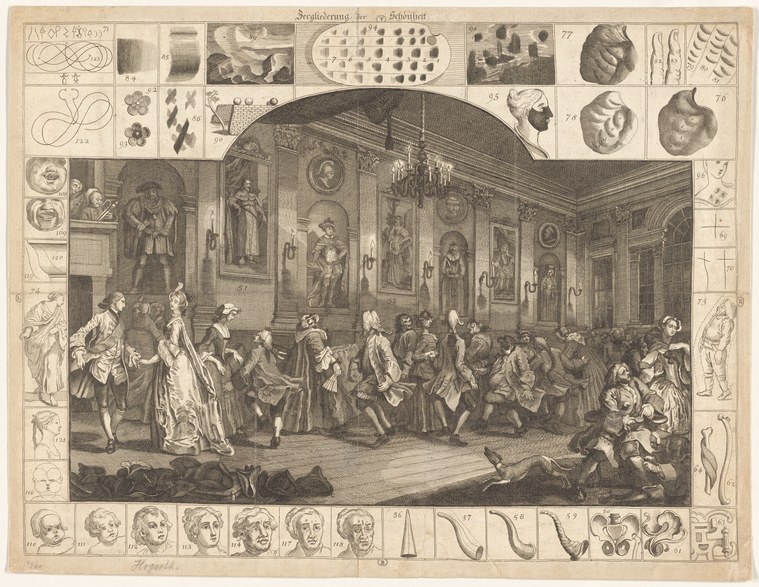
This work uniquely documents how 18th-century theorists understood dance as a site of beauty—not merely as entertainment but as a discipline that embodied universal principles of proportion and grace. For dance historians, it shows how the formal patterns of court dance were taught and valued as demonstrations of ideal human form.
What you are looking at
An elaborate salon or ballroom scene of the 18th century, viewed from above at an architectural vantage point that shows the full length of a grand rectangular room with ornate wall panels, paintings, and a decorated ceiling. Two dozen or more figures in formal court dress move through the space in patterns suggesting a formal dance. The walls are lined with framed portraits, columns, and neoclassical ornament; a large chandelier hangs from the coffered ceiling. The composition surrounds the central scene with an encyclopedic array of small diagrams, geometric patterns, anatomical studies, and facial expression sketches—a scholar's apparatus for analyzing human beauty and motion. The entire work reads as a systematic study, the dance scene illustrating aesthetic principles mapped out in the marginal illustrations.
The dancing
The dancers are arranged in loose couples and lines across the floor, dressed in rich silks and formal attire of the 1700s—men in breeches and coats, women in wide-skirted gowns. Their posture is upright and formal, with arms held at mid-level and bodies angled to show the three-quarter view preferred in court ballet. Several pairs appear to face each other or move in parallel lines. The small scale of the figures relative to the room prevents precise reading of hand positions or footwork, but the overall carriage is that of trained courtiers executing a learned pattern, not social abandon.
The dance depicted
This is almost certainly a ballroom scene of the French baroque or rococo court, most likely a minuet or quadrille—the formal group patterns and architectural setting point to court ballet or the learned dances of the salon rather than common social dance. The title *Zergliederung der Schönheit* ('Dissection of Beauty' or 'Analysis of Beauty') suggests the work is not documentary but theoretical: the dance is a vehicle for demonstrating ideal proportions, grace, and the principles of human movement. The marginal apparatus—geometric diagrams, facial profiles, and anatomical studies—identifies this as an Enlightenment project linking dance to natural philosophy, proportion, and the science of aesthetics.
How it was made
This is a copperplate engraving with hand finishing, in the characteristic technique of 18th-century German or Swiss publishing: fine parallel lines and cross-hatching build tone and shadow, with the marginal studies executed in the same linear idiom. The architectural perspective and the density of detail indicate accomplished printmaking; the work was intended for an educated audience with leisure to examine it closely. The binding of a narrative scene to systematic analytical diagrams suggests a printed book or portfolio—a pedagogical object, not a single artwork.
About this work
This engraving presents an 18th-century court or ballroom dance—likely a minuet, quadrille, or other formal salon dance—as the centerpiece of a systematic analysis of beauty, proportion, and human motion. The title and marginal illustrations identify it as part of a Enlightenment project linking dance to aesthetic theory and natural philosophy. The work treats dance not as spectacle but as evidence: a legible expression of mathematical proportion and ideal form. It sits at the intersection of dance history, art history, and the visual culture of early modern science.
How to look at it
The viewer should first read the central scene to understand the social and historical context—the dress, the room, the patterns of movement. Then move outward to the marginal studies, which reveal the analytical framework: the geometric diagrams show ideal proportions; the facial profiles and expressions suggest that beauty is readable in the human form; the anatomical details imply that grace flows from correct bodily structure. The artist has chosen a moment of formal arrangement rather than dynamic motion, allowing the geometry of the pose to dominate. This is a lesson presented as a picture.
The period
The 18th century saw the codification of court ballet and the formal dances of the salon—minuets, quadrilles, contredanses—as both social practice and object of theoretical analysis. Works like this emerge from the Enlightenment impulse to systematize knowledge, apply mathematics and proportion to the human body, and ground aesthetics in natural philosophy. The marginal diagrams recall contemporary anatomical and physiognomic studies; the architectural setting reflects the rococo aesthetic of the French court and its imitators in Germany and Switzerland. Dance was understood as a natural expression of proportion and grace, teachable through rules and analyzable through geometry.
Where it lives
This engraving is part of the New York Public Library's collection of prints depicting dance. The work is catalogued only by title and collection; its maker, date, and original context remain unrecorded in the available metadata.
Dance in this work
Questions about this work
What dance is being shown?
The specific dance cannot be identified with certainty from the image alone, but the formal court dress, the architectural setting, and the arranged patterns suggest a minuet, quadrille, or other learned dance of the 18th-century French or German court. The work is not primarily interested in capturing a particular dance but in using dance as evidence for aesthetic principles.
Why are there diagrams around the edge?
The title *Zergliederung der Schönheit* ('Analysis of Beauty') identifies this as an analytical or pedagogical work. The marginal diagrams—geometric patterns, facial proportions, anatomical studies—show the principles of beauty and correct human form that the central dance scene is meant to illustrate. The dance is the proof; the diagrams are the theory.
Who is the artist?
The artist is not recorded in the catalogue. The style and subject matter suggest an 18th-century German or Swiss publication, and the execution is skilled, but without a signature or further documentation, attribution is not possible.
Is this a single print or part of a larger work?
The systematic layout and the binding of narrative scene to analytical apparatus suggest this is part of a printed book or portfolio on aesthetics, beauty, and human form. It is most likely a single plate from such a work, created for an educated audience interested in Enlightenment natural philosophy and aesthetics.
More dance artwork





