49 works in this view — arrow keys or swipe to move between them.
Dance in Art
Charges de carnaval
Unknown artist
- Collection:
- Prints depicting dance
- Source:
- New York Public Library
- Rights:
- Public domain — free to use, share and adapt.
- Recorded as:
- Public Domain
Carnival performance and commedia dell'arte represent a suppressed or undervalued strand of dance history—one in which the body's comic and expressive capacity took precedence over technical refinement or aesthetic restraint. This print is primary visual evidence of how performers used exaggerated posture, gesture, and physicality as tools of entertainment and social satire. Understanding carnival culture is crucial to understanding how theatrical dance evolved and how 19th- and 20th-century modernists recovered a sense of bodily freedom and character that formal ballet had constrained.
What you are looking at
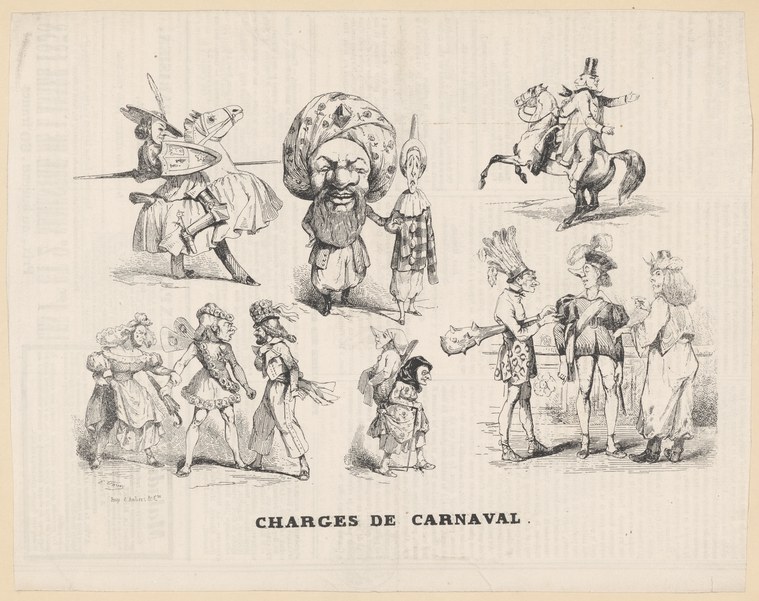
This engraving presents a satirical panorama of carnival revelry arranged in six vignettes across the page. The composition is dense with caricatured figures in exaggerated dress and posture. In the upper left, a thin figure in ragged costume gestures wildly, holding a long staff or sword. The center is dominated by a grossly obese figure with an enormous belly, wearing a cap and holding two small figures—apparently children or dwarves—in his hands like puppets. To the right, a figure in aristocratic dress rides a horse with theatrical flair, one arm raised high. The lower sections show clusters of costumed revelers: on the left, three women in elaborate dress with feathered headdresses and full skirts, posed in exaggerated attitudes; in the center, a single figure in tattered costume striking an absurd pose; on the right, a mixed group of five figures in various carnival costumes—some military, some fantastical—interacting and gesturing broadly. The entire scene vibrates with kinetic energy: bent knees, flying arms, twisted torsos, and expressions of grotesque delight. The engraving technique creates sharp contrasts between light and dark, emphasizing the theatrical artifice of the costumes and the deliberate distortion of the human form.
The dancing
The bodies throughout display exaggerated, unnatural postures typical of carnival satire and commedia dell'arte. Figures lean, twist, and contort; legs are bent at odd angles; arms fling outward or raise overhead in gestures of abandon or mockery. The obese central figure has no weight distribution or balletic grace—the body is rendered as comic mass. The mounted figure maintains theatrical uprightness with an extended arm. The lower groups show figures in varied stances: some with legs crossed or one foot lifted, arms raised or extended sideways, the whole creating an impression of chaotic, uncontrolled movement rather than coordinated dance. None of the figures show the closed holds, aligned frames, or measured positions of formal social dance; instead, these are individual expressions of carnival excess.
The dance depicted
This appears to document carnival performance and street entertainment rather than ballroom or theatrical dance proper. The title *Charges de carnaval* ("Carnival Caricatures" or "Carnival Tricks") points directly to carnival festivities, a tradition across European cities (particularly Venice, Paris, and Italian courts) where masks, grotesque costumes, and deliberate physical absurdity were central to performance. The figures' exaggerated bodies and costumes suggest commedia dell'arte influence—stock character types performing for public amusement through physical comedy, mimicry, and improvisation rather than choreography. The movements depicted are gestural and narrative (the mounted figure showing off, the fat man displaying his grotesque form, the ragged figures contorting) rather than dance steps per se. This is street carnival culture, not salon or theatrical dance, though carnival performance heavily influenced later theatrical traditions.
How it was made
This is an engraving or etching on paper, executed with fine lines and careful cross-hatching to create tone and shadow. The technique allowed precise detail in costumes and facial features despite the caricaturing intent. Engravings of this type were reproducible and affordable, making them ideal for popular circulation: prints like these were sold singly or in sets to a broad urban audience who wanted satirical commentary on contemporary society and entertainment. The style and execution suggest a French or Northern European origin, likely 19th century, when such carnival and commedia satires were commercially popular subjects for print publishers.
About this work
This engraving documents carnival performance culture—the tradition of masked, costumed street entertainment and body-based comedy that flourished in European cities, particularly during carnival season. Rather than depicting formalized ballroom or theatrical dance, it captures the gestural excess, grotesque physicality, and improvisational character-work of carnival performers and commedia dell'arte practitioners. The work is satirical in intent, using exaggerated anatomy and wild posture to mock both the performers themselves and perhaps the audiences who enjoyed their antics.
For dance historians, the work matters as evidence of a parallel performance tradition to formal dance: one rooted in physical grotesquerie, public improvisation, and the body as instrument of comedy and social commentary. Carnival culture influenced later theatrical dance through costume, character-work, and the recovery of bodily expressiveness beyond courtly restraint. Understanding carnival as a dance-adjacent practice—a space where bodies moved, gestured, and performed outside formal structures—is essential to a complete picture of dance history.
How to look at it
Attend to the postures: how does each body depart from naturalism or balletic alignment? Notice the deliberate distortion of proportion (the grossly fat man) and the twisted, inverted, or asymmetrical poses. These exaggerations are not errors of anatomy but intentional satire—the artist's way of showing that carnival is *anti*-dance, or at least anti-refinement. Look at how the figures relate: they are not in formation or synchronized, but isolated, scattered, each performing for the viewer rather than for each other. The staging is theatrical (note the mounted figure's display), but the intention is comic deflation rather than elevation.
The period
Carnival as organized urban festivity flourished in European cities throughout the 18th and 19th centuries, with particular intensity in Venice, Paris, and major Italian centers. Commedia dell'arte—the professional improvisational theater tradition featuring stock characters, physical comedy, and mask work—was at its height in the 16th–18th centuries but remained influential in carnival performance and popular entertainment well into the 19th century. Engravings and lithographs documenting carnival scenes were commercially produced and widely circulated in the 19th century, reflecting middle-class fascination with (and often disdain for) popular festivity. The Romantic era's interest in folk culture, the grotesque, and the unchoreographed body made carnival an appealing subject for artists and publishers. This print likely dates to the early-to-mid 19th century, when such satirical carnival imagery was at peak popularity in European art markets.
Where it lives
The work is held in the New York Public Library's collection of prints depicting dance, catalogued as a historical document of performance culture. As a reproducible engraving from a commercial publisher, it would have circulated widely and been owned by multiple institutions and private collectors.
Dance in this work
Questions about this work
Is this actually a dance?
Not in the formal sense. Carnival performance and commedia dell'arte are gestural and comic rather than choreographed. But they are deeply embodied practices—bodies move, gesture, contort, and perform. For dance historians, carnival is a sibling tradition to dance proper, part of the broader ecology of how bodies performed publicly before modern dance formalized movement.
What is commedia dell'arte and why does it matter to dance?
Commedia dell'arte was improvisational street theater featuring masked stock characters (Arlecchino, Pantalone, etc.) performing physical comedy and narrative scenarios. It trained performers to move expressively and fluidly within character, and it influenced later theatrical dance by showing that the body could be an instrument of comic expression and social commentary, not merely technical display.
Why are the figures so grotesquely drawn?
Satire. The exaggeration mocks both the performers themselves and the carnival crowds who enjoyed their antics. It may also reflect bourgeois discomfort with carnival—a popular, collective, embodied tradition outside formal social structures. The grotesqueness is a way of positioning carnival as primitive, excessive, or ridiculous.
When did carnival culture decline?
Organized carnival tradition weakened in the 19th century as urbanization and modernization reshaped city life, though masked carnival continued (Venice's Carnevale was revived in the 1970s). However, carnival's influence on performance—its embrace of the masked body, physical comedy, and embodied character—never disappeared from theater and dance.
More dance artwork





