49 works in this view — arrow keys or swipe to move between them.
Dance in Art
Jodelet
Unknown artist
- Collection:
- Prints depicting dance
- Source:
- New York Public Library
- Rights:
- Public domain — free to use, share and adapt.
- Recorded as:
- Public Domain
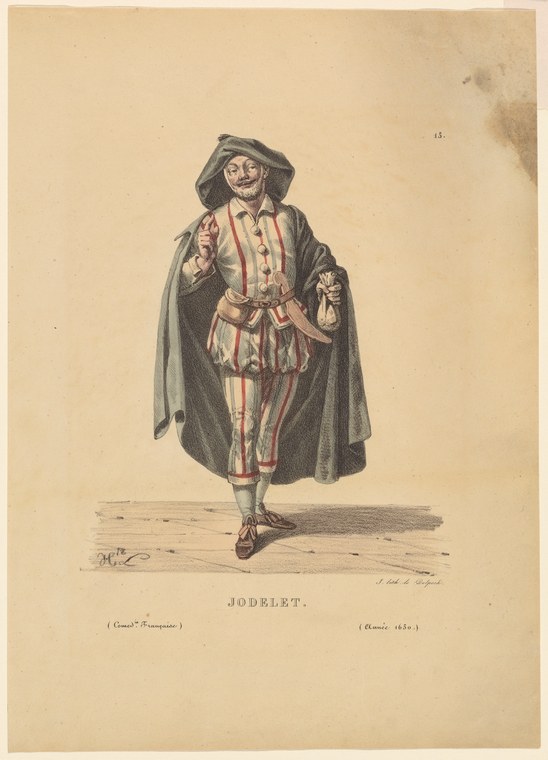
Jodelet was one of the most celebrated comic performers of the 17th century, and this print is primary visual evidence of his stage presence, costume, and the physical comedy style that made him famous across Europe. For historians of theatre and dance, it documents the reality of how comic character performance was embodied and presented—showing the integration of costume, makeup, gesture, and expressive movement that characterized popular performance before modern theatrical naturalism.
What you are looking at
A single figure stands against a pale background in what appears to be a hand-colored engraving or print. The dancer wears period costume consistent with 17th-century French theatre: a decorated justaucorps (fitted doublet) with vertical striping in red and cream, over which sits a dark cloak or mantle draped across one shoulder. The figure wears a wide-brimmed hat and distinctive facial makeup or mask suggesting theatrical performance. The stance is animated and theatrical rather than naturalistic—the dancer stands with one leg extended and bent, the body angled in three-quarter view, one arm raised in an expressive gesture and the other lowered. The lighting is diffuse, with no strong shadows, typical of early printed theatrical portraiture. The composition is a simple figure study against a flat ground, with a handwritten notation visible at bottom reading "Jodelet" and what appears to be attributions or dates in parentheses below.
The dancing
The single figure displays a lively, asymmetrical pose with clear weight shift toward one leg. One arm is elevated expressively at shoulder height with the hand visible; the other rests lower. The bent supporting leg and extended opposite leg create dynamic diagonal lines through the body. The stance suggests comedic or character performance rather than balletic technique—the posture is loose-limbed and angled, with emphasis on personality and theatrical presence rather than formal alignment. The exaggerated gesture and facial expression (visible despite or through makeup) read as character acting.
The dance depicted
Jodelet was a celebrated figure in 17th-century French comedy and commedia dell'arte, known for comic roles in theatrical performance. This print documents a theatrical character or comic persona rather than a specific dance style. The costume, makeup, and posture identify this as theatrical portraiture of a comedic actor-dancer of the period. The pose suggests the kind of energetic, physically expressive performance that characterized popular theatre of the era, where dancing, gesture, and comic business were integrated. The animated stance and theatrical dress indicate this figure was known for physical comedy and movement, but this is documentation of character and costume rather than notation of a particular dance form.
How it was made
This is a hand-colored engraving or possibly colored print, evident from the fine parallel line-work visible in the clothing and background, characteristic of 17th- or early 18th-century intaglio printing. The delicate crosshatching and linear detail suggest professional engraving work; hand-coloring in watercolor or gouache was applied afterward, visible in the warm cream and red tones of the costume and flesh tones. The technique allowed for reproducible theatrical documentation that could circulate among theaters, collectors, and enthusiasts across France and Europe, making this a widely distributed record of a famous performer. Such prints were common ephemera of the period, recording celebrated actors and their signature roles.
About this work
This is a theatrical portrait engraving of Jodelet, a major comic performer of 17th-century French theatre and commedia dell'arte. The print captures him in character costume and performance posture, representing the physically expressive style of popular comedy theatre of the period. The work belongs to a tradition of theatrical portraiture documenting celebrated performers and their signature comic characters—an important source for understanding how movement, gesture, and physical comedy were valued and practiced in early modern European theatre. Though not notation of a specific dance, it testifies to the integration of physical performance, dancing, and gestural comedy in the theatrical entertainments of the era.
How to look at it
Attend to the posture and gesture as evidence of comic performance style. The asymmetrical, energetic stance conveys movement and personality rather than formal beauty. Note how the costume—the striped doublet, cloak, and wide-brimmed hat—reads as instantly recognizable theatrical dress, designed to broadcast character type. The animated hand and facial expression (visible despite the makeup) suggest the kind of exaggerated, physically expressive performance that characterized popular comedy. This is not a moment of stillness captured from dance, but a staged pose that communicates character and performance energy.
The artist
The artist is not recorded in the catalogue. The engraving's technical quality and the notation style suggest it was produced by a professional print shop, likely in Paris, as part of the standard theatrical documentation and celebrity portraiture of the period. Unsigned theatrical prints of this era were often collaborative productions, with engravers, colorists, and publishers working from performance or from preparatory drawings by theatre artists.
The period
This print dates to the heyday of French commedia dell'arte and popular theatrical comedy in the mid-to-late 17th century. Jodelet (c. 1600–1660) was performing in Paris during the reign of Louis XIV, when theatre was becoming increasingly professionalized and documented. Theatrical prints like this served as marketing, record-keeping, and entertainment merchandise, circulating in networks of theaters, collectors, and enthusiasts. The style of costume and the character type reflect the conventions of the commedia dell'arte tradition, which blended Italian performance traditions with French theatrical practice.
Where it lives
The work is held in the New York Public Library's collection of prints depicting dance. It represents a surviving example of theatrical ephemera from the 17th century—documentary prints that were produced in quantity but survive in relatively small numbers due to their utilitarian nature and the fragility of hand-colored paper prints.
Dance in this work
Questions about this work
Who was Jodelet?
Jodelet (c. 1600–1660) was one of the most celebrated comic actors of 17th-century French and Italian theatre, renowned for his physical comedy and his roles in commedia dell'arte-influenced plays. He performed in Paris and traveled throughout Europe, becoming famous for his comic characters and energetic stage presence.
Is this a dance?
Not a formal dance style, but theatrical performance in which dancing, gesture, and physical comedy were integrated. The pose documents the kind of physically expressive, gestural performance that was central to popular theatre and commedia dell'arte tradition, where movement and acrobatic skill were valued alongside comic acting.
Why is there a print of him in a dance collection?
Because early modern theatre was fundamentally physical and integrated dancing, gesture, and acrobatic movement with dramatic performance. This print documents a performer celebrated for physical skill and expressive movement, representing the historical reality that theatre and dance were not separate categories.
More dance artwork





