49 works in this view — arrow keys or swipe to move between them.
Dance in Art
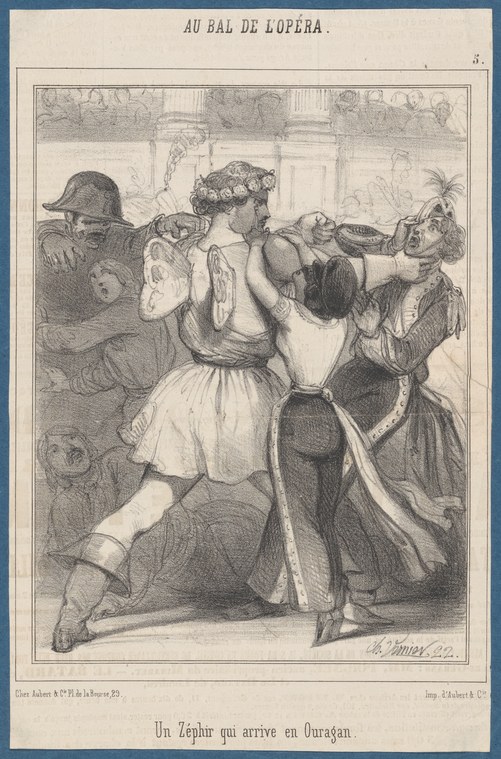
Un Zéphir qui arrive en Ouragan
Unknown artist
- Collection:
- Prints depicting dance
- Source:
- New York Public Library
- Rights:
- Public domain — free to use, share and adapt.
- Recorded as:
- Public Domain
This engraving demonstrates how dance representation in the nineteenth century served satirical and social commentary, not just documentation. It shows that artists understood the waltz not as a static form but as a site of tension between formal rules and actual behavior, and it uses the bodies of dancers to expose broader anxieties about social order, gender, and propriety.
What you are looking at
A satirical engraving of a social dance at the opera, rendered in the sharp, caricatural style of nineteenth-century French comic journalism. At center, a woman in a white ballroom dress with bare shoulders dances energetically, her body tilted back dramatically and one leg raised high—a posture of exaggerated abandon. She is surrounded by three men in dark formal coats: one to her left plays a wind instrument (possibly a cornet or trumpet), another behind her gestures broadly in mock enthusiasm, and a third to the right observes with sardonic amusement. The setting is a grand interior with classical columns visible in the background, suggesting the foyer or ballroom of the Opéra. The woman's hair is elaborately dressed and crowned; her partners wear top hats. The composition is crowded and deliberately awkward, with overlapping figures and sharp contours that emphasize the chaos of the moment. The title—*Un Zéphir qui arrive en Ouragan* (A Zephyr Arriving as a Hurricane)—suggests the woman's wild energy is as sudden and disruptive as a storm.
The dancing
The central female dancer is held or supported by the surrounding men in no stable ballroom frame; instead, her body arches backward in a pose of theatrical exaggeration, with weight thrown onto one leg while the other lifts high—a posture hostile to the controlled partner work of contemporary social dance. Her arms are not engaged in a closed or open ballroom hold but are instead loose or braced for balance. The three male figures are not executing any recognizable dance step but rather reacting to her gyrations: the musician supplies comic accompaniment, the others provide audience and support. This is not a depiction of ballroom technique but a satire of it—the artist has deliberately abandoned any pretense of genuine dance partnership.
The dance depicted
The work satirizes the waltz and the broader culture of social dancing at the Opéra during the mid-to-late nineteenth century. The wild, tilted posture and high leg extension parody the sensuality and energy of the waltz, which had scandalized earlier generations but by this period was the dominant social dance of the French elite. The engraving ridicules not the dance itself but the excess and loss of decorum in its execution—the woman's abandon, the musician's intrusion, the male spectators' theatrical reactions. This is popular satirical art, aimed at a broad audience familiar with ballroom convention, and it uses exaggeration and caricature to expose the contradictions between the formal rules of dance and the actual behavior of dancers.
How it was made
This is a wood or steel engraving, executed in fine parallel lines and cross-hatching to create tone and texture. The artist has signed the work (visible at lower right, though the signature is not clearly legible in reproduction). The technique allows for rapid, emphatic linework that conveys both the energy of the scene and the sharp wit of caricature; the sharpness of the lines and the precision of the hatching are characteristic of mid-nineteenth-century French reproductive engraving. The work was created for print circulation—likely as an illustration in a satirical journal or as a standalone print for sale—which means it was aimed at an urban, literate, art-aware audience. The fineness of the engraving indicates professional production.
About this work
This is a satirical engraving of social dancing at the opera, likely from the Second Empire or early Third Republic (mid-to-late nineteenth century), rendered in the caricatural manner typical of French satirical prints of the period. The work mocks both the waltz and the behavior of dancers who abandon decorum in pursuit of sensation. It belongs in a history of dance representation because it reveals how visual artists used exaggeration to comment on social dancing as a site of transgression—a place where rules of deportment and partnership were tested and sometimes broken. The work is also a document of how the waltz was understood by contemporaries: not as an established, respectable dance form (as it had become by this period) but as a vehicle for excess and disruption.
How to look at it
Attend to the moment the artist chose to freeze: not a stable dance position but a moment of maximum disruption and energy, with the woman's body thrown backward and off-balance. Note how the artist has abandoned any pretense of depicting actual ballroom technique; instead, the figures are arranged for maximum visual chaos and comic effect. The woman's tilted posture and raised leg violate the decorum of the waltz, which demanded an upright carriage and a closed hold. The musician intrudes into the dance space, and the male onlookers' exaggerated reactions amplify the sense that something improper is happening. The formal setting (the columns, the refined dress) makes the disruption more pointed.
The artist
The artist is not recorded in the catalogue, but the style, technique, and subject matter are consistent with mid-nineteenth-century French satirical printmaking—the tradition of Honoré Daumier, Paul Gavarni, and their contemporaries. The print was produced by a professional engraver working in the commercial market for satirical illustrations. The signature visible at lower right suggests a named artist, but without better reproduction or additional documentation, identification is not possible.
The period
By the mid-nineteenth century, the waltz had been established in elite social dance for nearly a century, but it remained a site of cultural anxiety. Early critics had condemned it for its close partner hold and sensual movement; by mid-century, such objections had largely faded, and the waltz was the dominant ballroom dance. However, satirical representation of excess in dance continued, often directed at nouveau-riche dancers or at the behavior of women in public spaces. The engraving dates to a period when the opera house was a primary venue for social display and when satirical prints were a major medium of public commentary on urban life and behavior.
Where it lives
The work is held in the New York Public Library's collection of prints depicting dance. It is reproduced here from that collection. The inscription at bottom left (*Gat. Adbert & Cie à la Bourse 25*) likely indicates the publisher or seller.
Dance in this work
Questions about this work
Why is the woman dancing so wildly?
This is satirical exaggeration, not a documentary representation of actual dance. The artist has distorted the waltz to mock both the sensuality of the dance form and the loss of decorum among dancers. The title—*A Zephyr Arriving as a Hurricane*—reinforces this: what should be gentle and controlled has become violent and unruly.
What dance is this?
This is a satirical representation of the waltz, the dominant ballroom dance of the nineteenth century. However, the woman's posture and the overall composition are too exaggerated to be treated as a guide to actual waltz technique. The engraving is social commentary, not dance instruction.
Who made this print?
The artist's name is not recorded in the catalogue. The signature visible on the print at lower right may identify the engraver, but it is not clearly legible in reproduction. The style and subject matter are consistent with professional French satirical printmaking of the mid-nineteenth century.
What is the setting?
The classical columns and refined dress suggest the foyer or ballroom of the Opéra—the primary venue for elite social dancing and display in Paris. The opera house was a site of public spectacle where behavior was scrutinized and mocked by satirical artists.
More dance artwork





