49 works in this view — arrow keys or swipe to move between them.
Dance in Art
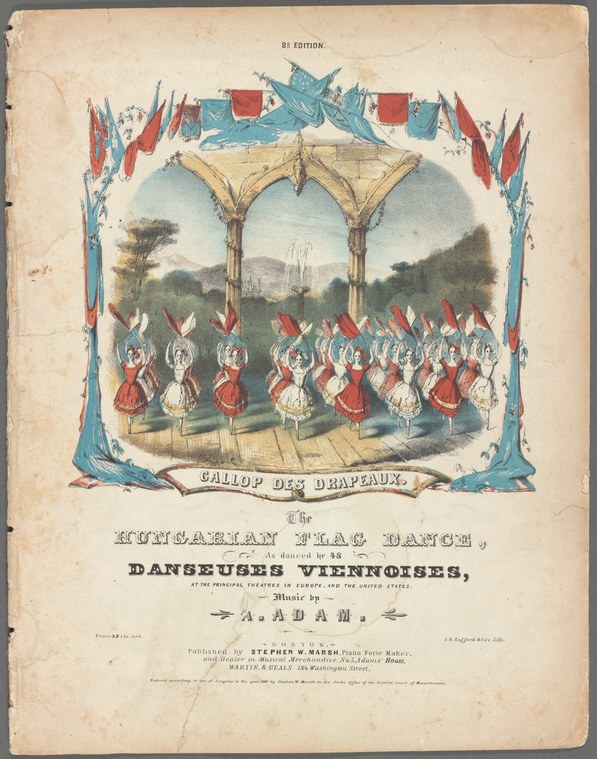
The Hungarian flag dance: as danced by 48 Danseuses Viennoises, at the principal theatres in Europe, and the United States
Unknown artist
- Collection:
- Prints depicting dance
- Source:
- New York Public Library
- Rights:
- Public domain — free to use, share and adapt.
- Recorded as:
- Public Domain
This work documents a now-obscure but historically significant meeting point: the moment when ballroom dances (gallopp, waltz, polka) were being absorbed into theatrical spectacle, and when European nationalism began to be expressed through stylized, massed dance formation—an aesthetic that would later dominate 20th-century state pageantry. The Danseuses Viennoises were a commercially successful travelling troupe, and their repertoire reveals how quickly choreographers adapted social dances to large ensembles and proscenium stages to capture transatlantic audiences.
What you are looking at
A theatrical lithograph presents a stylized stage scene framed by ornamental borders hung with blue and red flags. Within a proscenium arch, forty-eight dancers in white skirts with red bodices are arranged in a tight formation across the stage, their arms raised in unison. They hold small flags—predominantly blue and red—aloft in their right hands. The dancers stand on a wooden stage before a backdrop painted with a classical landscape: a gazebo or temple structure in the middle distance, mountains or hills beyond, and trees on either side. The composition is highly symmetrical and geometric, emphasizing the collective precision of the ensemble rather than individual dancers. The stage itself is rendered in pale tones, contrasting with the darker landscape backdrop. The overall effect is one of civic or national pageantry—the massed, synchronized bodies and flag-waving suggest a patriotic demonstration rather than a narrative ballet.
The dancing
The dancers are arranged in tight rows, all facing forward toward the audience in a uniform stand. Each dancer's posture is upright and regimented, with both arms at approximately shoulder height or raised, gripping small flags. The dancers wear identical costumes: high-waisted white skirts reaching mid-calf, red bodices with short sleeves, and what appear to be headdresses. No dynamic weight shifts, turns, or footwork are visible; the bodies are presented in static, salute-like positions. The uniformity is absolute—there is no variation in height, angle, or gesture across the ensemble. The arrangement suggests drill, synchronization, and collective rather than individual movement vocabulary.
The dance depicted
This depicts the *Gallop des Drapeaux* (Flag Gallop), a divertissement choreographed to celebrate Hungarian and Austrian national identity and performed by a company of 48 female dancers known as the Danseuses Viennoises. Despite the title's reference to a gallop—a quick, jumping ballroom step—what we see here is a formal tableau or finale, not the locomotion of the dance itself. The image captures the ensemble in formation holding national flags, likely the moment of apotheosis in a work that combined ballroom-derived movement (the gallop was fashionable in mid-19th-century salons) with civic pageantry. The emphasis on flags, the symmetry, and the national titles indicate a dance created to appeal to both Vienna's theatres and international audiences during an era when national identity was expressed through stylized ensemble performances.
How it was made
This is a hand-colored lithograph, identifiable by the characteristic texture, the bold outlines defining forms, and the flat color application. The process allowed for rapid mass production of theatrical publicity and dance notation images in the 19th century. The decorative border—an ornamental frame within the image itself—is typical of theatrical prints from the Romantic era, which used elaborate framing devices to signal the work's status as a theatrical spectacle worthy of display. The printing technique meant this image could be circulated widely in theaters, salons, and as sheet-music covers, making it accessible to the middle-class audiences who attended such performances. The hand-coloring added after printing ensured each copy could reach buyers quickly without lengthy printing delays.
About this work
This is a hand-colored lithographic theatrical print documenting the finale or key moment of a mid-19th-century ensemble dance spectacle combining ballroom tradition with nationalist pageantry. The *Gallop des Drapeaux*, performed by the Danseuses Viennoises, represents a transitional moment in dance history when social-ballroom forms (the gallop) were being scaled up and formalized into theatrical numbers serving political and commercial purposes. The image is both a work of visual art and a historical record—it preserves the silhouette, costume, formation, and apparent choreographic principle of a work that has left little other trace. Such prints were essential to mid-19th-century theatre: they advertised performances, commemorated successful runs, and circulated images of dancers and choreography to audiences who might never see the work live.
How to look at it
Attend to the absolute uniformity of the ensemble: every dancer is identically positioned and costumed, and no individual performer is distinguished—the work of art is the *formation* itself, not virtuosity. This represents a fundamentally different choreographic principle from the Romantic-era ballets (like *Giselle* or *Swan Lake*'s later cousin ballets) that focused on a prima ballerina's dramatic presence. The flattened perspective and heraldic framing of the print itself—with its ornamental border and flags—emphasizes that this is a *display* meant to be viewed from a distance, like a civic ceremony or military formation. The static pose captured here likely represents only one moment in a work that included actual dancing (the gallop itself), so the print is documenting the spectacle's *visual climax* rather than its kinetic logic.
The artist
The artist is not recorded. The work was published by Stephen W. Marsh, a London print publisher and music publisher based in Piccadilly, suggesting the print was produced for the English market. Marsh's list included theatrical prints, dance notations, and sheet-music covers for mid-19th-century entertainments. The quality of hand-coloring and composition suggests a professional theatre illustrator, but attribution remains uncertain.
The period
This print dates to the Romantic era in European theatre (circa 1840s–1860s), when ballet was transitioning from its narrative, pointe-work-dominated Romantic idiom toward the grand spectacle and national identity performances of the Second Empire and Victorian periods. The waltz and polka had recently become respectable in society ballrooms, and theatrical choreographers were quick to exploit their popularity by elevating them to the stage. The Danseuses Viennoises were part of a boom in travelling ballet troupes and specialty ensembles—a commercial model that thrived on touring circuits between London, Paris, Vienna, New York, and other major cities. The emphasis on flags and national identity reflects 1848 and post-1848 European politics, when revolutionary and nationalist sentiment made such imagery commercially attractive.
Where it lives
The print is held in the Library of Congress Prints collection under the title given here. It is catalogued as a theatrical print and piece of dance documentation from the mid-19th-century popular entertainment trade. The publisher, Stephen W. Marsh of London, was a specialist in theatrical and musical ephemera, making this a product of the commercial print industry rather than fine art circulation.
Dance in this work
Questions about this work
Did the dancers actually hold flags during the performance, or is this artistic interpretation?
The title *Gallop des Drapeaux* (Flag Gallop) indicates flags were central to the choreography and likely held throughout the piece. This is not a generic theatrical scene but a faithful record of a specific visual element. However, the lithograph shows only one moment—probably the finale or a formation pose—so we cannot know whether dancers held flags during the actual galloping passages or only during the formation displayed here.
What is a 'Danseuses Viennoises' and how did this company differ from other ballet troupes?
The Danseuses Viennoises (Viennese Dancers) were a commercial touring ensemble of female dancers based in Vienna who specialized in short, spectacular divertissements combining ballroom steps, national themes, and massed formations. They were not a formal ballet company like the Paris Opera or Imperial Russian Ballet, but rather a travelling troupe that performed in theatres and concert halls across Europe and America. Their appeal lay in novelty, spectacle, and the relative accessibility of their movement vocabulary compared to classical ballet.
Is this a photograph or a drawing?
This is a lithograph—a print made from a stone or plate—that was then colored by hand. Lithography was the dominant reproductive medium for theatrical imagery in the mid-19th century before photography became common. The technique allowed the image to be printed in multiple copies and distributed widely, making it an ideal medium for theatrical publicity and dance documentation.
More dance artwork





