49 works in this view — arrow keys or swipe to move between them.
Dance in Art
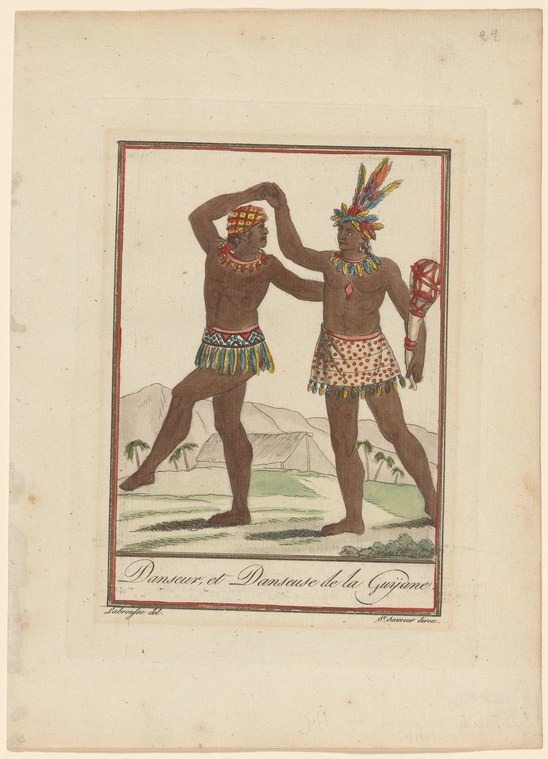
Danseur et danseuse de la Guÿane
Unknown artist
- Collection:
- Prints depicting dance
- Source:
- New York Public Library
- Rights:
- Public domain — free to use, share and adapt.
- Recorded as:
- Public Domain
This image documents not only an indigenous Guyanese dance tradition but also the visual conventions and power dynamics through which European artists rendered non-European bodies and movement in the 18th century. For scholars of colonialism, ethnography, and the history of dance documentation, it reveals what was deemed worthy of recording and how those recordings shaped European understanding of distant peoples.
What you are looking at
Two male figures stand facing each other in a landscape of minimal depth. The figure on the left wears a brown waistcloth (a type of loincloth) decorated with small geometric patterns, a beaded necklace or collar, and an armband; his right arm is raised to his head in a gesturing pose. The figure on the right wears a similar waistcloth with a spotted or dot pattern, carries what appears to be a shield or circular object decorated with geometric designs, and wears feathered headdress and additional beadwork. Both men have dark brown skin rendered in a uniform wash. The ground beneath them shows minimal modeling—a few green lines suggest terrain. The background is plain cream, with a simple rectangular frame in red and brown ink enclosing the scene. The composition emphasizes frontal display of the two figures rather than narrative action; they appear posed for ethnographic presentation rather than caught mid-movement.
The dancing
Both dancers stand with weight evenly distributed, legs straight and positioned shoulder-width apart—a stance suggesting readiness rather than active motion. The left figure's raised arm to his head is the primary gesture; his other arm hangs at his side. The right figure holds his shield-like object at waist height with one arm while his other arm is also lowered. Neither figure displays the flexed knees, tilted spine, or dynamic weight shift typical of active dance movement. The poses read as statuary or presentational rather than kinetic.
The dance depicted
This print depicts dancers or warriors from Guyana, as stated in the French inscription below the image. The work appears to document an ethnographic or ceremonial dance tradition of an indigenous Guyanese people, though the specific dance form cannot be identified from the image alone. The minimal narrative action and posed, symmetrical arrangement suggest the artist's primary interest was in recording costume, adornment, and physical type for a European audience, a common approach in 18th-century ethnographic prints. Whether this represents an actual moment of performance or an arrangement for documentation purposes cannot be determined from the image.
How it was made
This is a hand-colored engraving or print, identifiable by the fine parallel lines (hatching) creating tonal modeling, the crisp linear frame, and the evidence of applied watercolor pigment. The technique of engraving allowed for reproducible images distributed across Europe, making this part of a visual archive of colonial-era ethnographic documentation. The quality of the coloring—particularly the uniform brown wash of the skin and the deliberate attention to costume detail—indicates this was a commercially produced work intended for collectors of travel narratives and natural history.
About this work
This is an 18th-century ethnographic print documenting the appearance of dancers or warriors from Guyana. Titled in French as "Danseur et Danseuse de la Guÿane" (Dancer and Dancer of Guyana), it presents two figures in a frontal, symmetrical composition emphasizing their costume and adornment rather than the movement or narrative of dance. The work belongs to a broader European visual practice of recording and displaying indigenous peoples through engraved prints, which circulated widely through travel narratives, natural history collections, and curiosity cabinets. As a record of how European artists of the period represented non-European dance and the bodies that performed it, the print is historically significant despite—or because of—its ethnographic remove and staged presentation.
How to look at it
Notice the symmetry of the composition and the way both figures are presented directly facing forward, as if for measurement or display rather than as participants in an unfolding action. The artist has chosen to freeze not a moment of dynamic movement but rather a static presentation of two bodies and their adornments. The attention to detail in the beadwork, the shield decoration, and the feathered headdress reveals the artist's primary interest in documenting material culture and costume. The minimal landscape and plain background further emphasize the figures as objects of visual study rather than as agents moving through a space.
The period
This print dates from an era of intense European colonial expansion and the growth of the natural history print market. The 18th century saw an explosion of illustrated travel narratives and ethnographic compilations aimed at educated European audiences eager for images of exotic peoples and lands. Such prints often derived from earlier travel accounts, earlier prints, or descriptions rather than direct observation, and they typically presented non-European peoples through the lens of European aesthetic and scientific conventions. The frontal, posed arrangement and the emphasis on costume detail reflect Enlightenment-era taxonomic thinking—the impulse to catalogue and display human diversity as specimens.
Where it lives
This print is part of the New York Public Library's collection of prints depicting dance. It is a hand-colored engraving in the ethnographic tradition of 18th-century European travel documentation.
Dance in this work
Questions about this work
Is this actually a dance, or is it just two people standing still?
The titled inscription calls them dancers, but the image itself shows two static figures in a posed arrangement rather than captured mid-movement. This may reflect either the limitations of the engraving medium, the artist's working from a description rather than observation, or the conventions of ethnographic display in this period, which prioritized documentation of costume and type over the capture of action.
What does 'Guÿane' mean?
Guÿane is the French spelling of Guiana (or Guyana), referring to the region in northern South America. This print is part of a broader European archive of colonial-era visual documentation of indigenous and other non-European peoples.
Why are both figures called dancers if one is labeled 'danseur' (male) and the other 'danseuse' (female)?
The title in French uses gendered forms, but both figures appear visually male or masculine in presentation. This may reflect a convention of the period in which European artists and writers imposed European gender categories or dance partnerships onto unfamiliar bodies and practices, or the engraver may have worked from a description or earlier image that contained this designation.
Who made this print?
The artist is not recorded in the catalogue. The signature at the bottom right of the image may identify the engraver or publisher, but it is not legible enough in this reproduction to confirm.
More dance artwork





