49 works in this view — arrow keys or swipe to move between them.
Dance in Art
Wild brier: valse de salon
Unknown artist
- Collection:
- Prints depicting dance
- Source:
- New York Public Library
- Rights:
- Public domain — free to use, share and adapt.
- Recorded as:
- Public Domain
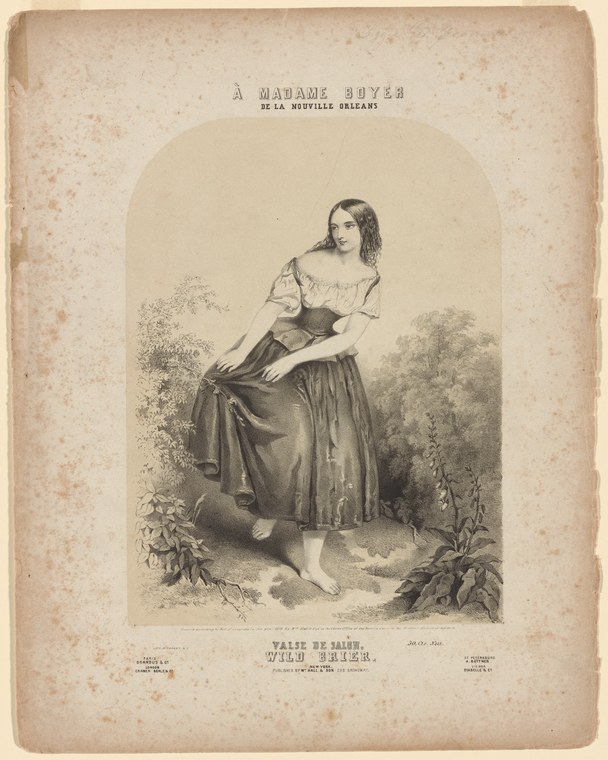
The salon waltz was one of the dominant social dances of the nineteenth century, and this print provides direct evidence of how it was marketed and visualized to its audience. For historians of dance and print culture, the image reveals the gap between the actual choreography of a social dance and its representation in commercial imagery—a gap that tells us as much about Victorian taste and gender ideology as it does about dance technique.
What you are looking at
A young woman stands alone in a woodland glade, her body twisted in a graceful contrapposto that suggests arrested motion. She wears a dark, full skirt—likely silk or wool, gathered to reveal her bare feet—and a white chemise with off-shoulder sleeves that expose her upper arms and shoulders. Her head is tilted, her gaze downward and inward, her long dark hair loose and flowing. The composition is framed within a rounded arch, and the background is softly rendered with trees and foliage in pale wash. The title below reads "Valse de Salon / Wild Brier," identifying this as a salon waltz, and the entire image is rendered in the soft tonal ranges of a lithograph or engraving: warm cream and pale grays, with deeper tones reserved for the figure's dress and the darker vegetation.
The dancing
The dancer's weight appears to settle into one leg while the other extends slightly, a pose common to the waltz. Her torso is upright but her head inclines with romantic languor; her arms hang naturally at her sides with a slight curve to the elbows. The pose suggests a moment between steps rather than active turning—a moment of repose or reflection that draws on the expressive vocabulary of Romantic-era ballet. The solitary figure and introspective bearing are characteristic of salon dance imagery, where the dancer performs the feeling of the dance rather than its technical content.
The dance depicted
This is a salon waltz, a social dance form of the mid-nineteenth century that was performed in ballrooms and parlors and celebrated through prints, sheet music covers, and dance instruction books. The title *Wild Brier* is typical of the sentimental nomenclature applied to salon waltzes, which often carried floral or emotional names. Unlike the virtuosic, theatrical waltz that would develop later, the salon waltz was performed by amateurs in ordinary dress, with steps that emphasized the three-count turning motion and the swaying upper body. The image captures not the dance in action but its emotional essence: the introspection and romantic reverie that the waltz was understood to evoke. No partner is shown, which is common in print imagery promoting these dances—the focus is on the woman as the embodiment of the dance's character.
How it was made
The work is a lithograph or steel engraving, likely produced as a commercial print for sale to the parlor market. The technique allows for soft tonal gradations that create an atmospheric woodland setting, and the printing process suggests wide circulation: sheet music covers, dance instruction books, and popular periodicals of the mid-nineteenth century frequently employed this medium to advertise and promote salon dances. The rounded-arch framing device (a tondo format) was common in decorative prints of this era and lent an intimate, almost religious quality to the subject. The presence of publisher's marks and lettering at the base confirms this was a mass-produced commodity.
About this work
This is a commercial print promoting a salon waltz from the mid-nineteenth-century ballroom market. It captures not the mechanics of the dance but its emotional character: the romantic yearning and introspection that the waltz was understood to embody. The image serves as both advertisement and cultural artifact, reflecting the enormous popularity of the waltz in European and American society and the commercial apparatus that surrounded it. The solitary, contemplative pose of the dancer—despite the waltz being fundamentally a partner dance—suggests that these prints were addressed as much to the individual daydreamer or music-lover as to the actual dancer. The work belongs in a gallery about dance because it documents how the waltz was imagined, sold, and consumed as a symbol of romantic feeling and social aspiration.
How to look at it
Attend to the dancer's stillness and inwardness. This is not a moment of active stepping or turning, but rather a pause in the dance where the dancer's body and expression become a mirror for the listener's own feeling. The artist has chosen the moment of romantic absorption rather than technical display, and the woodland setting reinforces the Romantic association of nature with emotion and authenticity. The bare feet and simple chemise, despite their appearance of undress, signal sincerity and freedom from artifice—values the Romantic era prized. The rounded arch framing isolates the figure as a kind of vision or dream, inviting the viewer to project onto it their own fantasies of movement and feeling.
The artist
The artist is not recorded in the catalogue. The work bears the signature or publication mark of commercial producers active in mid-nineteenth-century Paris or London, but without additional research the attribution remains unknown. The style is consistent with the decorative lithographic tradition of the period, when theatrical and salon-dance imagery was a staple of commercial print production.
The period
The salon waltz reached the height of its popularity in Europe between 1820 and 1870. It was danced to orchestral music in private ballrooms and public dance halls, and it became an object of intense commercial exploitation: sheet music, instruction manuals, illustrations, and choreographic variations flooded the market. In visual culture, the waltz was represented through prints, paintings, and photographs that emphasized its emotional and sensual qualities rather than its technical demands. The Romantic movement in art and literature had elevated the waltz as a symbol of passion, danger, and transgression (women danced it in the scandalous close hold), and commercial imagery capitalized on this mythology. By the mid-nineteenth century, when this print was likely made, the waltz had become thoroughly domesticated as a respectable parlor entertainment, yet images like this one preserved the sense of romantic reverie and emotional intensity that had always been central to its appeal.
Where it lives
The work is held in the Prints collection of the New York Public Library, which acquired it as part of a larger body of nineteenth-century commercial dance imagery. It is catalogued as a print depicting dance, and the catalogue record provides the title but not the artist's name or the date of publication. The work is representative of the enormous output of salon-dance prints that entered public collections in the late twentieth century as scholars began to recognize the historical value of ephemeral commercial imagery.
Dance in this work
Questions about this work
Was the waltz really danced this slowly and thoughtfully?
Not always. The waltz in performance was energetic and often rapid, with continuous turning that could be dizzying. But the emotional essence of the waltz—its association with romantic feeling and intimate partnership—made it a subject for introspective imagery. This print captures the waltz as an idea, or as a memory of feeling, rather than the dance in actual motion.
Why is the dancer alone if the waltz is a partner dance?
Prints promoting salon dances often showed a single figure, usually a woman, because they were addressed to amateur dancers in parlors and private homes. A solitary figure could represent the universal experience of learning or feeling the dance, while also allowing the viewer (often a young woman) to imagine themselves in the pose. Images of couples were less common, though they did exist.
What is the significance of the bare feet?
Bare feet in nineteenth-century imagery of women carried multiple meanings: innocence, naturalness, and sometimes eroticism. In this context, the bare feet may signal authenticity and freedom from the constraints of formal ballroom dress, aligning the waltz with Romantic values of passion and nature over artifice and social convention.
More dance artwork





