49 works in this view — arrow keys or swipe to move between them.
Dance in Art
La walse
Unknown artist
- Collection:
- Prints depicting dance
- Source:
- New York Public Library
- Rights:
- Public domain — free to use, share and adapt.
- Recorded as:
- Public Domain
The Waltz was one of the most significant dance innovations of its era, and early prints like this are key sources for understanding how it was perceived and performed. This image captures a moment when the dance was still new enough to warrant explanation through prints, and controversial enough to invite satire—and that ambiguity between documentation and comedy is characteristic of how transgressive social change gets recorded in visual culture.
What you are looking at
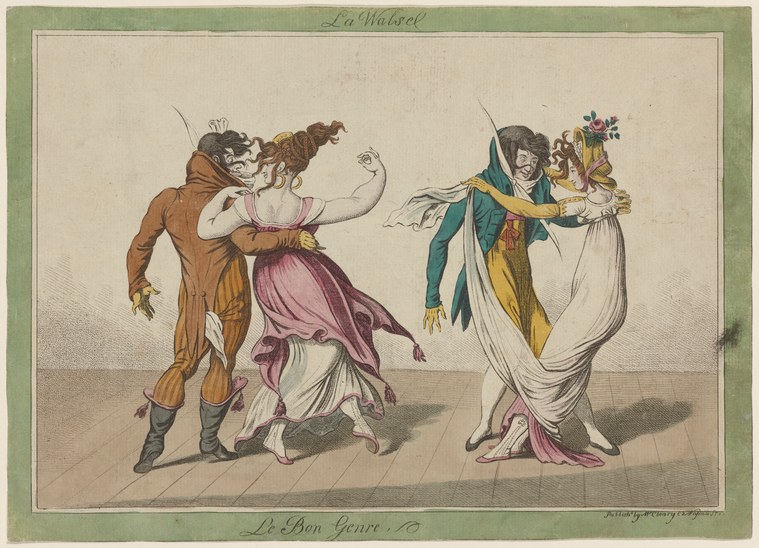
This hand-colored engraving depicts two pairs of dancers in a ballroom or theatrical setting, dressed in early 19th-century costume. On the left, a man in a brown coat and fitted breeches holds aloft a small dog or similar animal while dancing with a woman in a pink skirt and white bodice; her body arches backward in a dramatic pose. On the right, a second couple—the man in a dark green coat with gold trim, the woman in classical white drapery—performs a more upright dance, the woman holding flowers. Both pairs occupy a bare wooden floor against a neutral background, lit from the left. The composition suggests a moment of fashionable social dance, with an emphasis on elegance and the theatrical display of the female body. The title *La Walse* appears at the top of the print.
The dancing
The dancers are shown in an open or semi-closed frame rather than the closed ballroom position of later Waltz. The left couple displays exaggerated, almost acrobatic extension—the woman's body is thrown into a deep arch or lean-back while the man supports her with one arm raised; the right couple maintains a more vertical alignment, with both partners standing upright. Neither pair shows the rotational, spinning quality that would later define the Waltz. The postures are theatrical and display-oriented rather than functional for continuous turning movement.
The dance depicted
The title identifies this as *La Walse* (The Waltz), a dance that emerged in Vienna in the 1770s–80s and scandalized European society for its close hold and rotating motion. By the early 19th century the Waltz had become fashionable among the upper classes across Europe, though it remained controversial. This image likely dates to the period 1810–1830 when Waltz imagery proliferated in prints. However, the postures shown here are more theatrical and exaggerated than instructional—the deep back-arch and the whimsical detail of the dog suggest this is satirical or entertainment-focused rather than a literal depiction of how the dance was performed. The engraving may be playing on both the Waltz's exotic appeal and anxieties about its intimacy.
How it was made
This is a hand-colored engraving, a technique that allowed the image to be mass-produced and widely distributed. The outline and detail are cut into a copper plate; the hand-coloring (pinks, greens, browns, flesh tones) was added to individual impressions by brush or wash, making each print slightly variable. The technique was ideal for fashion and social imagery and reached a broad urban middle-class audience. The fine line work and careful composition suggest a commercial print house, likely Parisian or Viennese, rather than a fine artist's work.
About this work
This is a satirical or semi-comic print of the Waltz, one of the most scandalous and fashionable dances of the early 19th century. The Waltz was revolutionary for its close embrace and rotating motion, and it generated intense moral and social debate. This engraving does not present the Waltz as instruction but as spectacle: the dancer on the left is shown in an impossible arch, the man holds up a lapdog, both couples display aristocratic elegance tinged with absurdity. The print belongs to a large body of early Waltz imagery that mixed genuine documentation of fashion with satire and caricature. It is valuable both as evidence of how the Waltz was popularized in print and as a window into contemporary anxieties about bodily intimacy and the body's display on the dance floor.
How to look at it
The engraver has chosen a moment of extreme extension and display rather than a moment of rotation. Notice the woman on the left: her body is arched almost to the horizontal, a feat of flexibility and trust that emphasizes the physical daring of the dance. The man's uplifted arm and the small animal he holds aloft add a note of burlesque or comedy—this is not a sober portrait of proper dance but a theatrical version. The right pair is more sedate, but still shown in a static pose rather than mid-motion. This is typical of dance prints of the period: they freeze the moment of maximum visual interest or maximum scandal, rather than trying to convey the continuous rotation that defines Waltz. The title and the two contrasting couples (one comic, one elegant) suggest the artist is presenting the Waltz as both an object of desire and of ridicule.
The artist
The artist is not recorded. The print is inscribed with the credit line or publisher mark at the bottom right (partially visible as a maker's signature or house mark). The style and technique are consistent with early 19th-century commercial dance prints produced by Parisian or German houses, which flooded the market as the Waltz craze spread. Many such prints were collaborative: a designer composed the scene, an engraver cut the plate, and colorists added pigment. Individual printmakers are often lost to history.
The period
The Waltz emerged in Vienna in the 1780s from folk and courtly dance traditions and spread rapidly across Europe in the early 1800s. It was shocking because it abandoned the formal patterns and distance of earlier court dances—the Minuet, Contredanse, and Quadrille—in favor of a closed embrace, rapid rotation, and an apparent intimacy that alarmed moralists. Satirists and caricaturists (notably Gillray and Cruikshank in London, and numerous French printmakers) seized on the Waltz as a symbol of moral decay, sensuality, and foreign (especially Continental) corruption. Simultaneously, fashionable society embraced it. By 1815–1820, when this print likely dates, the Waltz had won the battle: it was the dominant dance of the ballroom, taught in dancing schools, and the subject of countless prints, poems, and novels. This image is part of that explosion of Waltz imagery.
Where it lives
The work is held in the New York Public Library's Prints collection, which documents social and dance imagery from the 18th and 19th centuries. It is catalogued as part of a series of dance prints and is accessible through NYPL's digital collections.
Dance in this work
Questions about this work
Why is the woman in such an extreme backward arch?
The engraver is showing off the Waltz as a daring, physically intimate dance. The lean-back or arch-back (sometimes called a *penché* or swoon) was a real move in early Waltz, emphasizing trust and the close embrace. But here it is exaggerated for theatrical effect—it signals danger, excitement, and the transgressive nature of the dance.
Is this a serious depiction of how the Waltz was actually danced?
It is a mix. The basic elements—the close hold, the upright posture, the paired formation—are accurate. But the extreme gestures and the lapdog are satirical. Early Waltz prints often blended documentation with caricature, using humor and absurdity to both attract and critique the dance.
Why are there two couples?
The contrast between them suggests a commentary: the left pair is theatrical and almost comic; the right pair is more decorous and classical. Together they may be saying that the Waltz could be danced in different ways—as proper drawing-room fashion or as a more daring, sensual spectacle.
When was the Waltz invented?
The Waltz emerged in Vienna in the 1770s–80s from folk roots and Continental courtly dance. It remained controversial through the 1800s but became dominant in ballroom dancing by about 1815. This print dates to the early 19th century, when the Waltz was still novel and newsworthy.
More dance artwork





