49 works in this view — arrow keys or swipe to move between them.
Dance in Art
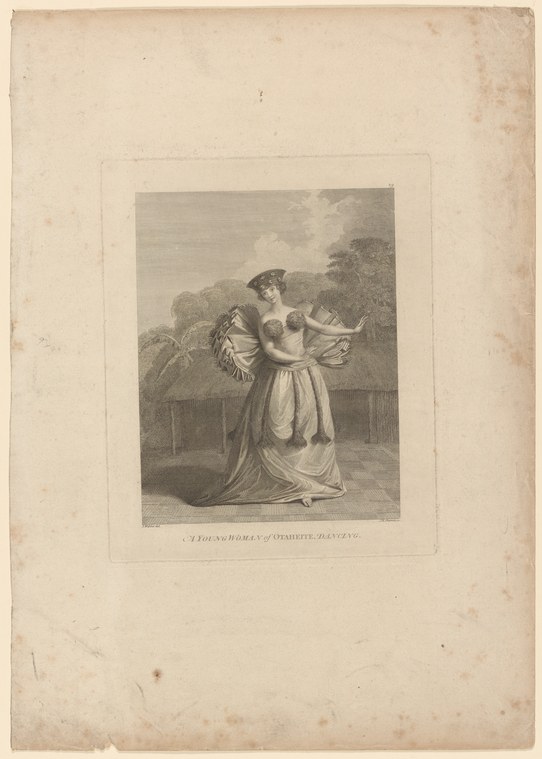
A young woman of Otaheite dancing
Unknown artist
- Collection:
- Prints depicting dance
- Source:
- New York Public Library
- Rights:
- Public domain — free to use, share and adapt.
- Recorded as:
- Public Domain
The image is a crucial document of how European artists visualised and colonised Pacific dance in the Romantic period, transforming living cultural practice into aesthetic fantasy. It shows how theatrical and courtly conventions of posture and presentation were imposed on 'exotic' subjects, and how prints like this shaped European imaginative geography for generations.
What you are looking at
A young woman stands alone in a columned neoclassical setting, her body caught in a moment of dance or gestural display. She wears a high-waisted white muslin dress in the Regency style, with her arms raised and extended to either side in an open, expansive gesture. Her left leg appears to be lifted or extended, suggesting active movement. The figure is rendered in fine detail against a landscape background visible through classical columns, with soft atmospheric effects creating depth. The composition is intimate and focused entirely on the single figure, treating her dance or movement as a display of grace and refinement rather than narrative action.
The dancing
The dancer stands in a contrapposto position with her weight shifted, one leg appearing to lift or extend while the other supports her body. Her arms are raised in a symmetrical, open frame—not clasped or supported by a partner—with elbows bent and hands at shoulder height or above. The posture suggests a moment of elevation or a turning movement, with the body elongated and the carriage upright. No partner is present; this is a solo performance piece.
The dance depicted
The work depicts what the title calls a 'young woman of Otaheite dancing'—a reference to Tahitian dance filtered through European Romantic imagination. The raised-arm gesture and the isolated, framed presentation suggest European theatrical convention rather than authentic Tahitian movement vocabulary, marking this as a Europeanised fantasy of Pacific island dance. The image belongs to the late 18th or early 19th-century vogue for 'exotic' dance subjects treated through neoclassical aesthetics. Otaheite (Tahiti) was a focal point of European imaginative interest following Cook's voyages, and depictions like this conflate real Pacific dance practice with Romantic ideals of natural grace and sensibility.
How it was made
This is a finely executed engraving, likely stipple-engraved or line-engraved, characteristic of late 18th-century British printmaking. The technique produces precise tonal modelling and delicate detail in the drapery and flesh, and allowed for wide circulation as a print sold individually or in series. The refinement of technique and the classical architectural setting suggest an art-historical rather than documentary purpose—this was made for drawing rooms and galleries, not for ethnographic record. The print medium ensured the image could reach a large educated audience interested in Romantic exoticism.
About this work
This is a Regency-era engraving depicting an imagined Tahitian female dancer posed against neoclassical architectural elements. The work belongs to a widespread European fascination with Pacific island cultures and their 'natural' grace, a fascination kindled by Captain Cook's voyages and mediated through Romantic artistic convention. The dancer is presented not as a document of actual Tahitian dance practice, but as a refined artistic study—the fusion of exotic subject matter with European aesthetic ideals of beauty, delicacy, and upright posture. The solitary figure, the careful architectural framing, and the formal presentation all signal this is a print for elite viewing and collecting, not a record of lived practice.
How to look at it
Attend to the contradiction between the classical architectural setting (completely European) and the claimed Tahitian subject. Notice how the body—upright, elongated, arms framed with balletic symmetry—follows European codes of refined movement rather than any documented Tahitian gesture or posture. The raised-arm position and the solitary framing are conventions of European theatrical display, not Pacific dance practice. The print is worth examining precisely because it reveals the imaginative distance between what was claimed as 'exotic' documentation and what was actually European artistic fantasy.
The artist
The artist is not recorded, which is typical for anonymous engravings of this period. The execution is skilled and the inscription is professionally rendered, suggesting a London or other major print-publishing centre. The work may have been produced by a professional engraver working from a painter's design, which was standard practice for print circulation of fashionable theatrical and exotic subjects.
The period
This engraving dates stylistically to the late 18th or early 19th century, during the height of European Romantic fascination with non-European cultures, amplified by Pacific exploration narratives. The classical architectural framing reflects the continued prestige of neoclassical aesthetics, even as subject matter became increasingly 'exotic.' In dance, this was the era of the Romantic ballet in its infancy—a period when European choreographers were beginning to stage fantastical scenes of distant lands and 'natural' peoples. The image sits at the intersection of Enlightenment curiosity about the wider world and Romantic aestheticisation of otherness. The Regency-era dress confirms an early 19th-century context.
Where it lives
Held in the New York Public Library's collection of prints depicting dance. The source record provides minimal information, suggesting this is an anonymous print from a large holding of 18th and 19th-century theatrical and exotic prints, many undated and unattributed.
Dance in this work
Questions about this work
Was this based on real observations of Tahitian dance?
Very unlikely. The body posture, arm frame, and formal presentation all follow European neoclassical and early Romantic theatrical conventions. The print reflects European fantasy about Pacific cultures more than documented dance practice. It is representative of how Romantic-era artists and printmakers used non-European subjects as frameworks for expressing European aesthetic ideals.
What does 'Otaheite' mean?
Otaheite is the anglicised spelling of Tahiti, used in English texts from the 18th and early 19th centuries, especially following Captain James Cook's voyages to the Pacific (1768–1779). The name became shorthand in Europe for exotic island paradise and unrestrained natural beauty, a fantasy that shaped artistic representation.
Why is she alone without a partner?
The solo presentation was a common device for theatrical prints of the period, especially for 'exotic' or specialty dances. It allowed the artist to frame the dancer's body as an object of aesthetic contemplation, isolated and formally composed. In actual Tahitian dance practice, group movement and social participation are central, so this is another sign of European reframing.
More dance artwork





