49 works in this view — arrow keys or swipe to move between them.
Dance in Art
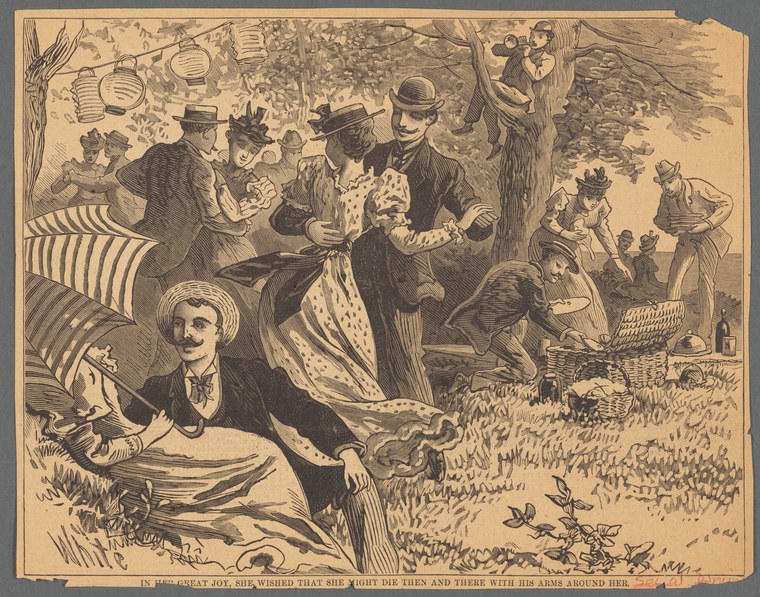
In her great joy, she wished that she might die then and there with his arms around her
Unknown artist
- Collection:
- Prints depicting dance
- Source:
- New York Public Library
- Rights:
- Public domain — free to use, share and adapt.
- Recorded as:
- Public Domain
For historians of dance, this image documents how the waltz and social dancing functioned in Gilded Age society—not as performance art but as courtship choreography, where the dance is valuable chiefly as the occasion for romantic feeling and gender display. For art historians, it exemplifies the use of engraving to illustrate narrative sensation: the artist's task is to freeze a moment of emotional climax within a scene of social spectacle. The work also shows how dance imagery circulated in the 19th century through mass reproduction rather than fine art exhibition.
What you are looking at
A wood engraving depicts an outdoor picnic or garden party in the Gilded Age, with elegantly dressed figures arranged across a verdant landscape. In the foreground, a woman in a white gown reclines on the grass, gazing upward in rapture; a gentleman in formal dress bends toward her. Behind them, other couples and figures populate the scene—some standing, some seated on striped blankets or chairs. Hanging lanterns and draped fabric suggest evening entertainment. The composition balances intimate foreground drama with a busy social backdrop: trees frame the scene, and the middle distance shows additional guests engaged in conversation and leisure. The engraver has captured a moment of romantic climax—the woman's posture and expression suggest swoon or ecstatic surrender, her companion's protective stance intimate and proprietary.
The dancing
The central couple are in close proximity but not in formal dance hold; the woman is semi-recumbent, her body arched and relaxed, while the man leans in with one arm extended toward or around her. Her posture reads as surrender or collapse rather than active movement. Surrounding them, other figures maintain upright, conversational stances typical of Victorian social gathering rather than dance formation. The spacing and body orientations suggest promenade or strolling, not structured choreography. No footwork or technical placement is visible; these are figures at leisure.
The dance depicted
This is not a depiction of formal ballroom dance, though it is a social dance scene. The title—"In her great joy, she wished that she might die then and there with his arms around her"—suggests romantic narrative rather than technical choreography, and the composition reflects Gilded Age social dancing: outdoor evening entertainment, the waltz or promenade as courtship ritual, and the woman's emotional abandon as the climactic moment. The intimate foreground couple may be pausing mid-dance or caught in the romantic framing of a slow waltz. The picture conflates dance with courtship spectacle, where the dance itself is less important than the emotion and social theater it occasions.
How it was made
This is a wood engraving, a technique that uses the end-grain of a hardwood block and fine burins to create intricate linear compositions. The medium is visible in the delicate parallel hatching that models the figures' clothing, the layered texture of foliage, and the precision required to render both intimate foreground detail and atmospheric background. Wood engraving was the dominant process for newspaper and periodical illustration in the 19th century, suggesting this was made for reproduction in a literary or society publication—likely accompanying a serialized story or poem about romantic courtship. The technique's association with narrative illustration and its capacity to combine delicate detail with narrative clarity make it ideal for this sentimental subject.
About this work
This wood engraving captures a Gilded Age social scene in which ballroom dancing (or its garden equivalent) becomes the stage for romantic emotion. The artist has chosen the climactic moment of emotional surrender—a woman overcome with joy in her partner's arms—and framed it within a larger tableau of fashionable leisure and courtship ritual. The work belongs to a body of 19th-century illustration that treated dance not primarily as a technical or aesthetic achievement but as a social and emotional event: the space where courtship, class display, and sentiment converge. The medium of wood engraving anchors it to the world of periodical illustration and popular narrative, suggesting it was made for a broad middle-class audience familiar with novels of sentiment and social comedy.
How to look at it
Observe how the artist has organized the composition to make the central couple the emotional focus while maintaining a sense of social context: the woman's upturned face and languid posture command the eye, while the clustered figures behind suggest the ballroom or garden as a stage for private feeling made public. Note the detail of the formal dress—the woman's decorative gown, the man's coat and hat—which signals class and propriety even as the woman's body language transgresses proper restraint. The hanging lanterns and evening light suggest a liminal moment: the formal entertainment is underway, but the couple has stepped into their own emotional drama. The work demonstrates the 19th-century convention of using landscape and gathered society as framing for the romantic couple's moment of feeling.
The period
The Gilded Age (roughly 1870s–1900) saw the waltz and country-dance firmly established in American and European society as vehicles for courtship and social performance. Outdoor evening parties and garden dances became fashionable among the prosperous middle and upper classes. Simultaneously, wood engraving was at the height of its use in periodical illustration, before photographic reproduction displaced it in the early 1900s. Sentimental narratives about love and social aspiration were staple fare in weekly and monthly magazines, and dance scenes—especially moments of romantic intensity—were common subjects. The artistic convention of depicting emotional climax through the woman's swoon or rapture, watched by an admiring male figure, was a hallmark of mid-to-late Victorian visual culture.
Where it lives
The work is part of the New York Public Library's collection of prints depicting dance, suggesting it was selected as relevant to the history and iconography of social dance. It may have been clipped from a periodical or collected as a separate print. The catalogue record provides no artist attribution, publication venue, or date, though the style and subject are consistent with 1880s–1890s literary and society illustration.
Dance in this work
Questions about this work
Is this a ballroom scene or an outdoor party?
Both. The image depicts an outdoor evening entertainment—a garden party or lawn fête—which mimics ballroom social dancing in a naturalistic setting. The formal dress, the structured gathering, and the coupled figures suggest ballroom convention transplanted outdoors, a fashionable Gilded Age practice. The hanging lanterns and draped furnishings create an improvised ballroom atmosphere beneath trees.
What dance are they doing?
The specific dance is not identifiable from the image. The couple in the foreground are not in standard dance hold and appear to be pausing or conversing. Other figures are standing and walking rather than dancing. The scene is a dance occasion or dance-adjacent social moment rather than a depiction of choreography in action.
Who made this print?
The artist is unknown. The catalogue record does not attribute the work. The style and subject are consistent with professional periodical illustration of the 1880s–1890s, suggesting it may have been made for a magazine or newspaper rather than as a fine art print with a named artist.
What does the title mean?
The title expresses a Romantic and Victorian sentiment: the woman is so overcome with joy in her partner's arms that she wishes the moment might be eternal, even if it meant death. This sentiment—romantic love as transcendence or annihilation—was common in 19th-century literature and sentimental visual culture. The title frames the dance or social moment as the stage for this emotional climax.
More dance artwork





