49 works in this view — arrow keys or swipe to move between them.
Dance in Art
Bellerofonte
Unknown artist
- Collection:
- Prints depicting dance
- Source:
- New York Public Library
- Rights:
- Public domain — free to use, share and adapt.
- Recorded as:
- Public Domain
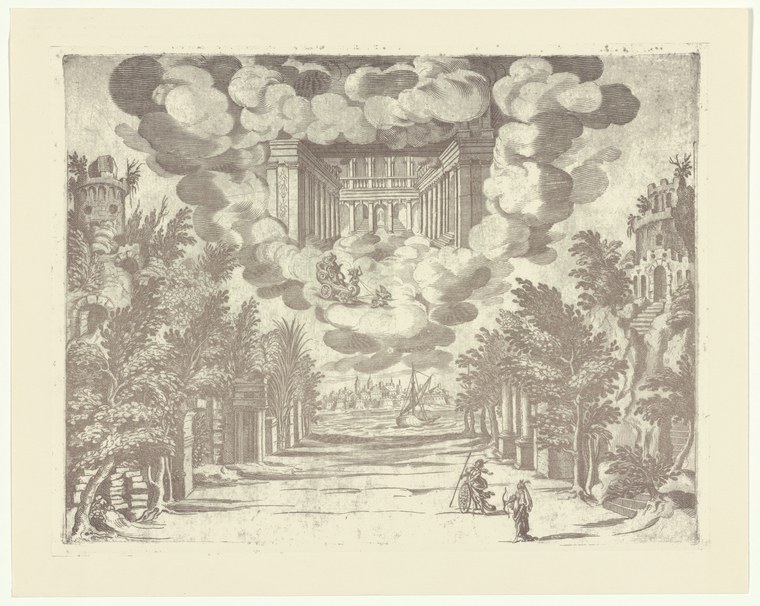
This work reveals how Renaissance and baroque theatre understood 'dance' beyond human performance: the movement of celestial figures, the flow of architectural perspective, and the illusion of weightlessness were aesthetic languages continuous with formal choreography. For historians of early ballet and court spectacle, this engraving documents the visual vocabulary and spatial ambitions that shaped the emergence of theatrical dance in early modern Europe.
What you are looking at
This is an engraved theatrical scene depicting a celestial or allegorical vision. At the centre, a grand classical temple with Corinthian columns opens onto billowing clouds that fill the upper half of the composition. From these clouds emerge putti or cherubs in various poses of flight and motion. The foreground is framed by a tree-lined avenue in strict perspective, with tall palms and cypresses flanking both sides of a paved walkway that recedes toward the temple. Two figures in contemporary dress—likely spectators or witnesses—stand at the extreme right foreground, gesturing and observing the vision. The entire scene is rendered in fine crosshatching and line work typical of 16th- or 17th-century engraving, with careful attention to atmospheric effect and spatial recession.
The dancing
The putti scattered across the clouds display varied poses: some appear to be in flight with arms outstretched, others recline or tumble against the clouds. Their bodies are small and distant, rendered with the playful informality of baroque cherub iconography rather than the formal technique of theatrical dance. The two figures at lower right are stationary observers; the nearer one gestures upward in wonder or instruction, pointing toward the celestial display. No earthly dancers occupy the stage or foreground—the 'dance' is celestial and allegorical rather than performed by human bodies.
The dance depicted
This image does not depict theatrical dance performed by human dancers. Instead, it shows a vision of celestial or mythological putti in playful, airborne movement against clouds. The work illustrates a theatrical or pageant vision—possibly an intermezzi or court spectacle—rather than a dance itself. The composition suggests this is a design for a stage setting or a record of an elaborate illusionistic effect, where the 'movement' is that of painted or sculpted figures representing the heavens. The title 'Bellerofonte' suggests a classical mythological subject, likely one of the many Renaissance or baroque treatments of the hero and his winged horse Pegasus.
How it was made
This is an engraving—a line-based intaglio print executed with burin and needle work into a copper plate. The fine, consistent parallel hatching (cross-hatching) and the precision of the architectural and botanical detail are characteristic of northern European or Italianate engraving practice of the 16th or 17th century. The technique allowed for wide circulation as a reproducible image, suggesting this was likely a design for a pageant, festival decoration, or theatrical spectacle of aristocratic scale. The careful atmospheric effect—the gradation of cloud forms through varying density of line—demonstrates sophisticated understanding of how engraving could render immaterial or celestial subjects.
About this work
This engraved print documents a theatrical vision rather than a dance performance. It captures the design or concept behind an elaborate court spectacle or intermezzi, likely depicting a scene from the Bellerophon myth. The work belongs in a dance gallery not because it shows dancers in motion, but because it records the visual logic and aesthetic ambition of Renaissance and baroque theatrical display—the marriage of architecture, illusion, and movement that made court spectacle and pageantry a forerunner of formal ballet. The image preserves evidence of how mythological narrative and celestial vision were staged through perspective, cloud machinery, and the figures of putti rendered in airy, buoyant poses that suggest flight and divine motion.
How to look at it
Notice the two-part structure: the rigid architectural perspective of the earthly avenue below, and the fluid, weightless cloud space above. The contrast between these registers—the geometric order of the temple and trees versus the organic tumble of putti—embodies a fundamental tension in baroque theatrical aesthetics between rational design and ecstatic vision. The engraver's choice to depict the moment of transition—clouds breaking open, putti suspended in mid-gesture—captures the spectacular effect of stage machinery designed to surprise and elevate the spectator's eye upward. The two observers at the right anchor the composition in an earthly viewpoint, inviting the reader to share their wonder at the vision.
The period
This engraving dates stylistically to the 16th or 17th century, a period of intense experimentation with theatrical spectacle at European courts. Court pageantry, intermezzi, and allegorical tableaux vivants were major art forms, and prints like this served both as records of ephemeral events and as designs for future productions. The Bellerophon myth was a favourite Renaissance subject, treated by composers, poets, and visual artists across Italy, France, and northern Europe. The engraving technique itself was the primary medium for circulating knowledge of such spectacles beyond the court that commissioned them.
Where it lives
This print is held in the New York Public Library's collection of prints depicting dance. Such collections preserve both actual dance records and broader theatrical imagery that illuminates the visual and spatial contexts in which early dance developed.
Dance in this work
Questions about this work
Why is this in a dance collection if no one is dancing?
Because Renaissance and baroque theatre understood spectacle as a total art form in which architecture, perspective, celestial machinery, and the movement of figures (including putti and allegorical beings) were all choreographed together. Prints like this record the design logic and visual imagination that shaped early ballet and court spectacle, which emerged from these grand theatrical visions.
What does the title 'Bellerofonte' tell us?
It indicates the subject is the classical hero Bellerophon and likely his encounter with the winged horse Pegasus. The myth was a favourite of Renaissance artists and court spectacle designers because it combined celestial themes, heroic narrative, and opportunity for stunning visual display—exactly the elements used in elaborate court pageants and early ballet.
Is this an actual record of a performance, or a design?
It is most likely a design or conceptual record—either a proposal for a stage set or a memory of an actual spectacle. Engravings like this served as both documents and blueprints, circulating throughout Europe and influencing how courts staged their own theatrical visions.
More dance artwork





