49 works in this view — arrow keys or swipe to move between them.
Dance in Art
The celebrated Ethiopian melodies
Unknown artist
- Collection:
- Prints depicting dance
- Source:
- New York Public Library
- Rights:
- Public domain — free to use, share and adapt.
- Recorded as:
- Public Domain
Minstrelsy is a foundational and deeply contested chapter in American dance history—it was a primary vehicle through which African American rhythm, musicality, and movement vocabulary reached and influenced wider audiences, yet it did so entirely within the framework of racist caricature and appropriation. This broadside is essential primary source material for understanding how nineteenth-century popular dance was promoted, performed, and received; it also documents the visual codes and marketing strategies of theatrical entertainment in an era before photographs or recordings. For historians and dancers, it raises urgent questions about appropriation, representation, and the relationship between exploitation and cultural transmission.
What you are looking at
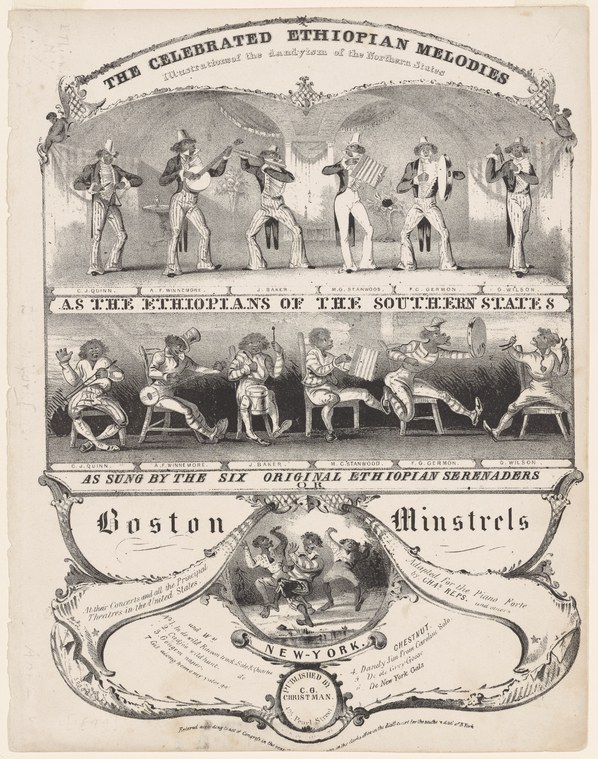
This is a broadside print advertising the Ethiopian Serenaders, a mid-19th-century blackface minstrel troupe. The composition is divided into three distinct sections. The top register shows six male performers in formal dress—suits and bow ties—standing in a line and playing various instruments: banjo, bones, tambourine, and other percussion. The middle section depicts the same six men seated and performing, their bodies leaning forward in energetic postures. The bottom section contains a central circular vignette showing performers in close social interaction, framed by decorative cartouches bearing text identifying the group and their locations (Boston Minstrels, New York). The entire composition is enclosed in an ornate engraved border with flourishing typography reading "The Celebrated Ethiopian Melodies" at the top and "As Sung by the Six Original Ethiopian Serenaders" below. The print uses the visual language of entertainment advertising to promote what was a popular if now deeply troubling form of theatrical entertainment.
The dancing
The performers in the top register stand upright in a loose line, each holding or demonstrating an instrument with arms extended or raised—a pose designed to display technical skill and the instruments themselves rather than to suggest continuous movement. In the seated section below, the figures lean forward from the waist, shoulders hunched, in postures that suggest rhythmic, percussive playing; their bodies are animated but remain grounded. The seated poses show torsos bent and arms in active positions, suggesting the vigorous, rhythmic playing that characterized minstrel performance. Throughout, the figures are posed rather than captured mid-movement; this is promotional imagery designed to present the performers as skilled musicians and entertaining spectacles.
The dance depicted
This is not primarily a depiction of dance but of minstrel entertainment—a form that combined instrumental music, song, comedy, and social dancing. The Ethiopian Serenaders were a blackface minstrel group that performed in the 1840s–1850s in Boston, New York, and other cities. Minstrelsy was a significant form of popular entertainment and a source of African American musical and movement traditions, though filtered through and distorted by the racist conventions of blackface performance. The broadside advertises the group's instrumental and vocal talents rather than any specific choreography. However, minstrel performance of the era often included solo and ensemble dancing, and the posed, energetic positions in the lower register suggest the kind of rhythmic physicality that would have accompanied such music—though the image does not depict actual dance movement but rather a promotional arrangement of poses.
How it was made
This is a wood engraving or lithographic print, produced for mass circulation as a broadside advertisement. The technique allowed rapid, inexpensive reproduction and wide distribution—essential for promoting theatrical tours to local audiences. The fine detail of the engraving, the ornamental border, and the integrated typography are characteristic of mid-19th-century theatrical advertising. The print was designed to be posted in public spaces and would have been one of the primary means by which traveling entertainment troupes announced their arrival in a new city. The legibility of the performers' faces and the clarity of the instrument details served both artistic and commercial purposes, making the performers recognizable and the entertainment tangible to potential audiences.
About this work
This broadside advertises the Ethiopian Serenaders, a blackface minstrel ensemble active in the 1840s–1850s. Minstrelsy was the dominant form of American popular entertainment in the antebellum period, and this print is a crucial artifact of how such performances were promoted and understood. The image documents not choreographed dance but the visual presentation of a performance tradition that blended instrumental music, song, comedy, and social dancing. It shows how nineteenth-century entertainment was sold to the public and reveals the racist conventions that shaped even as they popularized African American musical and movement traditions. The work belongs in a dance history collection because minstrelsy was a formative influence on American vernacular dance and because the image documents both the performance aesthetic and the commercial apparatus that sustained it.
How to look at it
The print is organized to emphasize the performers' musicianship and theatrical presence rather than to capture the actual moment of performance. Notice how the top register presents instruments and formal posture—a display of respectability and skill—while the lower registers show the same men in energized, informal positions that suggest the rhythmic physicality of minstrel entertainment. The ornate frame and typography place the performance within a commercial apparatus; the repeated names and city names are advertising copy, meant to be readable from a distance. Look at how the poses are balanced between formal (the standing musicians) and loose (the seated players)—this tension between respectability and spectacular physicality is central to how minstrelsy was marketed to audiences. The central circular vignette suggests intimate social gathering, a strategy to make the entertainment seem both refined and accessible.
The artist
The artist is not recorded. The print was produced for commercial theatrical promotion and would have been created by a shop specializing in broadside production—a rapid, vernacular form of printmaking driven by demand from entertainment promoters and traveling companies. Such prints were not typically signed or attributed; they were functional advertisements, not fine art objects. The quality of the engraving and the sophistication of the composition suggest a competent commercial print shop, likely in Boston or New York where the troupe performed, but the individual engraver or lithographer cannot be identified from the image or record.
The period
The Ethiopian Serenaders performed during the peak era of blackface minstrelsy in North America (1840s–1860s). Minstrel shows were the most popular form of theatrical entertainment in the United States before the Civil War, rivaling circus and legitimate theater. The form originated in the early 19th century as white performers in blackface caricatured African American music, speech, and dance for white audiences; by the 1840s, minstrel troupes had become institutionalized, touring widely and establishing a set repertoire and performance conventions. The broadside coincides with the rise of chromolithography and the refinement of theatrical advertising—entertainment promotion had become a sophisticated commercial practice. In this period, minstrelsy was also beginning to be challenged and reformed by some performers and promoters who sought to move away from crude caricature toward more "refined" representations, though racist conventions remained fundamental to the form.
Where it lives
This print is held in the prints collection of the New York Public Library, which has extensive holdings of theatrical broadsides and advertising from the 19th century. The collection was assembled to document the history of entertainment, journalism, and public life in New York City and beyond. Such broadsides are ephemeral objects—intended for posting and disposal—so surviving examples are fragile witnesses to how performance was promoted and consumed.
Dance in this work
Questions about this work
Who were the Ethiopian Serenaders?
The Ethiopian Serenaders were a minstrel ensemble active in the 1840s–1850s, performing in cities including Boston and New York. They were part of the dominant form of American popular entertainment of that era. The name "Ethiopian" was a common (and deeply offensive) label applied to blackface minstrel groups. Like all minstrel performers of the period, they would have performed in blackface makeup, though this is not visible in this particular promotional print.
Is this a depiction of dance?
This broadside promotes a minstrel ensemble whose performances would have included dance, but the image itself shows posed musicians rather than dance in motion. The instrumental and physical energy suggested by the poses would have accompanied the kind of social and solo dancing characteristic of minstrel performance, but we cannot see actual choreography or movement quality in this promotional arrangement.
Why was minstrelsy important to American dance?
Minstrelsy was the primary vehicle through which African American musical and movement traditions reached broader audiences in the antebellum United States. The rhythm, musicality, and dance vocabulary that minstrel performers drew from—and distorted through racist performance codes—became foundational to American vernacular dance forms including tap, jazz, and social dance. At the same time, minstrelsy was a system of racist appropriation and caricature that profited white performers and audiences while excluding Black people from participation in and benefit from the entertainment they created.
What does this broadside tell us about 19th-century entertainment?
Theatrical advertising like this broadside shows how traveling entertainment companies promoted themselves to local audiences before photography, film, or widespread newspaper coverage. The mix of illustration, typography, and repeated names and locations was designed to be readable at a distance and memorable. The formal presentation of the performers—named, identified by instrument, and framed in ornate typography—conveyed respectability and professional skill, key marketing strategies for attracting paying audiences.
More dance artwork





