49 works in this view — arrow keys or swipe to move between them.
Dance in Art
French fashion plates
Unknown artist
- Collection:
- Prints depicting dance
- Source:
- New York Public Library
- Rights:
- Public domain — free to use, share and adapt.
- Recorded as:
- Public Domain
Fashion plates are primary evidence for the physical culture of historical dance. They show not the technical execution of steps, but the carriage, the posture, and the dress of the social dancer—knowledge that is often invisible in written descriptions or in the idealized poses of academic figure drawing. This sheet documents the transformation of the female body in the ballroom during a period when dance was the primary form of social interaction and bodily display among the aristocracy and gentry of Europe.
What you are looking at
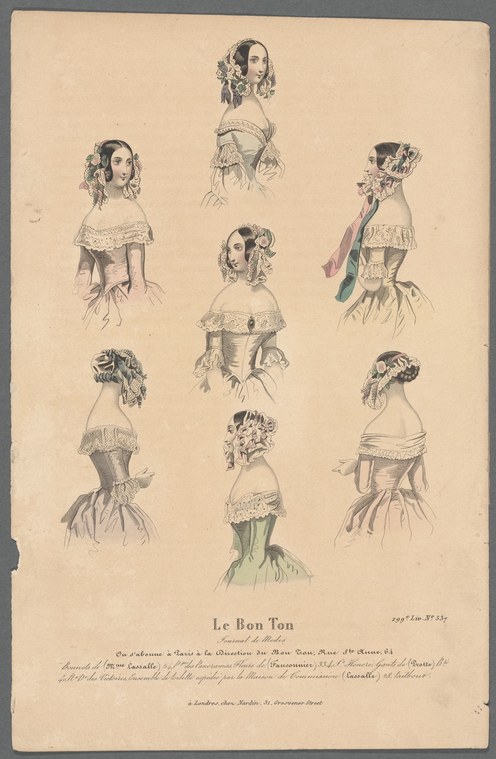
This is a sheet of nine fashion illustrations arranged in a three-by-three grid, each showing a young woman in contemporary dress typical of the 1830s–1840s. The figures are depicted from roughly the waist or knees upward, allowing full view of their upper bodies and elaborate skirts. Each woman wears the characteristic costume of the period: off-shoulder or bertha necklines with white lace or embroidered trim, fitted bodices, and full skirts with deep pleats or flounces at the hem. The women are posed in a variety of attitudes—some standing formally, others in a light, springing stance suggesting motion or the moment before a step. Their hair is uniformly styled in long ringlets or waves gathered at the back with ribbons or ornaments. The drawing is rendered in fine pen line with selective hand-coloring in pastels or watercolor, chiefly in the skirts (pale green, pink, blue, and yellow tones visible in the original). The title at the base reads "Le Bon Ton" (Good Taste), indicating this is a fashion plate designed to display the current modes of dress to a readership of women concerned with style.
The dancing
The women are shown in varied postures that suggest both standing and movement: several display an upright, composed bearing with arms at rest or held lightly at the sides; others adopt a more animated stance with a slight forward tilt of the torso or a lifted knee that implies the readiness to step or glide. The proportions are characteristic of fashion illustration rather than anatomical precision—elongated limbs, small waists, and an emphasis on the silhouette. The poses are elegant but not balletic; these are poses of social propriety and grace rather than technical dance positions. Several figures appear to be in the act of promenading or in a moment of social pause, which was the primary mode of movement in the ballroom of this period.
The dance depicted
These are not depictions of dance as a choreographed performance, but rather fashion illustrations of the dress worn during social dancing—the cotillion, quadrille, and promenade that dominated aristocratic and upper-middle-class social life in early 19th-century Europe. The postures and the contexts (ballroom settings implied by the formal dress and composed demeanor) suggest the graceful, upright carriage and small, controlled steps characteristic of the regency and early Victorian ballroom. The women's readiness to move, visible in the springing quality of certain poses, reflects the physical preparation required for the figure dances and reels of the period. These are not dancers being depicted; rather, these are the fashionable garments and the bodily comportment of women who danced in them.
How it was made
This is a hand-colored engraving or possibly a colored lithograph, techniques that allowed for relatively rapid reproduction and wide distribution of fashion plates to the periodical press or to bound volumes of fashion illustration. The fineness of the line work and the selective application of watercolor or pastel suggest this was a print made from an engraved or lithographic plate, with color added by hand afterward or by chromolithographic process. The technique was well suited to the commercial fashion press: reproducible, elegant, and capable of registering both the fine detail of the ornament and the overall silhouette of the garment. Such prints were frequently published in fashion journals, ladies' magazines, or collected into volumes, and were circulated among women of means as guides to current metropolitan style.
About this work
This is a French fashion plate from the early 19th century showing nine variations of fashionable women's ballroom dress. It records both the garment and the bearing of the wearer—the upright posture, the composed gesture, and the readiness for social dancing that defined female propriety and elegance in the aristocratic ballroom. Fashion plates are documents of dance as much as of dress, because they show the body in motion and the body at rest within the context of the ball and the promenade. This sheet, titled "Le Bon Ton," was designed for circulation among women of fashion in France or the broader European elite, and it offers a precise visual record of how the fashionable woman prepared herself for the social dances of the regency era.
How to look at it
Attend to the variety of poses: the artist has chosen not to show identical standing figures, but rather a range of moments and attitudes that imply motion, social interaction, and the physical preparation for the promenade and the dance. Notice how the pose changes the silhouette of the dress—how a forward tilt of the torso or a lifted knee alters the line of the skirt and suggests the way the fabric would move in the body's movement. The careful rendering of the ornament (the lace, the ribbons, the embroidery) contrasts with the simplified rendering of the face, which is characteristic of fashion plates, where the dress is the primary subject and the woman is a vehicle for displaying it. The hand-coloring of the skirts in varied pastels was a commercial choice: it showed the buyer what colors were available and how the garment would appear in daylight.
The artist
The artist is not recorded in the catalogue. The style and the inscription "Le Bon Ton" suggest this was a commercial fashion print produced in France, likely in Paris, during the 1830s–1850s. French fashion plates of this period were world-renowned and set the standard for European ladies' magazines and fashion journals. The work was produced for a commercial publisher, not for exhibition as a fine art object, and was part of the vast printed apparatus of fashion advice and aspirational imagery that emerged in the early 19th century.
The period
The 1830s–1840s were the heyday of the Romantic ballet in Europe—a period when ethereal, ethereal female dancers in white tutus and pointe shoes were transforming the aesthetic of theatrical dance. In the same period, the ballroom remained the primary social dance venue for the aristocracy and gentry, and the dances performed there—the quadrille, the cotillion, the waltz, and the polka—had not changed in their essential form since the regency period. Fashion plates served as a crucial visual medium for disseminating knowledge of current styles to women who could not attend the salons and balls of Paris and London but who aspired to dress in the latest metropolitan modes. The emphasis in these illustrations on posture and on the moment of readiness for movement reflects the dance-centered culture of the ballroom.
Where it lives
This work is held in the New York Public Library's collection of prints depicting dance. It is identified as a French fashion plate of unknown date and artist, and is catalogued under the broad heading of dance imagery, suggesting that the collection curators recognized the connection between fashion, bodily bearing, and the social practices of the ballroom.
Dance in this work
Questions about this work
Are these dancers?
No. These are fashion illustrations showing the dress and the bearing of fashionable women in the early 19th century. They are not depictions of a choreographed dance, but rather of the posture and demeanor of women who danced in these garments in the ballroom. The poses suggest readiness for movement and social grace, but the women are not executing steps or movements of a specific dance.
What dances would have been danced in these clothes?
These dresses were worn for the cotillion, quadrille, waltz, and polka—the primary social dances of the ballroom in this period. The formal, upright bearing and the full skirts were designed to allow the small, controlled steps and the turning movements characteristic of these figure dances.
Why are there nine different poses?
Fashion plates often showed multiple variations of a style to demonstrate how the dress could be worn in different social contexts or with different ornaments. The variety of poses also showed how the dress moved and hung on the body in different attitudes, which was important information for a potential buyer.
What is 'Le Bon Ton'?
"Le Bon Ton" means "good taste" in French. It was a common title for French fashion journals and plates in the 19th century, indicating that the illustrations were displaying the current standards of fashionable dress among the Parisian elite.
More dance artwork





