49 works in this view — arrow keys or swipe to move between them.
Dance in Art
French fashion plates
Unknown artist
- Collection:
- Prints depicting dance
- Source:
- New York Public Library
- Rights:
- Public domain — free to use, share and adapt.
- Recorded as:
- Public Domain
Fashion plates are evidence of how ballroom aesthetics and dance training infiltrated and shaped the movement and comportment of fashionable society far beyond the ballroom itself. They show that the refined, corseted silhouette of the 1840s was not merely a static garment but a prescription for how the body should move—how it should stand, turn, gesture, and display itself. For dance historians, they document the embodied ideal that actual dancers (both professional and social) were trained to embody.
What you are looking at
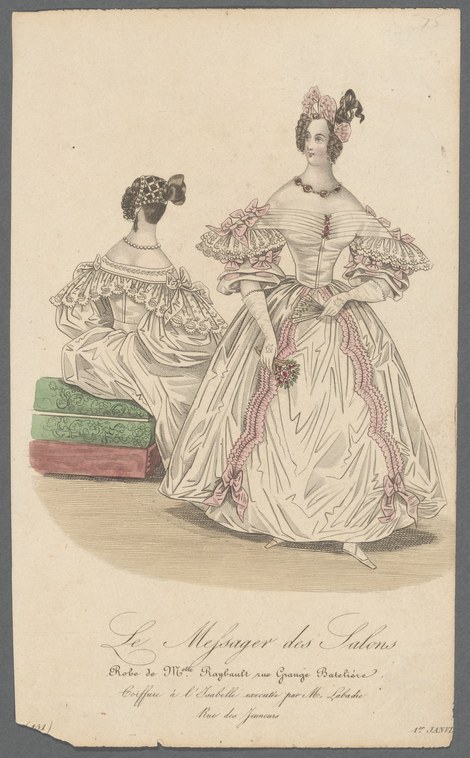
A fashion plate depicting two elegantly dressed women, likely from the 1840s, in a parlor or drawing room setting. The standing figure on the right wears a pale silk gown with voluminous off-shoulder sleeves trimmed in ornate lace, the skirt gathered and decorated with purple ribbon garlands that cascade diagonally. She wears a feathered headdress and holds a decorative fan. The seated figure on the left, shown in three-quarter view, wears a similar pale gown with an off-shoulder neckline and puffed sleeves; her dark hair is arranged in ringlets and she too holds a fan. Both women are depicted with the exaggerated posture and gesture typical of fashion illustration—the standing woman in a graceful contrapposto, the seated woman turned to display the drape of her gown. The setting is minimal: a green cushioned ottoman or seat is visible, rendered in watercolor wash, and the background is plain cream paper. The engraving is hand-colored, with subtle watercolor tinting in pink, green, and purple accents.
The dancing
Both figures adopt refined, elongated postures characteristic of Romantic-era fashion plates. The standing woman leans slightly forward with her weight shifted, one arm extended to display her fan, her body creating an S-curve silhouette enhanced by tight corseting and the bell-shaped skirt. The seated woman's posture is equally poised, her shoulders squared toward the viewer while her head turns gracefully. Neither figure depicts a moment of active dance, but rather the balletic refinement of bearing and gesture that characterized fashionable deportment—the kind of elongated, weightless line valued in both dance and society portraiture of the period.
The dance depicted
These are not depictions of a dance in progress but rather images in the visual language of ballroom culture. The elegant deportment, the careful display of the body, and especially the fans suggest women trained in ballroom accomplishment and courtship rituals. The fashion plate format itself originated in the aristocratic and court contexts where dance, music, and refined comportment were inseparable. The women's postures echo the arm positions and line prized in Romantic-era ballet and the cotillion—the fashionable couple dance of the 1840s—though no partner or dance frame is shown. The image documents how ballroom training shaped everyday gesture and movement.
How it was made
This is a hand-colored engraving, a common format for fashion documentation in the mid-19th century. The primary image is line-engraved, likely created by a commercial fashion atelier, with watercolor tints applied by hand afterward—visible in the subtle pink, green, and purple accents. This technique allowed rapid reproduction and distribution to fashion-conscious audiences, primarily women, through newspapers, journals, and standalone prints. The economy of the medium—fine lines, minimal background, focus entirely on silhouette and detail—served fashion's primary purpose: to communicate the cut, trim, and proportions of current styles. The hand-coloring made each print a semi-unique object suitable for framing in a boudoir or study.
About this work
This is a fashion plate from the height of the Romantic era, likely from the 1840s, a commercial print documenting the silhouette, trim, and deportment of fashionable women's dress. Fashion plates are not art prints in the fine-art sense but rather a specialized visual genre born from the courtly and ballroom world, where dance training, refined posture, and fashionable dress were deeply entangled. The print belongs in a dance gallery not because it shows dancing but because it documents the bodily training and aesthetic values—elongation, weightlessness, careful arm placement, the artful display of line—that ballroom culture demanded and that shaped how women moved both in dance and in everyday life. These were the bodies that waltzed and quadrilled.
How to look at it
Attend to the posture and arm placement: notice how both women's shoulders are held back, their necks elongated, their arms curved in graceful lines—this is not how bodies naturally rest, but rather a trained deportment. The artist has frozen a moment of refined display, not of active movement, yet the gesture is balletic. Notice how the fan is held and displayed: it is both a practical object and a prop in a choreography of courtship and refinement. The watercolor tints—especially the purple ribbons trailing down the skirt—emphasize the vertical line and the impression of movement, even in stillness.
The artist
The artist is not recorded in the catalogue. Fashion plates of this period were typically produced by commercial ateliers, often anonymously, with design, engraving, and coloring divided among multiple hands. The French fashion houses that led European taste—and French fashion journalism dominated the field—employed specialist engravers and colorists in assembly-line fashion. Attribution to individual artists is rare and usually unreliable for prints of this type.
The period
The 1840s were the height of the Romantic era in Europe, when the waltz and the quadrille dominated ballroom culture and set the standard for refined movement and posture in fashionable society. The exaggerated vertical elongation and the off-shoulder neckline visible here reflect the Romantic ballet aesthetic promoted by dancers like Marie Taglioni, whose ethereal, elongated line became the model for fashionable womanhood. Fashion and dance were not separate domains: the same aesthetics, the same ideals of weightlessness and grace, governed both. The hand-colored engraving was the dominant medium for disseminating fashion information to a growing middle-class audience of women consumers.
Where it lives
This print is held by the New York Public Library in their prints collection documenting dance imagery. It is one of thousands of fashion plates produced in the 1840s, many now in institutional collections; these prints survive in abundance and offer a systematic visual record of how fashionable bodies were meant to move and appear.
Dance in this work
Questions about this work
Is this a dance picture or a fashion picture?
Both. Fashion plates belonged to the world of ballroom culture and were designed to communicate not just clothing but the refined bearing and movement that ballroom training produced. The elongated posture, the careful arm placement, and the overall aesthetic are inseparable from Romantic-era dance and the waltz-dominated ballroom. Fashion plates thus document the bodily ideals that actually danced people aspired to embody.
Why are the women posed like this—are they dancing?
No, they are in a moment of refined display in a drawing room. But the pose is balletic: it shows the kind of elongated, weightless line that Romantic-era ballet training produced, and that fashionable women were expected to maintain in everyday life. The S-curve posture, the arm placement, the turn of the head—all reflect ballroom training and aesthetic.
What dance would these women have danced?
Primarily the waltz and the quadrille. These were the fashionable couple dances of the 1840s and required a specific training in posture, partnership, and the refined line visible here. The off-shoulder gown and full skirt were designed for the movement of these dances—the slight rotation of the torso, the sweep of the skirt in a turn.
More dance artwork





