49 works in this view — arrow keys or swipe to move between them.
Dance in Art
French fashion plates
Unknown artist
- Collection:
- Prints depicting dance
- Source:
- New York Public Library
- Rights:
- Public domain — free to use, share and adapt.
- Recorded as:
- Public Domain
Fashion plates reveal how dancers and ballroom participants were expected to look and carry themselves—the upright posture, the elaborate dress, the composed expression. For historians of dance, such images are evidence of the visual culture and social expectations surrounding ballroom life, showing that dance in this period was inseparable from fashion, courtship display, and the codes of refined society.
What you are looking at
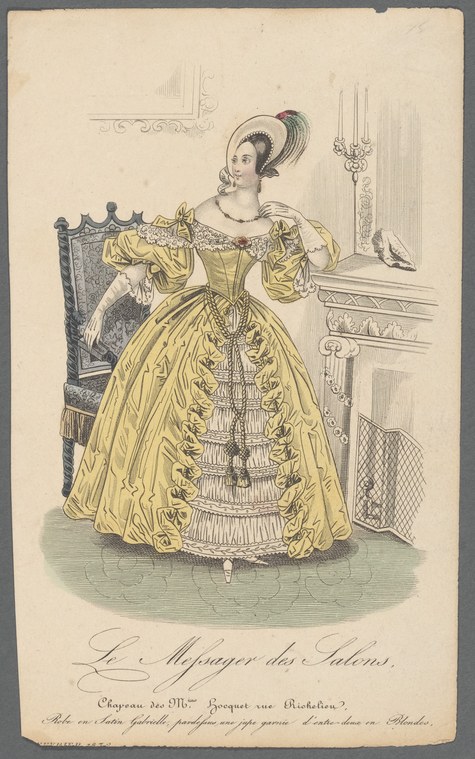
A woman in an elaborate golden ball gown stands in an ornate interior, posed in a moment of social performance or dance. The dress is the dominant visual feature: a sweeping skirt of pale yellow silk or satin adorned with elaborate ruched and pleated decoration down the front, creating a tiered or scalloped effect. The bodice is fitted and decorated with applied ornament, and the short puffed sleeves are typical of 1840s fashion. The woman wears a small feathered headdress or plume, and her posture is upright and composed. The setting includes a chair with decorative upholstery to the left, a tall candelabra with lit candles in the background, and architectural details suggesting a formal salon or ballroom. The interior is rendered in pale tones with delicate linear detailing, and a checkered floor pattern is visible at lower right. The overall effect is one of fashionable leisure and courtly display rather than vigorous movement.
The dancing
A single standing figure is shown in three-quarter view, weight settled on both legs with an upright, composed carriage. Her arms are positioned with the left slightly extended and the right held at her side, a posture more suited to display and acknowledgment than to the vigorous movement of dance. There is no sense of momentum, turn, or the dynamic weight transfer that characterises active dancing. The body faces forward with the head turned slightly, a classic pose for fashion illustration and portraiture rather than choreographic documentation.
The dance depicted
The image is ambiguous in its relationship to dance. While the figure's pose and the context of a formal interior might suggest a cotillion, quadrille, or other ballroom dance of the 1840s period, the standing position and static nature of the composition suggest this is fashion illustration rather than dance documentation. The title, 'Le Voyageur des Salons' (The Salon Visitor or Traveller), appears to refer to the social context of salon life rather than to a specific dance movement. If dance is represented here, it is through the conventions of ballroom fashion and deportment rather than through choreographic action.
How it was made
The work is a hand-coloured lithograph or engraving, rendered with fine linear work in black ink and hand-applied watercolour wash. The figure and architectural setting are executed in precise line work with delicate shading, while the dress receives careful attention to the rendering of texture, pleating, and applied ornament. The pale palette and refined line work suggest this is a fashion plate of the type produced for circulation among fashionable society—likely from a fashion journal or album. The technique allowed for both precise representation of dress construction and the soft modelling of fabric that made such plates valuable to dressmakers and the fashion-conscious.
About this work
This is a French fashion plate of the 1840s depicting a woman in fashionable ballroom dress standing in a formal interior. The work belongs in a gallery of dance in art not because it depicts active dancing, but because it documents the dress, deportment, and spatial conventions of ballroom culture—the formal salon context in which social dances like the cotillion and quadrille were performed. The standing figure embodies the ideal of fashionable leisure and the codes of formal social interaction that governed ballroom life. Such plates are primary sources for understanding how dance was situated within fashion, courtship, and social hierarchy in the nineteenth century.
How to look at it
Notice the extreme verticality and stillness of the pose: this is not a moment of movement captured mid-action, but a display of fashionable standing. The dress is shown in full—from the fit of the bodice to the precise construction of the skirt decoration—in a way that reveals the garment's engineering rather than the body's movement. The refined interior setting positions this figure not as a performer but as a salon visitor, one of a category of fashionable people documented in the period's visual culture. The work exemplifies how dance history and fashion history intersect: the ballroom was the stage for this costume, and the costume defined what ballroom dancing looked like.
The period
The 1840s saw the full flourishing of the Romantic ballet and the social ballroom dances that were its urban counterpart. The quadrille, the cotillion, and the waltz dominated fashionable society, and the dress illustrated here—with its low neckline, tight bodice, and elaborately decorated skirt—was standard for women participating in these dances. Fashion plates proliferated during this period as tools for circulating styles among the wealthy and as aspirational images for the broader middle class. The salon, as depicted here, was the primary venue for such social dancing among the urban elite.
Where it lives
The work is from the New York Public Library's collection of prints depicting dance, catalogued as a French fashion plate of unknown date and maker. It is one of many such plates produced for circulation among fashionable society in nineteenth-century France.
Dance in this work
Questions about this work
Is this actually a dance image?
It depicts the costume and posture of ballroom society rather than active dancing. The figure is shown standing in a formal salon context, not executing steps. Fashion plates are valuable sources for dance history because they show what dancers wore and how they were expected to carry themselves, but they document the social and sartorial context of dance rather than choreography itself.
What dance would this woman have performed?
In the 1840s, a fashionably dressed woman in a formal salon would have participated in quadrilles, cotillions, and waltzes. The dress and setting place her in the context of these social dances, though this particular image does not show her in the act of dancing.
Why is the dress so elaborate?
The dress serves two functions: it displays the wearer's wealth and fashionable taste, and it was the appropriate costume for formal social dancing. The full skirt and fitted bodice were essential to the silhouette of 1840s ballroom fashion. The ruched and pleated front decoration is characteristic of the period and would have been carefully constructed by a skilled dressmaker.
More dance artwork





