49 works in this view — arrow keys or swipe to move between them.
Dance in Art
French fashion plates
Unknown artist
- Collection:
- Prints depicting dance
- Source:
- New York Public Library
- Rights:
- Public domain — free to use, share and adapt.
- Recorded as:
- Public Domain
Fashion plates are primary evidence for the embodied ideals of their time—they show how a society wanted its people to look, stand, and move. For dance historians, they document the postural baseline from which the dances of the period emerged, and they reveal the inseparability of fashion, deportment, and dance in early 19th-century elite culture.
What you are looking at
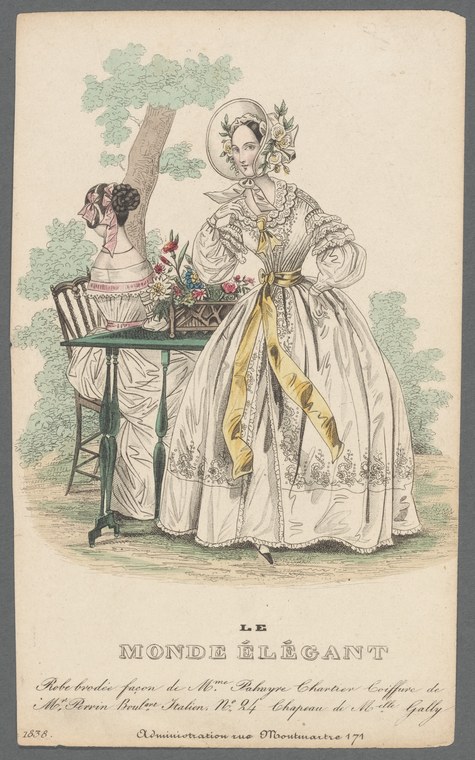
A young woman in elegant early 19th-century dress stands in an outdoor garden setting, posed in a moment of fashionable leisure. She wears a high-waisted white muslin gown with a fitted bodice and full skirt, accessorized with a gold sash or ribbon and an ornate bonnet tied under the chin. Her posture is graceful and composed, weight shifted slightly onto one leg in a refined stance. Behind her, a small table holds a potted plant or floral arrangement, and verdant foliage suggests a cultivated garden. The hand-colored engraving employs soft greens and golds to accent the composition, and the text at the base identifies this as "Le Monde Élégant" (The Elegant World), crediting the work to a fashion publication.
The dancing
A single standing figure, whose weight rests on one leg while the other extends slightly forward in a relaxed but controlled posture typical of Regency-era deportment. The arms hang naturally, with one hand visible at the side; the entire frame suggests ease and refinement rather than active movement. Her head is tilted slightly, gaze composed, presenting the figure as an object of observation rather than action. This is the vocabulary of fashion display—stillness elevated to an art form.
The dance depicted
This image does not depict active dance but rather the performative stillness of fashionable society in the Regency era. The stance and bearing, however, reflect the postural ideals that informed social dancing of the period: vertical carriage, controlled weight, and a sense of composure. The woman embodies the physical vocabulary of courtly Regency deportment, of which dancing—particularly the Quadrille or Cotillion—formed a natural extension. Her posture is closer to the promenade or presentation position of ballroom dance than to any actual choreography.
How it was made
This is a hand-colored engraving, a mass-produced reproductive technique common to European fashion plates of the 1820s–1830s. The fine linear work establishes form and detail, while watercolor or gouache adds selective color—particularly to the garment's ribbons, the bonnet trim, and the botanical background. The technique allowed rapid circulation of images to fashion-conscious audiences, typically appearing in fashion journals intended for the middle and upper classes. The inscription and publication details suggest this came from a serial publication, likely French, dedicated to contemporary styles.
About this work
This is a fashion plate from the Regency era, part of a print culture dedicated to disseminating elite styles of dress and deportment to a broad literate audience. It does not depict dance as action but as a set of postural values—the upright, composed, controlled body that Regency society demanded both in the ballroom and in public display. Fashion plates of this period are often overlooked as historical documents of dance, yet they recorded the physical ideals that shaped how dancers moved, held themselves, and were perceived. The woman's stance is that of an accomplished person of the era, and in a culture where dancing was central to courtship and social validation, such images implicitly advertised the wearer's fitness to dance.
How to look at it
Attend to the weight distribution and the angle of the supporting leg: this is not a static pose but a controlled moment between steps, the kind of graceful pause that the Regency ballroom demanded. Notice the height and angle of the head, the drape of the sash, the precise angle of the bonnet—every element is a display of restraint and refinement. The fashion plate freezes a moment of composed waiting, the stance from which a woman would rise to dance a Quadrille. The garden setting, though purely decorative, reinforces the idea that this is a woman of leisure and cultivation, attributes inseparable from dancing ability in her world.
The artist
The engraving is attributed to the publication *Le Monde Élégant* (also known as *Journal des Modes Galantes*), a French fashion periodical active in the 1820s–1830s. The artist is not recorded, as fashion plates of this era were typically unsigned collaborative products of design, engraving, and hand-coloring workshops. Such publications employed teams of draughtsmen and engravers to meet weekly or monthly deadlines.
The period
The 1820s–1830s were the mature Regency period, when Quadrille and Cotillion dominated the European ballroom, and when the Romantic ballet was emerging on the theatrical stage. In elite social life, dancing was inseparable from fashion—a woman's ability to move in a gown of this cut and weight was part of her social competence. Fashion plates were a new and powerful medium, allowing designs to circulate across Europe more rapidly than ever before. Simultaneously, the idealization of the upright, corseted female body in art and fashion was reaching its peak, and dance reflected and reinforced these aesthetic norms.
Where it lives
This is a print from the NYPL's collection of dance-related prints. It is catalogued simply as a French fashion plate, date unknown but stylistically datable to c. 1820–1835 based on the bonnet style, waistline, and engraving technique. No artist attribution is recorded.
Dance in this work
Questions about this work
Is this a dance image?
Not in the literal sense—no dance is in progress. But it is a record of how dancing bodies were expected to look and carry themselves. Fashion plates are documents of embodied culture, and in a society where dancing was central to social life, they tell us what the dancing body should look like at rest.
What period of fashion is this?
This is Regency or late Georgian fashion, c. 1820–1835. The high waistline, fitted bodice, full skirt, and style of bonnet are all consistent with this era. This is the dress in which women danced the Quadrille and Cotillion.
Why is the woman posed this way?
The pose is meant to display the cut and drape of the garment while also conveying grace, composure, and refinement—the qualities valued in a Regency woman. The slight forward extension of one foot hints at readiness and movement potential without breaking the pose. This is a moment of poised display, much like the promenade position in ballroom dancing.
More dance artwork





