49 works in this view — arrow keys or swipe to move between them.
Dance in Art
French fashion plates
Unknown artist
- Collection:
- Prints depicting dance
- Source:
- New York Public Library
- Rights:
- Public domain — free to use, share and adapt.
- Recorded as:
- Public Domain
For dance historians, fashion plates are invaluable documentary evidence of how bodies were dressed and postured during specific social dances—in this case, the waltz and cotillion period in Europe. The garments themselves constrained movement and communicated social status; understanding their construction helps explain the aesthetic and the physical experience of early 19th-century ballroom dance. This print is not about the choreography, but it reveals the material and visual world in which that choreography took place.
What you are looking at
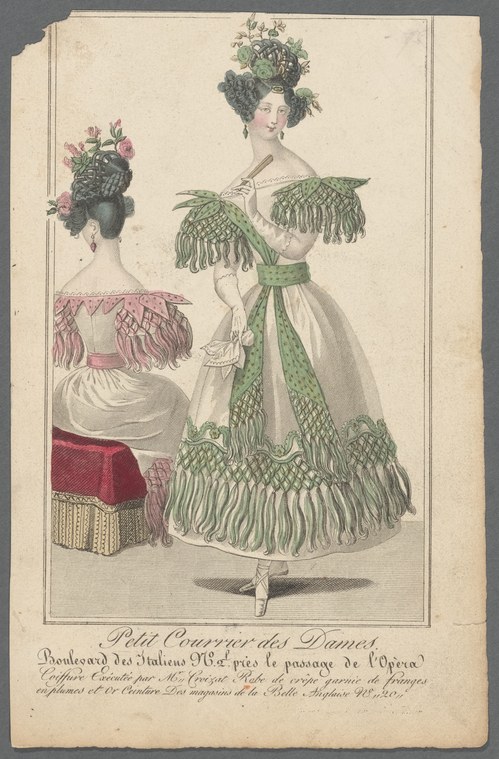
This is a hand-colored fashion plate showing two figures in early 19th-century ball dress, presented in the vertical format typical of periodical fashion illustration. The principal figure stands at center-right in a striking green silk gown with voluminous skirt and a dramatic high-waisted bodice; the sleeves are rendered as enormous, hanging fringed panels—a theatrical exaggeration that suggests the garment's ballroom function. Her dark hair is piled high and crowned with feathered ornament. At left, a smaller figure shown from behind wears a pale pink dress with a contrasting wine-colored velvet bow and similar fringed sleeve treatment, her hair also elaborately dressed. Both figures are poised as if in motion within a dance, the composition emphasizing the volume and movement of silk, the play of light across the fabrics, and the upright, elongated proportions of Regency fashion. A wine-colored cushioned footstool appears at lower left. The work is printed on laid paper with a narrow ruled border.
The dancing
Both figures stand in an upright, ballroom-ready posture with arms positioned to display the sleeve construction. The principal figure's body is set at a slight three-quarter angle suggesting forward motion or a turn; her companion is turned away, allowing the viewer to see the back of the elaborate coiffure and the fall of fabric. Neither figure bends or moves in a way that suggests active footwork—these are poses designed to exhibit the garment's structure rather than the body's movement. The composition treats the two figures as a visual pairing, possibly meant to show front and back views of the fashionable silhouette.
The dance depicted
This is a fashion plate rather than a documentary record of actual dance technique, but it depicts figures dressed for the ballroom in the Regency period (c. 1815–1820) when the waltz and cotillion were the dominant social dances. The exaggerated sleeve construction—the hanging fringed panels—is a fashionable conceit rather than functional dancewear, though the high-waisted Empire silhouette was indeed worn at balls. The upright posture and gentle S-curve of the torso are consistent with the carriage required for early 19th-century ballroom dance, where posture and deportment were paramount. The inscription below identifies this as a 'Petit Courier des Dames' plate, a French fashion journal, suggesting these are idealized costumes for ball attendance rather than records of specific choreography.
How it was made
This is a hand-colored engraving on laid paper, likely a wood or steel engraving given the fine line work and the date. The delicate parallel-line hatching visible in shadow areas is characteristic of engraving; the hand-coloring has been applied with watercolor or gouache in translucent washes. The fine detail and the careful registration of the colored layers suggest this was a commercial print of some quality, made for the periodical readership of the *Petit Courier des Dames*, a Parisian fashion journal aimed at women of means. The technique allowed for relatively rapid production and distribution of fashion plates, making this a form of visual media that circulated weekly or monthly and shaped contemporary taste in dress.
About this work
This is a Regency-era fashion plate from a French periodical, showing idealized ballroom dress c. 1815–1820. Although it documents fashion rather than dance technique, it is crucial evidence for understanding what dancers actually wore and how they were expected to carry themselves in the ballroom—upright, composed, and adorned with expensive silk and elaborate millinery. The exaggerated sleeves are a fashion fantasy, but the overall silhouette and posture are authentic to the period's courtship dances. The print's circulation in a popular journal means it reached a wide audience and shaped expectations about ballroom dress and deportment across Europe.
How to look at it
Look at the posture first: both figures stand upright and composed, with elongated spines and shoulders held back—the opposite of the modern body-forward stance. The exaggerated sleeve panels are not functional; they exist to display expensive silk and to create an impression of fragility and adornment. Notice how the engraver has used fine parallel lines to suggest the fall and fold of fabric and to model the form beneath; the hand-coloring applied afterward picks out the key colors and leaves much of the line-work visible. The small scale of the footstool and the way the figures are scaled against it are conventions of fashion-plate composition designed to make the garments appear as flattering as possible. This is not a moment of active dance, but a pose that shows off the entire silhouette.
The artist
This plate appeared in the *Petit Courier des Dames*, a Parisian fashion periodical founded in 1821 and published continuously into the 20th century. The journal commissioned hand-colored engravings from a stable of fashion illustrators, whose names were rarely recorded; the *Courier* itself is credited as publisher and editor. These prints were distributed to a fashionable European readership and were influential in setting ball-dress standards. The artistic conventions—the elongated proportions, the emphasis on textile display, the posed rather than dynamic composition—were standard to the genre and became familiar to anyone following fashion.
The period
In the 1810s–1820s, the waltz was displacing the contredanse and cotillion as the fashionable ballroom dance across Europe, and with it came changes in ballroom costume and carriage. The high-waisted Empire silhouette, worn here, was the dominant style for women's dress, and ballroom versions in silk, gauze, and net were far more expensive and refined than everyday wear. Fashion plates of this period were the primary medium through which new ballroom dress was circulated and adopted; they also served as visual standards for deportment and posture, encoding ideal femininity and marriageability. The *Petit Courier des Dames* was part of a broader explosion of fashion journalism in post-Napoleonic France, which reasserted Paris as the arbiter of elegant taste.
Where it lives
This print is part of the New York Public Library's collection of prints depicting dance, acquired as part of their holdings in fashion and social history. The inscription and style identify it as a plate from the *Petit Courier des Dames*, a French periodical; the New York Public Library holds a substantial run of this journal.
Dance in this work
Questions about this work
What dance is being shown here?
No specific choreography is depicted. The figures are posed to display ballroom costume, not to show technique or steps. However, the posture and dress are consistent with the waltz and cotillion as danced in the Regency period (c. 1815–1825). Fashion plates were not movement documents; they were advertisements for dress.
Could someone actually dance in those sleeves?
The enormous hanging fringed panels shown here are an exaggeration for visual effect. The actual sleeves of ballroom gowns from this period were shorter and less extreme, though they did emphasize the shoulders and upper arm. The fashion plate prioritizes the striking silhouette over practical movement.
What is the Petit Courier des Dames?
It was a French fashion and society journal founded in 1821 and published continuously throughout the 19th century. Each issue included hand-colored fashion plates, articles on dress, and reports from the ballroom and theater. It was influential across Europe and a primary means by which Parisian fashions reached other cities.
Why are there two figures shown together?
Fashion plates often showed variations of the same garment or silhouette from different angles—front, back, or three-quarter view. Here, the two figures likely represent a coordinated look or variations on the same high-waisted ball dress, allowing the viewer to see how the garment sat on the body from multiple sides.
More dance artwork





