49 works in this view — arrow keys or swipe to move between them.
Dance in Art
French fashion plates
Unknown artist
- Collection:
- Prints depicting dance
- Source:
- New York Public Library
- Rights:
- Public domain — free to use, share and adapt.
- Recorded as:
- Public Domain
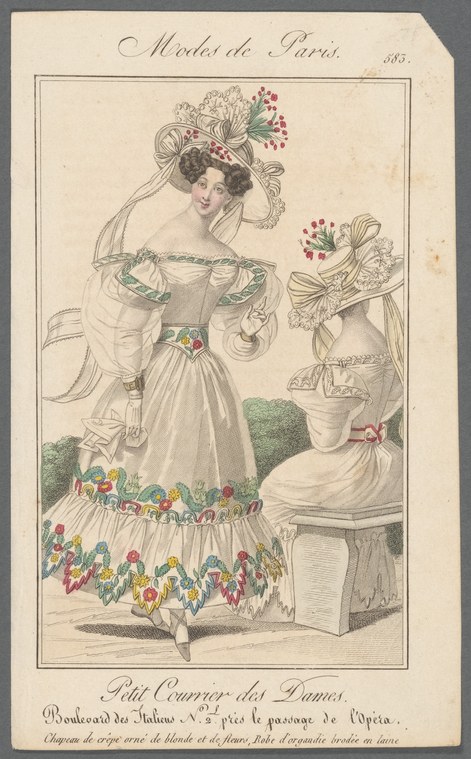
This plate documents the visual and postural ideal that governed women's participation in early 19th-century ballroom culture. The figure's open frame, extended arms, and refined deportment show us the aesthetic of grace and display that structured social dance in the Regency and Romantic periods—a visual grammar that dancers and choreographers of the era would have learned and embodied. As a commercial fashion image, it also reveals how dance postures and courtly bearing were commodified and circulated as markers of social class and desirability.
What you are looking at
A fashionable woman in Parisian haute couture stands in a three-quarter pose, displaying an elaborate early 19th-century gown. The dress features a high Empire waistline with a fitted bodice in pale silk or muslin, and a dramatically full skirt decorated with a dense flounce of colorful flowers—reds, yellows, blues, and greens—at the hem. She wears her dark hair swept up and crowned with an enormous feathered headdress of peonies or similar blooms. The woman holds a fan in one gloved hand and gestures gracefully with the other, her pose suggesting movement and refinement. To her right stands a smaller figure (possibly a maid or attendant) wearing similar but simpler dress, also adorned with flowers. The setting is spare: a classical vase or urn sits at table height, and the figures are framed by a neat border line. The hand-coloring is delicate, applied to an engraved line drawing, with careful attention to fabric texture and botanical detail.
The dancing
The primary figure stands in a relaxed, asymmetrical stance with weight settled into her hips, suggesting ease rather than tension. Her arms are held away from the body—one raised gently, the other extended to hold a fan—in the open, extended frame typical of social dance presentation. Her head tilts slightly, and her gaze is directed outward and downward with refinement. There is no suggestion of active footwork or the closed holds and frame of partner dance; instead, the pose resembles a tableau vivant or a display position used to showcase garments and deportment. The smaller attendant figure mimics this graceful stance in miniature.
The dance depicted
This is not a depiction of dance in motion but rather a fashion plate—a commercial illustration of dress and deportment. The pose and presentation conventions recall the ballroom manners and promenade attitudes of the Regency and early Romantic periods (circa 1810–1825), when young women were displayed in fashionable dress at social assemblies. While the figure's posture and gesture vocabulary draw from the refined presentation codes of courtly and ballroom culture, the work documents fashion and etiquette rather than a specific dance form. The emphasis on flowers, silks, and ornament signals the commercial purpose: to present an ideal of beauty and luxury to potential buyers or admirers of Paris fashion.
How it was made
This is a hand-colored engraving, identifiable from the fine black line work and the careful hand-application of watercolor or gouache wash. The precision of the engraved line—especially in the fabric folds, the botanical forms of the flowers, and the delicate facial features—indicates professional engraving, likely from a copper plate. The title "Modes de Paris" and the inscription at the base ("Petit Courrier des Dames" and references to the passage de l'Opéra) indicate this was produced for commercial circulation as a fashion journal, probably issued serially. Hand-coloring made each print unique and allowed for the subtle gradation of hue essential to fashion marketing; the technique was laborious but economical compared to color printing, making it ideal for high-end periodicals aimed at wealthy readers and dressmakers.
About this work
This is a fashion plate from the Parisian journal *Petit Courrier des Dames* (circa 1830s), documenting the silhouettes, ornaments, and bearing of Regency and early Romantic-era fashion. The work sits at the intersection of fashion history and social dance—while not depicting dance itself, it illustrates the posture, gesture, and presentation codes that governed women's public display in the ballroom and at social assemblies of the period. The hand-colored engraving is a primary document of how women were expected to move, stand, and present themselves in society, and the emphasis on flowers, lightness, and graceful extension reflects the aesthetics of Romantic-era ballroom culture. In a dance history collection, it serves as evidence of the embodied norms that framed social dancing of the era.
How to look at it
Attend to the figure's posture and the careful positioning of her limbs: the openness of the frame, the gentle extension of the arms, the lift of the head. These are not the positions of a person in motion but of someone presenting herself—displaying fabric, ornament, and bearing. Notice how the artist has frozen a moment of social display rather than active dancing. The floral ornament at the hem and in the headdress is not decorative accident but the focus of the composition; the figure's pose is designed to show off these costly flowers. The small scale and the fine line work indicate this was meant to be studied closely, probably with a magnifying glass, by potential buyers or dressmakers copying the design.
The artist
The engraver and colorist are not recorded in the catalogue. The plate was produced for *Petit Courrier des Dames*, a Parisian fashion journal established in the 1820s and known for high-quality hand-colored engravings that set and reflected trends in elite women's fashion. Fashion plates of this caliber required both skilled engravers and trained colorists; while individual attributions are often lost, the work reflects the professional standards of Parisian fashion publishing at its height.
The period
This plate dates to the 1830s, at the height of Romantic-era fashion and in the decades when Romantic ballet was emerging (the premieres of *La Sylphide* and *Giselle* would follow in 1832 and 1841). The lightness, verticality, and emphasis on flowers in the dress—and the woman's open, extended posture—reflect the aesthetic values of Romanticism: ethereality, refinement, and a fantasy of nature as ornament. In dance, these same values were manifest in the new pointe technique, the diaphanous tutus, and the sylph-like heroines of Romantic ballet. In fashion, they appeared as Empire waistlines, high skirts, and the profusion of floral ornament seen here. The *Petit Courrier* was aimed at wealthy women and dressmakers who aspired to Paris fashion, making it a vector for these aesthetic ideals across Europe.
Where it lives
This work comes from the New York Public Library's collection of prints depicting dance. It is a page or plate from *Petit Courrier des Dames*, a Parisian fashion journal of the 1820s–1840s. Fashion plates such as this were produced serially, often hand-colored to order, and circulated among wealthy subscribers and the fashion trade.
Dance in this work
Questions about this work
Is this a picture of someone dancing?
No—this is a fashion plate, a commercial illustration created to display dress and deportment. The pose and bearing reflect the aesthetic standards of ballroom culture, but the figure is in a display position, not dancing. The work documents how women were expected to stand and move in fashionable society of the 1830s.
Why is there so much floral ornament?
Flowers were expensive luxury ornaments in the 1830s, applied fresh to gowns for grand occasions or reproduced in silk for everyday wear. A profusion of flowers signaled wealth and fashion-forward taste. The artist has made the flowers the focal point of the composition to emphasize their desirability to potential buyers.
What does the pose tell us about dance of the era?
The open frame, extended arms, and lifted bearing reflect the aesthetic and postural codes of Regency and Romantic ballroom culture. Women were trained to stand and move with this refined, extended posture—lightness, verticality, and open arms were markers of elegance and social status. This pose would have been familiar to anyone who attended assemblies or dances.
Who made this and how?
The engraver and colorist are not recorded. The plate was produced professionally for *Petit Courrier des Dames*, a Parisian fashion journal. It is an engraving hand-colored with watercolor or gouache—a labor-intensive process that made each print slightly unique and allowed for the subtle gradations of color essential to fashion marketing.
More dance artwork





