49 works in this view — arrow keys or swipe to move between them.
Dance in Art
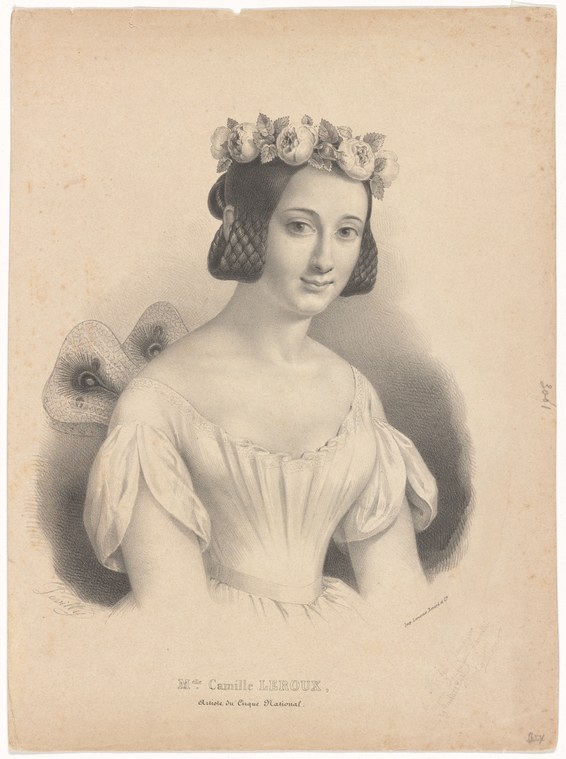
Melle. Camille Leroux, artiste du Cirque National
Unknown artist
- Collection:
- Prints depicting dance
- Source:
- New York Public Library
- Rights:
- Public domain — free to use, share and adapt.
- Recorded as:
- Public Domain
Circus performance and aerial acrobatics are often overlooked in histories that privilege ballet and theatrical dance, yet they were major venues for dance innovation and female professional employment in the 19th century. This image documents the appearance and costume conventions of a professional female performer whose work fell outside the ballet theater but was central to popular entertainment. It is one of relatively few surviving portraits of non-ballet dancers from this period.
What you are looking at
A young woman is shown in a three-quarter bust portrait against a neutral ground. She wears a pale, loosely gathered chemise or tunic with short puffed sleeves that slip off the shoulders in the Romantic fashion. Her dark hair is parted in the center and pulled back, decorated with an elaborate floral wreath or crown of white and pale flowers; a dark netted snood or hairnet contains the hair at the back. Large decorative elements resembling plumed or fanned ornaments flank her shoulders—these appear to be theatrical wing pieces or augmented costume details rather than natural accessories. The image is rendered as a lithograph or engraving in tones of gray and black, with skilled use of shading to model the face and fabric. The work is inscribed at the base with the sitter's name and profession.
The dancing
The figure is posed in a relaxed, three-quarter stance with head turned slightly toward the viewer. The shoulders are soft and dropped, the neck elongated. The arms are not visible, suggesting they fall outside the frame or are hidden by the composition's cropping. The overall carriage is graceful and passive rather than dynamic—this is a studio portrait pose rather than a moment of active dance.
The dance depicted
The inscription identifies the subject as Mlle. Camille Leroux, artiste du Cirque National (artist of the National Circus). The theatrical wing pieces and elaborate floral headdress are consistent with early-to-mid 19th-century circus costuming, particularly for aerial or acrobatic performers. However, the portrait does not depict Leroux in action; it is a formal commemorative image. The costume details—the romantic tunic, wreath, and especially the prominent wing or fan elements—suggest she may have performed aerial dance or acrobatic acts, genres that were spectacular attractions in the circus and early theatrical venues of the Romantic era.
How it was made
This is a lithograph or engraving, likely produced in the 1840s–1850s based on stylistic and dress conventions. The technique allows for fine detail in the rendering of fabric texture and facial features, with skilled halftone shading creating volume and light. The medium was ideal for theatrical promotion and circulation—such prints were sold individually to audiences and collectors, creating portable mementos of performers. The print's finish and the formal inscription suggest it was a professional theatrical portrait sold through commercial channels.
About this work
This is a theatrical portrait of a professional circus performer working in France during the Romantic period. Mlle. Leroux was employed by the Cirque National, an institution that presented acrobatics, pantomime, and aerial spectacles alongside traditional circus acts. The elaborate costume and wing pieces indicate she was a specialty performer, likely in aerial or dance-acrobatics, which were major attractions in early-19th-century circus entertainment. The portrait captures not a moment of performance but the cultivated visual identity of a professional entertainer—the idealized image she was contracted to present to her public.
How to look at it
Attend to the costume details: the puffed sleeves and gathered chemise were standard in Romantic-era female theatrical dress, but the large fanned or winged pieces flanking the shoulders are specialized elements suggesting aerial or acrobatic work. The floral crown is both a romantic aesthetic convention and a practical theatrical ornament. The pose is deliberately static and frontal—a portrait convention—but notice how the artist has emphasized the graceful line of the neck and the soft, elongated proportions of the body, qualities valued in early 19th-century dance and acrobatics. The face is rendered with careful attention to beauty and youth, reflecting the commercial nature of theatrical promotion.
The period
The 1840s–1850s saw the rise of permanent circus institutions in Europe, especially in France, where the Cirque National and Cirque Olympique competed for audiences with acrobatics, pantomime, and aerial performances. The Romantic era valorized spectacle, exoticism, and technical virtuosity; costume became increasingly elaborate and theatrical. Aerial arts and acrobatics were feminized and eroticized for audiences; female performers in circus and theater wore revealing, Romantic-era costume—the chemise, the floral headdress, the decorative wing or fan pieces seen here. This portrait sits at the intersection of theatrical commerce (sold as a keepsake), Romantic aesthetics (the flowers, the soft draping, the idealized beauty), and circus spectacle (the specialized costume, the formal naming of the venue).
Where it lives
Held in the New York Public Library's collection of prints depicting dance. This is a commercial theatrical portrait, one of many produced for circulation among audiences and collectors during the heyday of Romantic-era circus and theater.
Dance in this work
Questions about this work
What was the Cirque National?
The Cirque National was a circus institution in 19th-century France that presented acrobatics, pantomime, aerial acts, and equestrian performances. It competed with other venues like the Cirque Olympique for audiences and was a major employer of specialist performers.
What do the wing-like pieces mean?
These appear to be costume ornaments or augmented theatrical pieces, possibly indicating Leroux performed aerial dances, flying trapeze acts, or acrobatic feats requiring harnesses or special effects. Such elements were common in circus costuming to signal the nature of the performance.
Why is this a dance image if she's not dancing?
Dance history includes not just movement but the visual culture surrounding dancers and performers—their costumes, their professional presentation, and their place in entertainment. This portrait documents a performer's public image and the conventions of Romantic circus costume.
Who made this print?
The catalogue record does not identify the artist. The print was likely created by a commercial lithographer or engraver in Paris, working from a studio sitting or earlier portrait. Such prints were typically unsigned or bore only the printer's mark.
More dance artwork





