49 works in this view — arrow keys or swipe to move between them.
Dance in Art
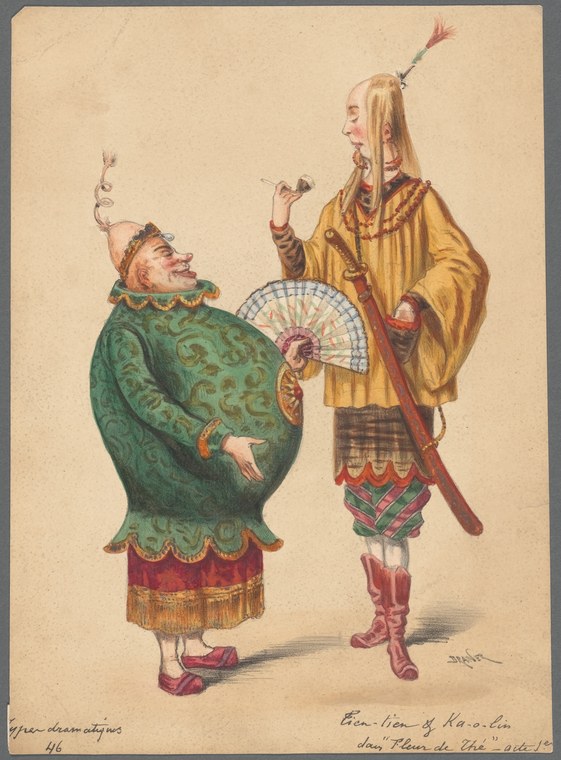
Tien-tien & Ka-o-lin dans 'Fleur de Thé' acte 1e
Unknown artist
- Collection:
- Prints depicting dance
- Source:
- New York Public Library
- Rights:
- Public domain — free to use, share and adapt.
- Recorded as:
- Public Domain
This work captures a moment when European theatre was reshaping itself through encounters with Asian visual culture. For historians of theatrical dance and pantomime, it documents how costume, character, and musical performance were integrated in narrative theatre of the period, and how non-European traditions were imagined and adapted for European stages.
What you are looking at
Two figures in elaborate East Asian theatrical costume stand face-to-face in conversation or confrontation. The figure on the left wears a rich green robe with ornamental patterning and a red underskirt with gold trim, holding a decorative fan; their head is tilted upward in animated expression. The figure on the right wears a mustard-yellow tunic with vertical striping over patterned lower garments and red boots, with a long feathered headdress or hair ornament extending upward; they hold what appears to be a small pipe or musical instrument to their mouth. Both figures have stylized, expressive faces rendered in profile or three-quarter view. The composition is spare—no background, no setting—placing entire focus on the figures' postures, costumes, and the interaction between them. The drawing style is delicate and colored in soft washes, with careful attention to textile pattern and ornament.
The dancing
Both figures stand upright with animated upper-body engagement. The left figure's head is thrown back slightly, mouth open as if speaking or singing, with the fan held at mid-chest. The right figure leans slightly forward with the instrument raised to the mouth, suggesting the production of sound or music. Neither figure shows obvious weight shift or footwork; the focus is on the theatrical presentation of character and costume rather than on locomotion or step patterns. The two are positioned to relate directly to one another, as if in dialogue or performance exchange.
The dance depicted
This is almost certainly a scene from a theatrical performance rather than social dance. The title 'Fleur de Thé' (Tea Flower) and the named characters Tien-tien and Ka-o-lin suggest a narrative work, likely a pantomime or musical theatre piece with Asian subject matter or setting. The elaborate costumes, the presence of a musical instrument, and the theatrical posturing point to East Asian operatic or dramatic traditions—possibly Chinese opera or a European work inspired by or depicting Asian characters. Without more documentation, the specific style cannot be confirmed, but the work is clearly theatrical and character-driven rather than based in any codified dance vocabulary.
How it was made
This is a watercolour or gouache drawing on paper, rendered in a style consistent with late 19th-century theatrical design practice. The delicate color washes, the careful line work defining costume detail, and the economical composition suggest this is a costume study or character design drawing—the kind of work an artist or costume designer would produce to document or propose a character for performance. The technique allows for rapid iteration and clear communication of color and silhouette, and implies circulation among theatre practitioners rather than a broad public.
About this work
This is a costume design or character study for a theatrical work titled 'Fleur de Thé,' depicting two named characters in elaborate East Asian-inspired dress engaged in a moment of performance or dialogue. The image belongs in a gallery of dance in art as a record of theatrical costume and character presentation in the late 19th century, when European theatre was intensely engaged with Asian aesthetics and subjects. It documents not dance technique but the visual framing of character through dress, posture, and stylized facial expression—core elements of theatrical presence.
How to look at it
The artist has chosen a moment of heightened character expression and interaction rather than a moment of movement or dance step. Look at the way costume announces character: the structured formality of the left figure's wrapped robe and fan versus the warrior-like suggestion of the right figure's tunic and feathered headdress. The open mouth and animated head position of the left figure, contrasted with the focused instrumental posture of the right, suggest a scene of musical or verbal exchange—a theatrical moment frozen to communicate character type and dramatic content.
The artist
The artist's name is not recorded. The drawing appears to be a professional theatrical design study, executed in a style consistent with late 19th-century European theatre practice. The confidence and specificity of the costume rendering and the presence of character names suggest the artist was working within a theatre company or for a known production, but no further attribution can be made from the image alone.
The period
This work dates to an era when European interest in Asian art, design, and performance was at a peak. The 1870s–1890s saw intensive engagement with Japanese prints, Chinese and Japanese ceramics, and Asian theatrical forms; this fed into aestheticism, art nouveau, and the broader remaking of Western theatre. Simultaneously, European theatre companies were producing works with Asian settings and characters, often for comic or exotic effect. 'Fleur de Thé' appears to sit within this complex exchange—a European theatrical piece with Asian characters and aesthetics.
Where it lives
The work is held in the New York Public Library's Prints collection, catalogued as a print depicting dance. The inscription on the verso names the characters and work and appears to document a specific performance or design concept.
Dance in this work
Questions about this work
Is this a dance work?
Not in the technical sense of choreographed steps or recognizable dance vocabulary. It is a theatrical character study, documenting costume and dramatic posture within a narrative performance. It belongs in a dance collection because theatrical dance and pantomime of the period depended on exactly this kind of stylized character presentation and costume design.
What is 'Fleur de Thé'?
The title translates as 'Tea Flower' and appears to name a theatrical work, likely a pantomime or musical theatre piece with Asian characters or setting. Without further documentation, the genre and date of the original work cannot be confirmed.
Why are the costumes so elaborate?
In 19th-century theatre, costume communicated character type immediately to the audience. The ornament, color, and silhouette of the garments shown here would have signaled social status, character type, and possibly nationality or cultural identity to a theatre audience familiar with the conventions of the time.
More dance artwork





