49 works in this view — arrow keys or swipe to move between them.
Dance in Art
Désiré, rôle de [text trimmed off]
Unknown artist
- Collection:
- Prints depicting dance
- Source:
- New York Public Library
- Rights:
- Public domain — free to use, share and adapt.
- Recorded as:
- Public Domain
For dance historians, this image is evidence of how theatrical dance and character roles were transmitted and standardized across Europe in the early modern period—not through notation, but through visual costume documentation that made the character immediately legible. The care lavished on the brocade, the symbolic staff, and the exaggerated facial expression shows how much of theatrical dance's meaning came from visual spectacle, costume, and character type rather than from technical footwork.
What you are looking at
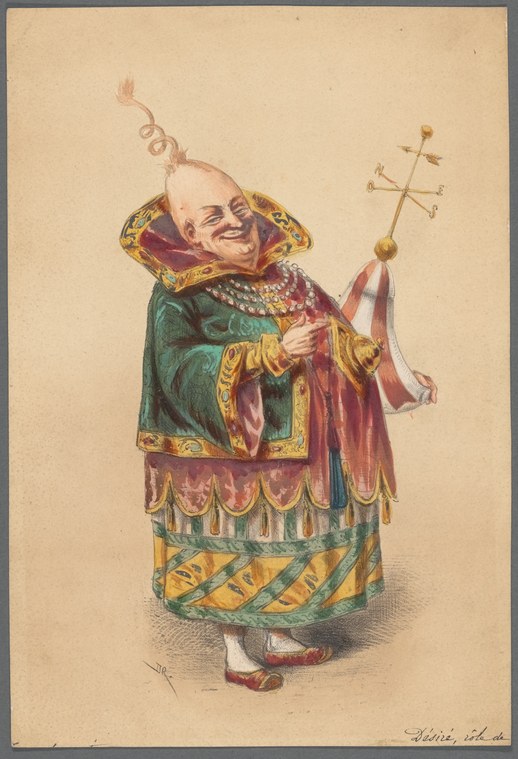
A single figure dominates the composition against a pale cream background: a stout, round-faced character with an exaggerated grin, bald head topped with a spiraling ornament that curls upward. The figure wears an elaborate theatrical costume of deep green and rich purple, with gold brocade trim, a high decorated collar, and ornate sleeves. The garment extends to the ankles in a dramatic skirt with scalloped hem edges in alternating colors, patterned with geometric designs in gold. Below, red stockings and red shoes are visible. The figure holds aloft in the right hand a staff topped with a cross symbol and ribbons in pink and red, rendered with energetic movement. The costume and bearing suggest a character role from commedia dell'arte or European carnival tradition—a figure of authority, wisdom, or mockery.
The dancing
The single standing figure is rendered in three-quarter view, turned slightly toward the viewer's right. The body is stout and settled, without significant weight shift or extension, suggesting a posed moment rather than active locomotion. The right arm is raised and extended, holding the staff with apparent vigor; the left arm hangs at the side. The facial expression—open-mouthed grin—and the frontal, presentational posture suggest address to an audience rather than interaction with another dancer.
The dance depicted
This is a costume study or theatrical character portrait rather than a depiction of active dance. The figure represents a stock character role—likely a fool, magician, or authority figure from commedia dell'arte or 18th-century carnival theater. The title fragment "Désiré, rôle de" indicates this is a named character role. The costume's theatrical elaboration, the formal presentation pose, and the absence of a partner or setting suggest this is documentation of a performer's costume and character type, possibly from a known production or a type-figure recognizable to contemporary audiences. This is costume documentation first and dance documentation second.
How it was made
This appears to be a colored engraving or lithograph, likely hand-tinted or hand-colored, produced in the 18th or early 19th century. The fine linear work, the delicate modeling of the face, and the precision of the gold-brocade pattern suggest engraving; the soft color gradations in the garment suggest hand-coloring over a printed foundation. The technique allowed for reproducibility and distribution of costume designs and character types to a wide theatrical audience—performers, company managers, and cognoscenti could circulate images to understand the visual conventions of known roles.
About this work
This is a costume portrait of a named theatrical character, Désiré, rendered as a single standing figure in elaborate early modern theatrical dress. The work documents a specific character type from the commedia dell'arte or carnival theater tradition, showing the visual language of European theatrical costume in what appears to be the 18th century. Rather than depicting a moment of choreographed movement, it serves as a record of costume, character, and the presentational conventions of a stock role—essential visual information for any actor, director, or theater-goer of the period who would recognize the costume and bearing as markers of a known character with established narrative and comic function.
How to look at it
Look first at the costume's construction—the layering of colors, the geometric patterning, the way the brocade draws attention to the torso and the dramatic scalloped hem. The staff held high is a prop that signals authority or magic; the ascending spiral ornament on the head and the grinning face complete a portrait of a figure designed to be immediately readable to an audience. The full-frontal, slightly theatrical stance—not quite still, not quite moving—is itself a convention of character portraiture: the performer is presenting the role, not enacting a narrative moment. The pink and red ribbons streaming from the staff suggest movement and theatricality, even within the stasis of the pose.
The artist
Unknown. The hand signature visible in the lower right corner is not fully legible in this reproduction. The print's style and finesse suggest a professional theater illustrator or costume designer working in the 18th or early 19th century, likely in France or a French-influenced court, given the French title and the costume's elegance. Such prints were often created by theater companies or published as series to document repertory and costume standards.
The period
This work belongs to the tradition of commedia dell'arte character documentation, which flourished in European theatrical culture from the 16th into the 19th century. In the 18th century, as theatrical dance became increasingly formalized and ballet companies standardized their costume and character vocabularies, such prints served an archival function—they recorded what "Désiré" looked like, what he wore, how he presented himself. The tradition of the character role, with its exaggerated costume, stock gestures, and predictable narrative function, remained central to theatrical entertainment even as ballet technique evolved. This print sits at the intersection of folk carnival tradition and courtly theater spectacle.
Where it lives
The work is held in the New York Public Library's collection of prints depicting dance. It is a loose item within that collection rather than part of a bound album or series, suggesting it was either a standalone circulation piece or part of a now-dispersed series.
Dance in this work
Questions about this work
Is this a real dance, or a costume for a character role?
It is costume documentation for a character role—a stock figure from commedia dell'arte or carnival theater tradition. The title tells us the character was called Désiré, and the print serves as visual reference for performers, directors, and audiences. Dance of the period mixed social dances with theatrical character roles; this is the theatrical end of that spectrum.
What does the spiral thing on his head mean?
It is likely a symbol of magic, foolishness, or elevated status—a visual marker to make the character immediately legible. In commedia dell'arte and carnival theater, such ornaments signaled the character type and set up audience expectations about how the figure would behave and what comic or magical role he would play.
Who was the performer?
The print does not identify the performer, only the character name, Désiré. Such prints often recorded the role, not the individual, so the same character could be performed by different actors, and the visual type would remain recognizable across productions and across time.
More dance artwork





