49 works in this view — arrow keys or swipe to move between them.
Dance in Art
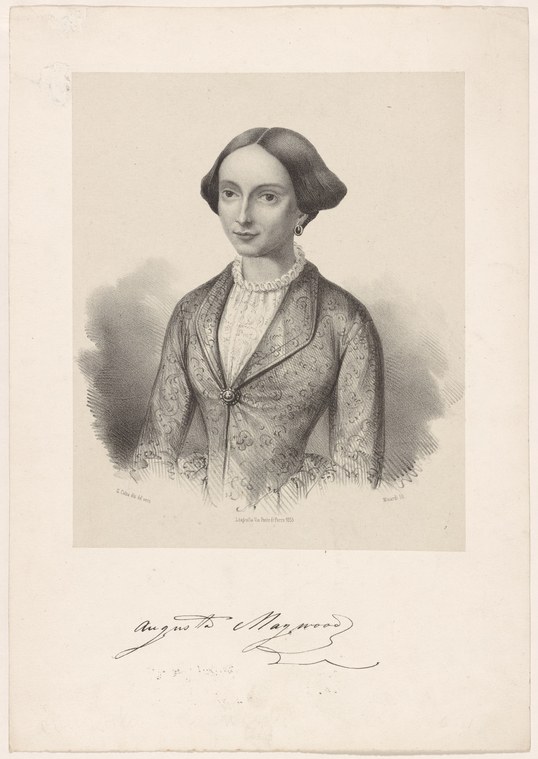
Augusta Maywood [fac. sig.]
Unknown artist
- Collection:
- Prints depicting dance
- Source:
- New York Public Library
- Rights:
- Public domain — free to use, share and adapt.
- Recorded as:
- Public Domain
Maywood was a pioneering figure in American dance history, among the first women born in the United States to command an international career as a prima ballerina. This portrait is a rare visual record of her public persona during an era when most documentation of dancers comes from theater programs, reviews, and the memories of contemporaries.
What you are looking at
A three-quarter-length portrait of a young woman, shown from approximately the waist up, against a plain background with subtle shading that suggests depth. She wears a tailored jacket or bodice of patterned fabric, ornately detailed with what appears to be embroidery or jacquard work, worn over a white blouse with a high neckline and a pearl or beaded choker. Her dark hair is parted in the center and swept back in the fashion of the mid-nineteenth century, framing a composed, forward-gazing face. The portrait is executed as an engraving or lithograph in black and white, with careful cross-hatching to model form and fabric texture. A signature in script appears below the image, and the work is presented as a formal commemorative print—the kind used to document notable performers of the period.
The dancing
The subject is stationary in a conventional portrait pose, not actively dancing. Her posture is upright and formal, with shoulders squared to the viewer. Her arms are not visible below the waist, and nothing in her stance or bearing conveys movement or the physical preparation of a performer in motion. The image documents her identity and costume rather than capturing a moment of performance.
The dance depicted
This is a portrait of a dancer—the inscription identifies her as Augusta Maywood, a celebrated ballerina of the Romantic era. She was known for her roles in classical ballet and her international career spanning Europe and the Americas. The image itself does not show her dancing; it is a formal portrait intended to document her likeness and her public identity. The ornate jacket suggests either stage costume or the fashionable dress of a woman of artistic prominence in the 1840s–1850s.
How it was made
This is a black-and-white engraving or lithograph, likely created from a painted original. The technique allows for precise rendering of detail—particularly evident in the patterned fabric and the modeling of the face—and the print format made it reproducible and widely distributable. Such prints were common currency in the theater world of the nineteenth century, circulated as souvenirs, advertisements, and biographical documents to establish a performer's public image.
About this work
Augusta Maywood (c. 1821–1876) was one of the first American-born ballerinas to achieve international stardom, performing in Philadelphia, New York, Paris, London, and across Europe. This engraved portrait preserves her likeness during the height of her career in the Romantic ballet era. The image belongs in a dance collection not as evidence of a specific dance or technique, but as a document of the theatrical infrastructure and star system of nineteenth-century ballet—the way dancers were marketed, remembered, and mythologized in the public imagination.
How to look at it
This is not a representation of dance itself, but a portrait designed to capture the public identity of a performing artist. The viewer should attend to the evidence of costume and status—the ornate fabric, the careful grooming, the formal composition—as markers of Maywood's standing as a celebrated performer. The quiet, composed expression is characteristic of Romantic-era portraiture, presenting the subject as a figure of artistic authority rather than as a physical virtuoso.
The artist
The engraver is not recorded in the catalogue. The signature below the image is in a hand consistent with mid-nineteenth-century theatrical prints, but the artist's identity would require reference to print archives or theater history resources. The work is typical of the commercial print industry that served the nineteenth-century theater world.
The period
Maywood's career flourished during the height of Romantic ballet, an era (roughly 1830–1870) when the art form was dominated by female dancers and when European and American performers achieved celebrity status comparable to opera singers. The print medium was the primary way such fame was distributed before photography became widespread; engravings and lithographs of famous dancers were sold to the public as collectible souvenirs. Maywood's success in this market was part of a larger shift in which dance began to establish itself as a legitimate theatrical and commercial enterprise in the United States.
Where it lives
The work is held in the New York Public Library in its collection of prints depicting dance. It is catalogued as a theatrical portrait, a common genre within nineteenth-century print production.
Dance in this work
Questions about this work
Who was Augusta Maywood?
Augusta Maywood (c. 1821–1876) was an American ballet dancer and one of the first native-born U.S. performers to achieve international stardom. She danced in major European and American cities and was celebrated for her roles in Romantic ballet classics. She is historically significant as a pioneer of American dance abroad.
Is this image showing her dancing?
No. This is a formal portrait documenting her likeness and public identity. It is a commemorative print of the kind circulated by and for the theater industry in the nineteenth century, similar to celebrity photographs today.
What is the signature below the image?
The signature reads 'Augusta Maywood' and is part of the print's caption, identifying the subject. The engraver's name is not recorded in the catalogue.
When was this print made?
The date is unknown, but based on Maywood's career timeline and the style of fashion and engraving, it was likely created in the 1840s or 1850s, during the peak of her fame.
More dance artwork





