49 works in this view — arrow keys or swipe to move between them.
Dance in Art
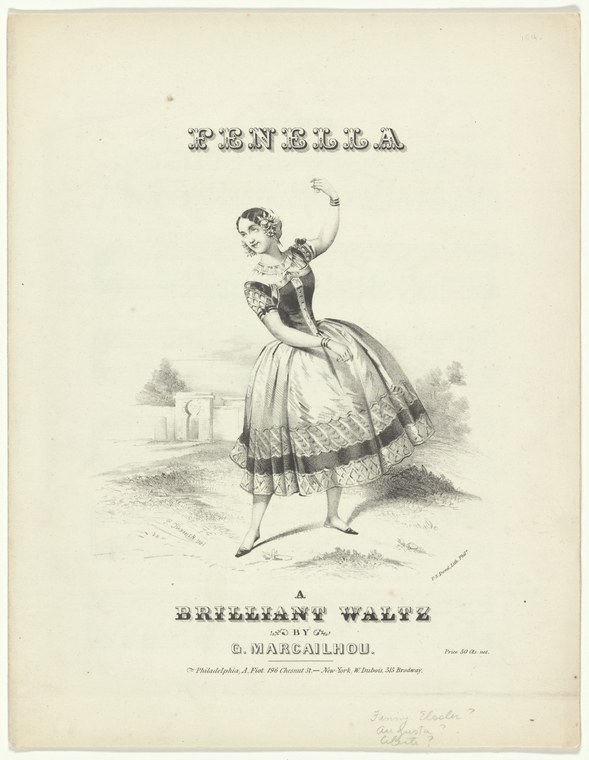
Fenella: a brilliant waltz
Unknown artist
- Collection:
- Prints depicting dance
- Source:
- New York Public Library
- Rights:
- Public domain — free to use, share and adapt.
- Recorded as:
- Public Domain
This is a primary source for understanding how the Romantic-era waltz was taught and visualized in the mid-nineteenth century. It preserves the standard of posture, arm placement, and turning technique that defined the dance in its era of greatest popularity. Images like this circulated widely in sheet music and instruction manuals, making them a reliable guide to how ordinary dancers (not theatrical professionals) were expected to move.
What you are looking at
A young female dancer in a full-skirted dress dominates the composition, positioned slightly left of center in a dynamic, turning pose. Her body is captured mid-motion, the left arm raised gracefully while her right arm extends across her body, and her head turns to follow the movement. The skirt—rendered in fine cross-hatching with a deep patterned border—swirls around her, its hem and lower panels darkly shaded to suggest volume and lift. She wears a fitted dark bodice with short off-shoulder sleeves trimmed in light fabric, and her hair is arranged in the neat, close curls typical of the 1840s. Behind her, in soft focus, stand simple classical structures—columns or pillars—and trees, suggesting either a park, temple portico, or theatrical set. The ground is indicated by light shading beneath her feet. The entire image is rendered in fine line work and stipple, characteristic of hand-engraved or lithographed reproductive technique.
The dancing
A single dancer is shown in three-quarter turn, her weight concentrated on her right leg while the left appears to be raised or extended. Her raised left arm is bent at the elbow and held at roughly shoulder height; her right hand rests near her waist or chest. The pose suggests a moment of pivoting or spinning—the instant where momentum carries her upright through the turn. Her shoulders are open to the viewer, her gaze directed to her left. The overall frame is that of a woman executing a controlled, upright turn with arms arranged for balance and grace rather than extended presentation.
The dance depicted
The title identifies this as a waltz composed by C. Marcailhou, and the pose is consistent with a turning figure in the Romantic-era waltz. The single dancer, the three-quarter spin, the upright carriage, and the period dress all point to social ballroom waltz of the 1840s. Waltzes were typically danced in couples, but single-figure illustrations of waltzing women were common in sheet music and dance instruction materials to show the essential movement and deportment. The pose captures the turning action that was fundamental to the waltz—continuous rotation around the room performed in a closed hold. This appears to be a promotional or instructional image rather than a narrative scene.
How it was made
This is a hand-colored or tinted engraving or lithograph, executed in fine line work with stippled shading, typical of reproductive prints from the 1840s. The technique allowed for mass production and wide distribution, making it affordable for sheet music covers, dance instruction books, and parlor prints. The careful attention to the patterning of the skirt and the subtle modeling of the fabric through hatching demonstrates skilled reproductive engraving. The print's small format and its inscription as the cover for a published waltz suggest it served both promotional and instructional purposes.
About this work
"Fenella: a Brilliant Waltz" is a sheet-music cover or promotional print depicting a solo female dancer in the act of turning—the central figure of a ballroom waltz as performed and understood in the 1840s. The image is in the tradition of Romantic-era dance representation: a single, elegantly dressed young woman shown executing the essential movement of the dance, without a partner present. The composition, costume, pose, and print technique all locate the work firmly in the commercial dance culture of the mid-nineteenth century, when the waltz was at the height of its fashionable dominance in European and American ballrooms. The print would have circulated as sheet music, serving as both advertisement for the composition and a visual guide to the correct posture and bearing expected of dancers.
The image belongs in a gallery of dance in art because it is a direct visual document of how the waltz was understood, taught, and imagined in its peak period. It shows not a narrative or allegorical dance scene but a practical pedagogical image—the kind of thing a young woman would have seen if she were learning to dance, and that her teacher or dancing master might have pointed to as an example of proper form.
How to look at it
Observe the precise moment captured: the dancer is caught mid-turn, neither beginning nor completing the rotation. Note the artist's rendering of the skirt's weight and movement—the lower panels are darkened and seem to lag behind the turn, creating a sense of motion through shading alone. The positioning of the arms—one raised, one lowered—is the classic "balance" position of the waltz, used to maintain the turn without a partner. Look at the face: turned to follow the direction of the dance, with the gaze helping to define the line of the movement. The classical architecture in the background is conventional to Romantic imagery of dance and does not necessarily indicate the actual setting—these prints typically combined portrait-like precision in the figure with idealized or generic background.
The artist
The artist is not recorded. The print was published by a Philadelphia firm (Fiot & Co. or similar) and may have been engraved in the United States or imported from Europe. The inscription credits the composition to C. Marcailhou, likely a pianist or composer working in the mid-nineteenth-century transatlantic dance music market.
The period
The waltz achieved unprecedented social dominance in the 1830s and 1840s, both as a ballroom dance and as a commodity—a source of printed music, instruction books, and promotional images. Romantic choreography and aesthetic emphasized the solo (or nominally solo) female figure as the embodiment of grace and refinement, even in what was fundamentally a partner dance. Sheet-music covers became a major venue for dance imagery, and the figure of a turning young woman in a full ball gown became a standardized icon. These prints were as much about marketing the music and the idea of fashionable dancing as they were about documenting actual practice.
Where it lives
The print is held by the New York Public Library's collection of prints depicting dance. It is catalogued with minimal information, typical of printed ephemera from the nineteenth century. Such prints were produced in quantity and survived in institutional collections because they were preserved as part of music or dance archives rather than as fine art.
Dance in this work
Questions about this work
Why is the dancer alone if the waltz is a partner dance?
Sheet-music covers and dance instruction images commonly showed a single figure, usually a young woman, to convey the essential movement and proper deportment. The pose—the turn, the arm placement, the upright carriage—would have been immediately recognizable to anyone familiar with the waltz. A solo figure was also easier to render clearly and more suitable for the small format of a sheet-music cover. The absence of a partner does not mean the waltz was danced alone; it is a conventional simplification for purposes of instruction and marketing.
What does the classical architecture mean?
The columns and portico in the background are part of the Romantic aesthetic of the period. They evoke an idealized, timeless setting—neither literally a ballroom nor a specific location, but rather a visual vocabulary of taste and refinement. Many dance images of this era used such classical elements regardless of where the dance actually took place. The setting is more symbolic than documentary.
How do we know this is a waltz and not another dance?
The title explicitly identifies it as a waltz. The pose—a dynamic, upright turn with the dancer spinning on one leg—is the signature action of the waltz. The arms are positioned in the classic balance pose of the waltz. The costume (a full-skirted ball gown, fitted bodice, short sleeves, 1840s styling) is consistent with ballroom waltz dress of the period. All these elements together confirm the dance type.
Could this be a theatrical or ballet waltz rather than a social ballroom waltz?
It could potentially be either, but the image suggests a social ballroom context. The dress is that of a wealthy young woman at a ball, not a theatrical costume. The pose and technique are those of ballroom dancing, not the extended lines and specialized technique of theatrical ballet. The format as a sheet-music cover also points to the social dance market. However, the waltz did appear in theatrical contexts in the 1840s, and the boundary between ballroom and theatrical was sometimes blurred in Romantic-era imagery.
More dance artwork





