49 works in this view — arrow keys or swipe to move between them.
Dance in Art
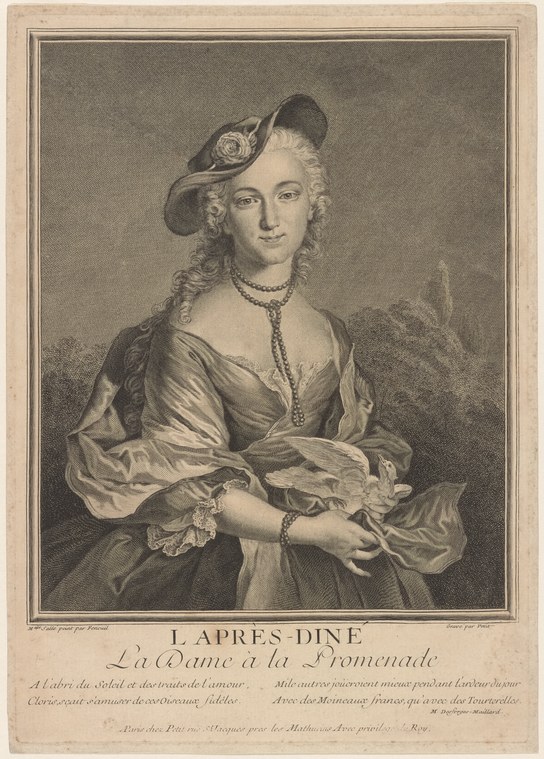
L'Après-Diné, la dame à la promenade
Unknown artist
- Collection:
- Prints depicting dance
- Source:
- New York Public Library
- Rights:
- Public domain — free to use, share and adapt.
- Recorded as:
- Public Domain
The promenade was the default mode of social display for aristocratic women in the 1770s–80s, and this engraving is a precise anatomical record of the posture, spacing, and comportment it required. The image shows us what 'graceful leisure' looked like in practice—how the body held itself, where the arms sat, how the gaze oriented itself. It is also evidence of the codification and teaching of dance and movement at the threshold between court ballet and modern dance; such prints were used as instructional aids and as models for imitation.
What you are looking at
A fashionable woman stands alone in three-quarter view, facing left, dressed in the haute couture of the 1770s–80s. She wears a silk gown with a fitted bodice, deep décolletage, and voluminous skirts gathered and looped to reveal an underskirt. Her pale hair is dressed high and ornamented with a large cockade or feathered plume. A pearl necklace and bracelet complete her ensemble. In her hands she holds what appears to be a fan or small fabric accessory. The background is minimal and neutral, rendered in soft tones that throw the figure into relief. The title, engraved below in French script, reads *L'Après-Diné, la Dame à la Promenade* (After Dinner, the Lady on Promenade), with text below describing her as a figure of leisure and propriety. The work is executed as a fine engraving, likely stippled or line-engraved, with careful attention to the textures of fabric and the play of light across surfaces.
The dancing
The woman's stance is upright and poised, weight evenly distributed, suggesting stationary display rather than active movement. Her left arm is bent and raised to chest height, the right arm extended slightly forward and down, both hands engaged with her accessories. Her body faces left while her head turns slightly toward the viewer, a pose that combines elegance with the gentle turn-and-pause characteristic of promenade. The figure is alone—no partner, no ensemble—and her posture conveys the refined decorum expected of a lady of quality taking leisure.
The dance depicted
This is not a depiction of theatrical dance but rather of the social promenade, a genteel walking figure performed in aristocratic circles during the late eighteenth century. The promenade was less a formal dance step than a choreographed mode of display—walking with intention, grace, and ornamental pause. The title explicitly situates this as a moment after dinner in polite society, a time when ladies would walk through drawing rooms or gardens to be observed. The engraving captures not movement but the aesthetic ideal of the promenade: the body held with refinement, the step leisured and unhurried, the whole figure composed as a picture. This belongs to the culture of *historic-regency* social dance, though the clothing suggests a date closer to 1780s than the Regency proper.
How it was made
This is a fine-line engraving, likely executed with a burin or needle. The delicate cross-hatching and stippling visible in the background, the precise rendering of fabric folds, and the fine linear definition of the figure's edges are characteristic of high-quality reproductive engraving of the late 18th century. The print was almost certainly made for sale to a gentleman collector or for circulation in fashion and etiquette prints; the text below indicates it is part of a series or collection documenting modes of polite behavior. Engravings of this type had wide but elite circulation and served both as fashion commentary and as prescriptive images of correct deportment.
About this work
This engraving documents the social promenade—a genteel walking figure of the late eighteenth-century aristocratic drawing room—through the portrait of a single fashionable woman posed in the act of taking her leisure after dinner. It is not theatrical dance but rather social choreography: the formalized, aestheticized walking that organized the visual and social life of polite society. The work belongs to a body of prints and treatises that codified and displayed the bodily disciplines of the ancien régime, and it captures a moment of profound historical change—the old courtly culture on the eve of its dissolution. For dance historians, it is invaluable evidence of how the body was meant to move, stand, and present itself in elite European society before the French Revolution.
How to look at it
Observe the placement of the body within the frame: upright, slightly off-center, with ample space around the figure that suggests the expansive room in which she moves. Notice the positioning of the hands and arms—engaged, refined, but not in any athletic configuration. The turn of the head toward the viewer is key: it invites observation, transforms the standing figure into a picture to be seen. The costume, too, is part of the choreography—the high hair, the cascading skirts, the placement of accessories—and you should read the figure as a totality. Finally, attend to the artist's choice to capture not a moment of transit but a moment of pause: this is the promenade at its apex, a held pose that contains within it all the grace and discipline the form demands.
The period
This engraving was produced in the 1780s, at the height of Rococo fashion and during the waning years of the ancien régime. The promenade and other figure-based social dances were the dominant modes of organized movement in aristocratic life; they required no music, no partner (though promenades were often executed in pairs or groups), and no special skill beyond an ingrained sense of propriety and posture. At the same time, theatrical ballet was undergoing rapid professionalization and technical innovation, moving toward the Romantic era of the 1820s–40s. The engraving belongs to a vast industry of fashion and etiquette prints that documented and prescribed the behavior of the affluent; such images were collected, studied, and imitated by a literate and leisure-rich public. The formal language of the print—the isolation of the single figure, the neutral background, the careful delineation of costume—places it within the tradition of fashion engraving that flourished in France and England throughout the eighteenth century.
Where it lives
The print is held by the New York Public Library as part of its Prints collection documenting dance and related social practice. It is part of a larger body of French and English fashion and etiquette engravings from the late 18th century, many produced for sale to collectors and as instructional aids.
Dance in this work
Questions about this work
Was the promenade a real dance?
Yes and no. It was a formalized way of walking, standing, and moving through social space—as codified and rule-governed as any dance, but performed without music and without the step-vocabulary of ballet or social dances like the minuet. It was the default mode of aristocratic movement, and it required training and constant attention to posture, spacing, and decorum.
Who would have seen this print?
Primarily affluent women and men interested in fashion, etiquette, and the visible markers of good breeding. Such prints were collected and studied as models; they served both as fashion commentary and as prescriptive guides to correct behavior. They circulated among the educated elite, and many were bound into albums or treatises on manners.
What is the woman holding?
Likely a fan or small piece of fabric or silk. Fans were essential accessories for fashionable women and were manipulated with considerable skill as part of the visual language of social interaction. The object in her hand may also be a handkerchief or a small piece of lace.
How do we know this is specifically 'after dinner'?
The title of the engraving tells us so: *L'Après-Diné, la Dame à la Promenade*. The text below the image elaborates on the scene and the woman's role as an exemplar of propriety and leisure. The engraving is part of a series documenting modes of polite behavior at different times of day and in different social contexts.
More dance artwork





