49 works in this view — arrow keys or swipe to move between them.
Dance in Art
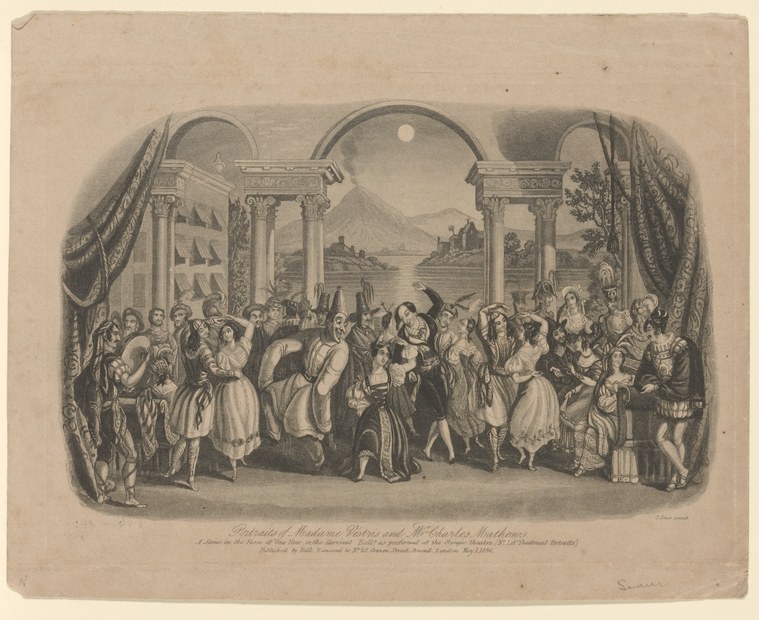
Portraits of Madame Vestris and Mr. Charles Mathews: A scene in the farce of "One hour; or, The carnival ball," as performed at the Olympic Theatre
Unknown artist
- Collection:
- Prints depicting dance
- Source:
- New York Public Library
- Rights:
- Public domain — free to use, share and adapt.
- Recorded as:
- Public Domain
This print documents how theatrical farce, a dominant form of entertainment in the 1830s-40s, integrated dance and festive scenes into comedic narratives. It also provides evidence of the performance aesthetics and star power of Madame Vestris and Charles Mathews, two of the era's most celebrated performers whose work influenced the development of modern theatrical dance and choreography. For historians, it shows the visual language by which a theatre audience of the period was invited to understand a 'carnival ball'—who attended, how they dressed, what movement and gesture signified in a theatrical context.
What you are looking at
A crowded indoor theatrical scene set in a columned hall with draped curtains, rendered in the tradition of 19th-century theatrical prints. The composition is dense with figures—men and women in evening dress of the 1830s-1840s period—arranged in social grouping across the space. The architectural setting features two prominent arched openings framed by classical columns, with fabric swags and heavy curtains in the upper corners suggesting a theatre interior or grand ballroom. A full moon or large circular light source visible through the central arch creates dramatic illumination. The figures are animated and varied in pose: some stand in conversation, others gesture expressively, and several appear to be in motion or dancing. The print technique creates strong contrast between lit figures and shadowed background, emphasizing the theatrical quality of the scene.
The dancing
The figures show mixed postures appropriate to a social gathering rather than coordinated dance formation. Several women wear high-waisted gowns characteristic of the 1840s with full skirts. Some figures gesture with raised arms or turned torsos, suggesting conversation and social animation rather than ballroom hold positions. The groupings appear casual and dispersed throughout the space rather than organized in the formal couples or sets of contemporary social dance. The variety of arm positions and body angles suggests theatrical acting and comedic business rather than the discipline of ballroom partnering.
The dance depicted
This represents a theatrical farce scene—specifically 'One Hour; or, The Carnival Ball' performed at the Olympic Theatre—rather than actual social dance documentation. The print depicts actors playing characters at a carnival or ball, and the movements shown reflect comedic pantomime and theatrical gesture rather than dance technique. The presence of named performers (Madame Vestris and Charles Mathews, both celebrated comedians and actors of the 1830s-40s) confirms this is a theatrical production scene. While the setting is a ball and figures are in motion, the composition prioritizes the narrative comedy and social interaction of the farce rather than showcasing choreographed dance.
How it was made
This is a steel or copper engraving, printed in black ink on paper, typical of theatrical illustration in the early Victorian period. The technique allows fine linear detail in costume and architecture while building tone through parallel lines and cross-hatching, particularly visible in the dramatic shadows framing the scene. Engravings of this kind were mass-produced and affordable, circulating widely through theatrical print shops and periodicals to audiences who had seen or wanted to see the production. The framing device of the columned archway creates a 'picture-within-picture' effect characteristic of contemporary theatrical prints designed to be both documentation and decorative object.
About this work
This is a theatrical print documenting a scene from a 1830s-40s farce performed at London's Olympic Theatre, featuring the celebrated actors Madame Vestris and Charles Mathews. Rather than capturing actual dance, it documents a theatrical representation of a carnival ball scene, showing actors in character at a social gathering rendered with the architectural grandeur and dramatic lighting of stage design. The work belongs in a dance collection as evidence of how theatre and dance intersected in this period—farces often included dance or choreographed movement as part of their comedy, and theatrical prints like this are primary sources for understanding what audiences saw and how 19th-century theatre represented social dance and festive scenes. The print also documents the celebrity of two major figures in early Victorian theatre whose work often incorporated physical comedy and movement.
How to look at it
The viewer should note the architectural framing of the scene—the theatricality is self-conscious and staged rather than naturalistic. Look at the variety of postures and the absence of the formal holds and symmetry that would characterize actual ballroom dance of the period; the movement here is comedic gesture and social animation. The dramatic lighting through the central arch and the use of shadow suggest stage lighting effects designed to guide attention. The density and disorder of the crowd, along with the mixture of animated and stationary figures, creates a sense of theatrical chaos and comedy rather than the orderly progression of a formal ball. The named figures in the title—Vestris and Mathews—should prompt the viewer to look for prominent or distinctly costumed figures, though the print style does not clearly distinguish individuals.
The artist
The print is attributed only to the engraver, not recorded in the catalogue. It was typical of theatrical print production in this period for the engraver's name to be secondary to the theatrical celebrities depicted and the play title advertised. Such prints were usually commissioned by theatres or print publishers to capitalize on the popularity of successful productions and well-known performers. The execution suggests a competent theatrical engraver working within established conventions for representing stage scenes—the use of architectural framing, the management of crowd scenes, the dramatic lighting effects.
The period
The 1830s-40s saw the height of theatrical farce in London, a form emphasizing physical comedy, social satire, and music-hall elements. Madame Vestris (1797-1856) was a celebrated dancer, singer, and comedic actress who revolutionized theatrical design and direction during her management of the Olympic Theatre. The Olympic specialized in burlesque, extravaganza, and farce—forms that frequently featured music, song, and choreographed movement as integral to comedy. Prints like this served as marketing, souvenirs, and documentation, circulating among the theatre-going public. The period saw a growing appetite for theatrical imagery as both cultural documents and decorative prints for domestic consumption, reflecting the professionalization and popularization of theatre in the early Victorian era.
Where it lives
This engraving is held in the New York Public Library's Prints collection focusing on dance imagery. It is one of thousands of theatrical prints produced in the 19th century for circulation to the theatre-going public; such prints were sold at theatres, through print shops, and distributed as illustrations in theatrical newspapers and periodicals.
Dance in this work
Questions about this work
Is this an actual dance or a theatrical scene?
This is a theatrical scene—a moment from a comedic farce performed at the Olympic Theatre. The print documents actors in character at a fictional carnival ball, not choreographed dance. However, farces of this period often included music, song, and movement as part of their comedy, so some dance-like motion may have occurred in performance.
Who were Madame Vestris and Charles Mathews?
They were among the most celebrated performers of early Victorian theatre. Vestris (1797-1856) was a dancer, singer, and comedic actress who became a theatre director and revolutionized stage design and production at the Olympic Theatre. Mathews was a celebrated comedian known for his physical comedy and character work. Both were stars of the London theatre in the 1830s-40s.
What is 'One Hour; or, The Carnival Ball'?
A theatrical farce performed at London's Olympic Theatre, a venue known for burlesque, extravaganza, and comedic spectacle. The play, as the subtitle suggests, was set at a carnival ball—a common setting for theatrical comedies because it allowed for costume, music, movement, and social satire.
What is the architectural setting supposed to represent?
The columns, arches, and drapery are meant to suggest both a grand ballroom and a stage set. The frame-within-a-frame created by the central arch was a common compositional device in theatrical prints, emphasizing the staged artificiality of the scene and the viewer's position as audience.
More dance artwork





