49 works in this view — arrow keys or swipe to move between them.
Dance in Art
Pepita
Unknown artist
- Collection:
- Prints depicting dance
- Source:
- New York Public Library
- Rights:
- Public domain — free to use, share and adapt.
- Recorded as:
- Public Domain
This image preserves the material reality of theatrical dance costume at a moment when ballet and stage dance were expanding their visual and geographical vocabulary. The specificity of the dress—the patterned silk, the careful construction, the decorative detail—shows how theatre costume blended European technique with romantic orientalism and folk-culture reference, shaping both stage performance and public taste. Without context identifying the source performance, the work raises questions about which dancers and roles were considered important enough to document and distribute, and which have since been lost to history.
What you are looking at
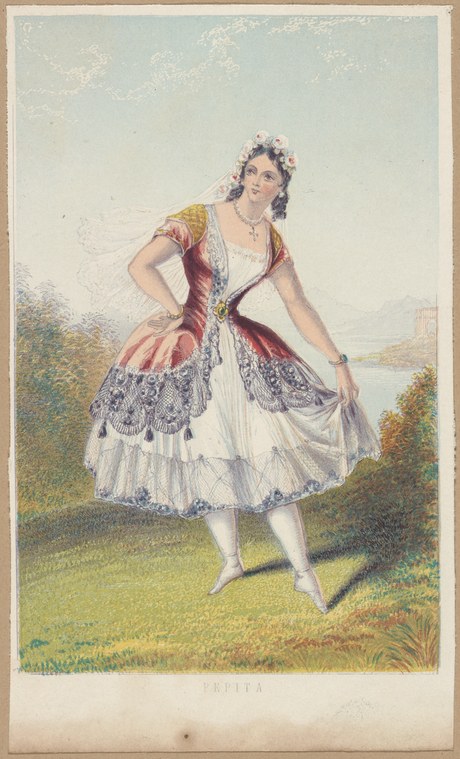
A young woman in theatrical costume stands alone in a sunlit landscape, captured mid-movement. She wears a white chemise under a rust-red velvet bodice laced at the front, and a spectacular skirt of white silk with a deep border of dark blue or purple silk, patterned with peacock-feather designs and bordered with white scalloped edging. A matching draped shawl or sash in the same patterned silk falls from her shoulders. Her hair is crowned with a wreath of white flowers. The setting is an open meadow beside a body of water, with green grass, trees, and a building visible in the distance. She stands with weight on one leg, the other extended, one arm akimbo at the waist and the other gesturing outward—a pose of confident display rather than active engagement in movement. The lithographic technique renders the fabric textures with delicate hatching, and the soft colouring (pale blue sky, warm greens, rosy skin tones) creates an intimate, almost pastoral mood.
The dancing
A single female figure occupies the composition. Her frame is upright and relaxed, with an easy contrapposto stance—one leg bearing weight, the other subtly extended or lifted. One arm rests at her hip while the other extends outward in a gesture of presentation or flourish. Her upper body is slightly turned, creating a sense of dynamic rotation without vigorous movement. The pose suggests a moment of repose or display between movements rather than active dance, though the extension of the leg and the graceful arm carriage indicate a body trained in movement.
The dance depicted
This appears to be a theatrical dance costume print, likely from the mid-to-late nineteenth century, though the specific dance type is difficult to determine with certainty. The elaborate Hispanic or Mediterranean-inspired costume—particularly the patterned silk skirt and decorative arrangement—suggests either a Spanish regional dance such as a sevillana, or a theatrical romanticized version of folk dance, popular in opera and stage productions of the era. The title 'Pepita' and the overall theatrical presentation suggest this may document a specific performer or a character from a theatrical production. The pose and setting do not clearly depict active steps; instead, this is a costume plate designed to showcase the performer and her dress.
How it was made
This is a hand-coloured lithograph, a reproductive print technology that allowed for wide circulation of theatrical imagery in the nineteenth century. The artist has used lithographic stone to establish the composition and line work, then hand-applied watercolour or gouache to achieve the delicate tonal variations and colour harmonies. This technique was standard for distributing costume designs and performer portraits to a broad audience—dancers, theatre-goers, and the fashion-conscious public. The softness and luminosity of the colouring is characteristic of the finest theatre prints of the period, suggesting a work of some commercial importance.
About this work
This hand-coloured lithograph documents a theatrical dancer or performer identified only as 'Pepita,' captured in full costume during what appears to be the 1850s–1870s. She wears an ornate dress combining European theatrical fashion with romanticized Mediterranean or Hispanic elements—a white chemise and red bodice beneath a striking white silk skirt with a deep patterned border and matching draped shawl. The isolated figure and pastoral setting emphasize the costume and the performer rather than the action of dance; this is a costume plate designed for theatrical circulation and publicity. The work belongs to a large tradition of nineteenth-century dance portraiture that documented performers and repertory through their dress.
How to look at it
Notice the care with which the artist has rendered the textile pattern on the skirt—the peacock-feather motif is not merely decorative but the technical and visual centerpiece of the costume. The performer's stillness and frontal presentation, despite the active extension of her leg and arm, suggest a pose designed for display rather than documenting movement in action. The lush landscape setting, unusual for most theatrical prints, may indicate that this dance had a narrative or pastoral context. The colour palette—the striking contrast between the white skirt and rust-red bodice, set against the pale blue sky—shows the kind of visual impact such a costume would create on stage.
The period
The mid-nineteenth century saw an explosion in theatrical dance costume prints, driven by the expansion of ballet beyond France and Italy and the growing appetite for theatrical imagery among urban audiences. The romanticized folk and regional costume elements in this print reflect the broader nineteenth-century turn toward 'authentic' or 'natural' dance vocabularies in opposition to rigid classical ballet—a move visible in the development of character dance within ballet and in the rise of dancers who specialized in Spanish, Hungarian, or 'exotic' national styles. Hand-coloured lithography made such images affordable and widely available, allowing performers and theatres to circulate costume designs and build their reputations. The title 'Pepita' suggests a Spanish or Latin context, a common framing for theatrical character dances of the period.
Where it lives
This work is held in the New York Public Library's collection of prints depicting dance. It represents one of thousands of theatrical costume prints produced and circulated in the nineteenth century, the majority now unattributed.
Dance in this work
Questions about this work
Who was Pepita?
The print carries only the title 'Pepita,' which may have been a performer's name or stage character. Without additional documentation, we cannot identify the specific dancer or theatrical production this costume documents. Many such prints survive without attribution or context, and the identity of the performer has been lost to time.
Is this a ballet or a character dance?
The costume elements—the ornate patterned skirt, the decorative shawl, the flower crown—suggest a character or national dance rather than classical ballet, or a hybrid theatrical form that blended ballet technique with folk or exotic imagery. The romantic pastoral setting and the absence of pointe shoes or rigorous classical positioning support this interpretation.
What is the dance position shown here?
The figure is not captured in active movement but in a posed presentation between movements or before the dance begins. She stands with weight shifted to one leg, the other subtly extended, and her arms arranged in a gesture of display—a conventional pose for costume portraiture rather than a moment of choreography.
How were such prints made and circulated?
Hand-coloured lithographs were one of the most popular theatrical merchandise of the nineteenth century. An image was drawn on a lithographic stone, then printed and hand-coloured by workers or artists, allowing theatres and performers to create and distribute multiple copies cheaply. These prints were sold to audiences, collected, and used as promotional material.
More dance artwork





