49 works in this view — arrow keys or swipe to move between them.
Dance in Art
Gros Guillaume
Unknown artist
- Collection:
- Prints depicting dance
- Source:
- New York Public Library
- Rights:
- Public domain — free to use, share and adapt.
- Recorded as:
- Public Domain
Gros Guillaume represents a tradition of physical comedy and character work that influenced modern performance and dance. The image documents how character, costume, and exaggerated physicality combined in popular theatre—a foundation for theatrical dance and the comic tradition that would shape 20th-century movement practice.
What you are looking at
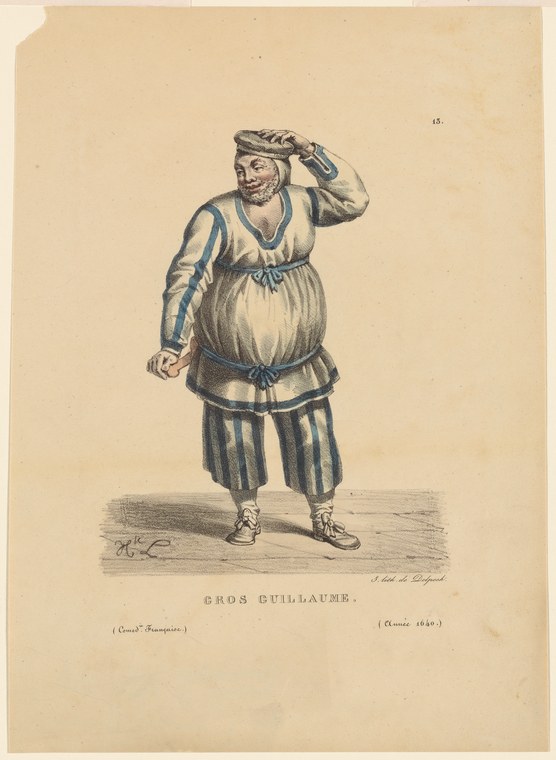
A stout man stands alone against a plain background, caught mid-gesture in a moment of comedic exaggeration. He wears a billowing dress or tunic cinched at the waist with drawstring ties, the fabric gathered voluminously across his torso and gathered again at the hips and ankles in a style that emphasizes his rounded silhouette. His long-sleeved upper garment is fitted but his lower body is swathed in striped or pleated fabric that extends to the ankles. He raises one hand to his head in a pose suggesting surprise, bewilderment, or theatrical affect, while his other arm hangs at his side. His expression is broadly smiling or grinning. The figure is rendered in black ink with careful cross-hatching and shading, creating volume and dimension. The print is inscribed beneath the figure with the title "Gros Guillaume" and credits to an artist and date (1840s).
The dancing
A single male figure stands in a contrapposto stance with weight distributed evenly. His raised hand touches his head in a gesture of astonishment or dramatic pose rather than a dance position. The body is static and frontal, not captured mid-movement; the stance is presentational and designed to display the costume and character rather than demonstrate footwork or balletic technique. The figure's proportions are exaggerated for comic effect, with the costume doing most of the expressive work.
The dance depicted
This appears to be a character study or costume print of Gros Guillaume (Big William), a stock character from French comic theatre, rather than a depiction of a specific dance. Gros Guillaume was a popular figure in 17th- and 18th-century French farce and commedia dell'arte traditions, known for physical comedy and buffoonery. If dance is present, it would be the broad physical comedy and gestural theatre of popular entertainment rather than formal dance technique. The pose—hand to head, exaggerated proportions, theatrical stance—suggests theatrical character rather than trained dancer.
How it was made
This is a hand-colored or tinted engraving or lithograph, established from the image by the fine linear hatching, the precision of the line work, and the tonal modeling through cross-hatching. The medium allowed for wide circulation of popular theatrical characters and comedy figures to audiences beyond the stage. The inscription and numbering (visible as "15" in the upper right) suggest this is part of a series of costume or character prints, a common commercial production in the 19th century.
About this work
This is a 19th-century theatrical character print documenting Gros Guillaume, a stock comic figure from French stage tradition. Rather than depicting a formal dance, it is a costume study of a character known for slapstick and physical comedy—a precursor to modern performance comedy. The print preserves the visual memory of how this character was costumed and presented to audiences. It belongs in a dance collection as a document of theatrical movement culture and the embodied humor that predated modern entertainment, where the body and costume together created comic meaning.
How to look at it
Attend to the exaggeration of the costume as the primary vehicle of character and comedy. The billowing fabric and gathered silhouette do not represent realistic dress but rather amplify the figure's comic proportions. The raised hand and expression freeze a moment of theatrical affect rather than a movement phrase—this is a pose designed to be instantly readable as "surprised" or "bewildered" to audiences familiar with stage comedy. The numbered series format indicates this print was one of many circulating documentation of popular theatrical types.
The artist
The artist is not recorded in the catalogue. The inscription indicates this is part of a numbered series of theatrical character prints, likely French, from the mid-19th century. This is a commercial printing practice—character and costume documentation for popular consumption, part of the broader market for theatrical imagery.
The period
The mid-19th century saw widespread circulation of theatrical character prints as affordable popular imagery. This was the era when Romantic ballet was establishing itself in Europe, yet parallel traditions of physical comedy and character-based theatre remained central to popular entertainment. Gros Guillaume himself derives from 17th-century commedia and French farce traditions, so this print is documenting a character type with deep historical roots, being kept alive through 19th-century performance and print culture.
Where it lives
This print is held by the New York Public Library in its collection of prints depicting dance, catalogued as "unknown era" and "unknown date." The inscription indicates a date of 1840 and artist credit, but these are not currently recorded in the catalogue record provided.
Dance in this work
Questions about this work
Is this actually a dance?
Not formal dance technique, but theatrical movement culture. Gros Guillaume was a comic character from French farce and early comedy traditions, known for physical humor and buffoonery. The pose is theatrical and gestural rather than balletic or technically trained movement. It belongs in dance history as a document of how bodies, costume, and exaggerated physicality created entertainment before modern dance forms were codified.
Who was Gros Guillaume?
A stock comic character in 17th- and 18th-century French theatre, part of the commedia dell'arte tradition and French farce. He was known for slapstick, physical comedy, and exaggerated character work. This 19th-century print revives and documents the character type for a new audience through the popular market for theatrical prints.
Why is a comic character in a dance collection?
Because theatrical movement—the physical language of characters, gesture, and embodied comedy—is part of dance history. Before ballet, modern dance, and other codified forms dominated, the body in popular theatre created meaning through exaggeration, costume, and character-based performance. This print documents that tradition.
More dance artwork





