49 works in this view — arrow keys or swipe to move between them.
Dance in Art
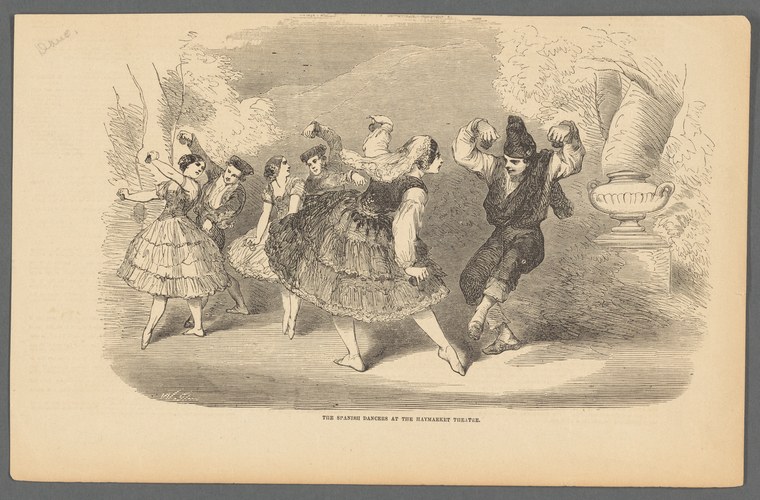
The Spanish dancers at the Haymarket Theatre
Unknown artist
- Collection:
- Prints depicting dance
- Source:
- New York Public Library
- Rights:
- Public domain — free to use, share and adapt.
- Recorded as:
- Public Domain
This work is rare evidence of how a professional artist documented social dance in a theatrical context, showing not a posed, idealized version but an energetic, playful moment of actual movement. The detail of costume and the specificity of the reference to a named theatre and performer (implied by the title) make it a primary source for the history of theatrical dance and Spanish-influenced entertainment in 1840s London.
What you are looking at
A theatrical scene set in what appears to be an elegant interior, with a grand decorative urn or vessel visible at right. A group of dancers in mid-performance occupy the center: women in tiered, ruffled skirts with fitted bodices and elaborate bonnets or headdresses; men in dark tailcoats and fitted breeches. The figures are arranged in a lively, social configuration suggesting a quadrille or similar formal group dance. The composition is energetic—bodies lean and turn, skirts billow, and the arrangement suggests a moment of active movement rather than a posed tableau. The engraver has captured the gathering with sharp attention to the textures of fabric and the articulation of limbs, using cross-hatching to create volume and shadow. The background is sketched loosely, emphasizing the figures themselves.
The dancing
The dancers occupy a loose, open formation typical of ballroom group dances rather than a partnered couple. Several figures are caught mid-turn or mid-step, with arms raised and extended; one man appears to be leaping or jumping. The women's skirts are rendered with fine detail, showing the characteristic tiered ruffles and fullness of 1840s fashion. The postures suggest vigorous, celebratory movement—this is not the restrained elegance of a slow waltz but something more exuberant. The grouping is deliberately informal and playful, with figures overlapping and at varied depths, creating a sense of spontaneous social interaction.
The dance depicted
This is almost certainly a scene of social ballroom dancing from the mid-19th century, most likely a quadrille, galop, or country dance—all fashionable group dances of the era that involved multiple couples in coordinated but lively movement. The title references Spanish dancers at the Haymarket Theatre in London, suggesting this may document an actual theatrical performance or a fashionable entertainment of Spanish or pseudo-Spanish character that was popular in London during the 1840s–1860s. The costume and setting suggest a theatrical context rather than a private ball, and the composition has the character of reportage or documentation of a specific event rather than a generic 'dance scene.' The energetic poses and exuberant grouping are consistent with the faster, more athletic dances of the Gilded Age ballroom repertoire.
How it was made
This is an engraving (determined from the image itself, as the record does not specify medium). The technique is evident in the fine parallel lines and cross-hatching used to model form and create shadow—characteristic of wood engraving or steel engraving rather than etching. The print shows skilled rendering of fabric texture, particularly the women's skirts and bonnets, achieved through careful line work. The medium allowed for wide circulation; this is clearly a commercial print made for publication in a newspaper, magazine, or illustrated book, intended for an audience interested in fashionable entertainments and theatrical gossip of London.
About this work
This engraving documents a theatrical dance performance at London's Haymarket Theatre, showing Spanish dancers engaged in what appears to be a lively social ballroom dance—possibly a quadrille or galop—with an all-female and male ensemble in mid-1840s formal dress. The work sits at the intersection of theatrical documentation, fashion reportage, and dance history, capturing both the physical character of a specific historical moment and the character of public entertainments that fascinated Victorian London audiences. As a professional engraving made for publication, it represents how dance was circulated and understood as a subject for popular visual culture, rather than as a fine-art subject.
How to look at it
Note the exact moment the engraver chose: not a formal opening or a structured figure, but a moment of genuine motion, with bodies at different levels of the turn and skirts caught mid-swing. Observe how the artist rendered the women's bonnets and the men's tailcoats with precision, using the costume to anchor the viewer's understanding of the period and the formality of the occasion. The loose, open composition and the slight awkwardness of overlap—rather than a perfectly balanced tableau—suggests the artist was working from observation or description of actual movement, not from a formulaic print tradition. The engraving technique itself, with its fine parallel lines, was well suited to rendering the texture of fashionable dress, which was the primary interest of the audience.
The period
The 1840s–1860s saw a flourishing market in London for illustrated newspapers and magazines, which created demand for skilled engravers to document fashionable society, theatre, and entertainment. The Haymarket Theatre was a prestigious venue, and performances by foreign—particularly Spanish—dancers were exotic attractions that appealed to prosperous audiences. The period was also one of transition in ballroom dance: the Romantic era's waltz and quadrille were giving way to faster, more energetic dances like the galop and polka, and theatrical performances often exploited these fashionable forms. The mid-19th century also saw growing interest in 'national' or 'ethnic' dances (often performed with considerable creative license by European and British performers), of which Spanish dance was a popular category.
Where it lives
The work is held in the New York Public Library's Prints collection, which specializes in graphic art from published sources. This engraving is likely extracted from a newspaper or periodical rather than issued as a standalone print, indicating it was part of the daily or weekly visual media consumed by London's literate public.
Dance in this work
Questions about this work
Who were these Spanish dancers?
The title indicates they performed at the Haymarket Theatre in London, but the image itself does not identify them by name. Spanish dance was a fashionable exotic entertainment in 1840s–1860s London, and such performances were often documented in the illustrated press. The performers may have been Spanish, or British and European dancers performing in a Spanish style.
What dance are they doing?
The formation and costume suggest a quadrille, galop, or similar group ballroom dance of the era. The title does not specify, and the engraver's primary interest was in the theatrical and fashionable context rather than the technical detail of the dance itself. The exuberant postures and the number of figures suggest one of the faster, more energetic social dances rather than a slow, formal style.
Why is this image important for dance history?
It is one of relatively few contemporary visual documents of how social ballroom dance was actually performed in a theatrical context in the 1840s–1850s. The specificity of the title and the detail of the costume make it a primary source for understanding both the dance repertoire and the fashionable entertainments of the period.
More dance artwork





