49 works in this view — arrow keys or swipe to move between them.
Dance in Art
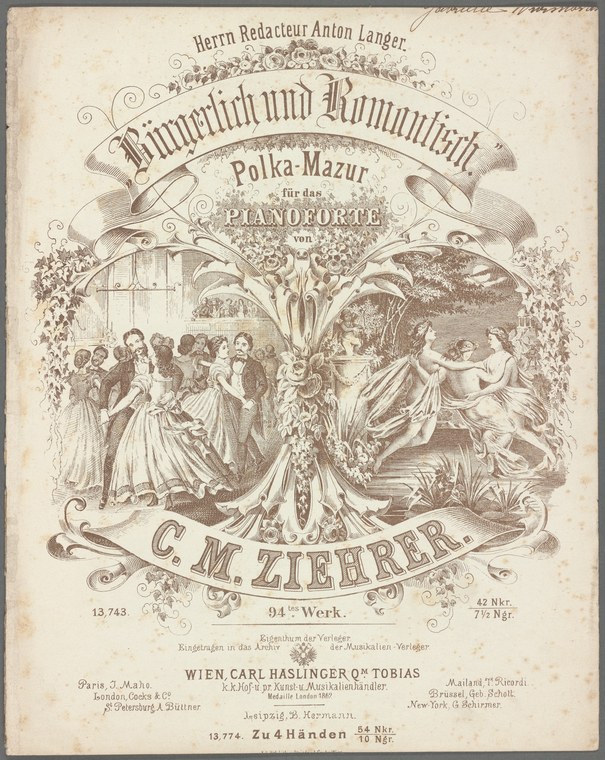
Bürgerlich und romantisch Polka-Mazur für das Pianoforte
Unknown artist
- Collection:
- Prints depicting dance
- Source:
- New York Public Library
- Rights:
- Public domain — free to use, share and adapt.
- Recorded as:
- Public Domain
This image is documentary evidence of how the polka-mazur was actually danced: the body positions, the closed hold, the scale of movement, and the social context are all rendered by an engraver working from life or from detailed observation. For historians of ballroom dance and Romantic-era social practice, such title-page engravings are invaluable records of movement culture, capturing ephemeral performance in a form that survives when dancers and choreography do not. The work also shows the internationalization of dance: a Viennese dance form, published simultaneously in Vienna, Paris, and New York, revealing the cosmopolitan circuits of popular dance in the nineteenth century.
What you are looking at
This is the title page of a piano score for a Polka-Mazur, a hybrid dance form combining elements of the Polish mazurka with the faster polka. The engraving depicts an elaborate Romantic-era scene centered on a large decorative tree or fountain, around which two groups of dancers are arranged. On the left, several figures in formal dress—men in dark coats and women in full skirts—appear to be in conversation or preparing to dance. On the right, a more animated group shows dancers in motion: women's skirts billow outward in swirling movement, and the figures lean into the dance with clear physical energy. The scene is framed by ornamental scrollwork and botanical decoration typical of mid-nineteenth-century commercial music publishing. The composition uses the central tree as a focal point to organize the narrative: the left side represents the social preliminaries of the ballroom, while the right side shows the dance itself in full swing. The title 'Bürgerlich und Romantisch' (Bourgeois and Romantic) sits prominently at the top, indicating this was a dance form accessible to the urban middle class rather than court nobility.
The dancing
The dancers on the right side show the characteristic rising action of the polka: bodies tilted forward, arms extended or held at mid-frame, knees bent in small springing steps. The women's full skirts create visual emphasis on rotational movement and the hop-step pattern of the polka. One couple in the center-right appears to be in a closed ballroom hold, the man's arm around the woman's waist. The men are uniformly dressed in frock coats and trousers; the women wear corseted gowns with the wide skirts and fitted bodices standard to the 1860s-1880s. The left side shows a more static social arrangement—standing figures, some in profile, suggesting conversation between dances rather than active movement. The contrast between the two sides emphasizes the transition from ballroom socializing to choreographed dance.
The dance depicted
This is a Polka-Mazur, a nineteenth-century hybrid form that merged the energetic hop-step of the polka with the accented rhythms and mazurka-like phrasing of Polish dance. The form was especially popular in German-speaking Vienna and Central Europe from roughly 1860 onwards, and became a fashionable item in amateur music collections for piano. The title's emphasis on 'Bürgerlich' (bourgeois) tells us this was dance for urban middle-class ballrooms, not peasant celebrations or court performances. The engraving shows the physical signature of the form: small, rapid bouncing steps with pronounced upper-body rotation, performed by couples in the closed ballroom hold standard to the period. By the time this score was published, the polka-mazur had begun to fade from fashion, but such hybrid dances remained common in family dancing and at public balls throughout the 1880s.
How it was made
This is a wood engraving, a relief printing technique that allowed fine detail and wide circulation through multiple printings. The delicate linework creates subtle modeling in the figures' bodies and fabric folds, while the bold architectural framing and scrollwork define the page as a commercial music title. The engraver has signed the work 'C. M. Ziehrer,' indicating a professional publishing house or print workshop rather than the composer. The technique was standard for mass-produced music of the period and would have been affordable for amateur musicians; the presence of multiple publisher marks (Carl Häslinger in Vienna, additional houses in Paris, New York, and elsewhere) shows this was a successful commercial product with international distribution. The durability and repeatability of wood engraving made it ideal for sheet music, which was often consulted and played until pages wore out.
About this work
This is the title page of a published piano score for a Polka-Mazur, a social dance form that flourished in European ballrooms during the mid-to-late nineteenth century. The engraved illustration documents both the music and the dance: the title advertises the musical work, while the imagery shows how the dance was performed and in what social context. The composition is typical of Romantic-era commercial music publishing—ornamental, detailed, and designed to appeal to amateur musicians and dancers buying sheet music for home use and public balls. The work belongs to the extensive archive of dance imagery embedded in nineteenth-century music publishing, which documents the movement vocabularies of popular ballroom forms more extensively than photographs or written description alone can achieve.
How to look at it
The engraver has frozen the polka-mazur at its moment of highest physical animation: the right side of the image captures the hop and turn that define the form, with swirling skirts and forward-leaning bodies. Notice the closed ballroom hold—the man's arm encircling the woman's waist—which is the structural constraint of all couple-dances of this era; the polka-mazur's speed and turning required dancers to maintain this contact securely. The contrast between the left side (static social arrangement) and the right side (kinetic motion) is deliberate: it shows the dance as an event that begins in conversation and erupts into choreographed movement. The ornamental tree at center serves as a spatial organizer that allows the engraver to show both social and kinetic space on a single page—a common solution in nineteenth-century ballroom-scene engravings.
The artist
The engraver C. M. Ziehrer is recorded here but little is known of his individual practice. He worked as a professional commercial engraver for music publishers in Vienna, a major center of music publishing and ballroom dance culture. Many dance title pages of this period were executed by anonymous or semi-documented workshop engravers whose names appear only on the print itself; Ziehrer's signature indicates he was a recognized craftsman rather than a major artistic figure. The publishers—Carl Häslinger in Vienna, and associated houses in Paris and New York—were major firms in the mid-nineteenth-century music trade, known for both classical and popular instrumental works.
The period
The polka-mazur emerged in the 1860s as one of many hybrid dance forms created to sustain interest in ballroom dancing as the nineteenth century progressed. The polka itself, which had swept Europe in the 1840s, began to lose novelty by mid-century; composers and dance masters responded by creating variations and fusions, of which the polka-mazur was one of the more successful. The mazurka—a Polish national dance known for its sharp accents and turning patterns—had already been adopted into European ballrooms through Chopin's piano compositions and salon dances; combining it with the polka's simpler hop-step made a form that was energetic but less demanding than the pure mazurka. This was the era of the Viennese waltz's dominance, but also of rapid innovation in secondary ballroom forms. The publication date of this work (the catalogue record lists it as 94th work by the publisher, suggesting the 1870s or 1880s) places it in the period when such hybrid forms were most actively created and danced.
Where it lives
This is a title page from a commercial music score held in the New York Public Library's collection of prints depicting dance. The work is part of the broader archive of published music distributed internationally through Central European and American publishers in the late nineteenth century. As a printed and distributed object, it would have been owned by many individuals; this particular copy came to the Library through general collecting of dance-related prints and ephemera.
Dance in this work
Questions about this work
What is a Polka-Mazur?
A Polka-Mazur is a ballroom dance form that combines the fast, bouncing hop-steps of the polka with the accented rhythms and turning patterns of the Polish mazurka. It emerged in the 1860s-1870s as European composers sought new variations to keep ballroom dancing interesting as the polka's initial novelty faded. The form was especially popular in Vienna and German-speaking cities, and it remained common in amateur music collections and public balls through the 1880s and beyond.
Who danced the Polka-Mazur?
The title of this score—'Bürgerlich und Romantisch' (Bourgeois and Romantic)—indicates that the polka-mazur was a dance for the urban middle class, not for peasants or court nobility. It was performed by amateur musicians and dancers in ballrooms, at public dances, and at home among families and friends. The music was affordable enough that amateur pianists could purchase and learn it.
How do I know what the dance looked like?
The engraving on the right side of the title page shows dancers actively performing the polka-mazur: women in full skirts with swirling hems, couples in closed ballroom holds, bodies leaning forward with bent knees in the springing hop characteristic of the polka. The engraver has captured the kinetic signature of the form. For a detailed view of footwork and timing, you would need the music score itself, but this image documents the body positions and partnering.
Why was this an important form of dance publishing?
Commercial music publishing for ballroom dances was one of the primary ways nineteenth-century dance forms were documented and disseminated. A single engraved title page like this could be reprinted hundreds of times, making the music and the imagery of the dance accessible across Europe and America. These scores are now valuable historical documents of how people actually moved and partnered in social dance.
More dance artwork





