49 works in this view — arrow keys or swipe to move between them.
Dance in Art
Folk dancing in England and Scotland in nineteenth-century prints
Unknown artist
- Collection:
- Prints depicting dance
- Source:
- New York Public Library
- Rights:
- Public domain — free to use, share and adapt.
- Recorded as:
- Public Domain
This is a primary document of nineteenth-century folk dance as lived social practice rather than stage spectacle or formalized instruction. It shows the integration of dance into community gatherings, street fairs, and domestic life, the participation of multiple ages and both sexes, and the distinction between virtuosic ballroom dancing and the looser, more spontaneous movement that characterized village and working-class dancing. For historians and dancers interested in how ordinary people moved and gathered, this evidence of context, costume, venue, and social participation is as important as any written account.
What you are looking at
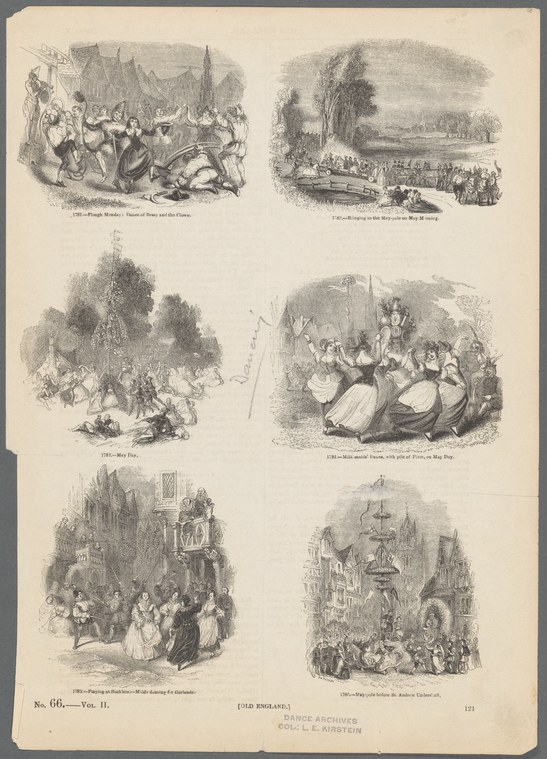
This is a composite engraving containing six separate vignettes of English and Scottish folk dancing in the nineteenth century, arranged in two columns. The upper left shows a village green dance with buildings in the background, figures in period dress performing energetic movements in a loose group. Upper right depicts a riverside or lakeside gathering with spectators lining the banks watching dancers on the green. Middle left shows a pastoral outdoor scene under trees with dancers scattered across a meadow. Middle right captures an indoor domestic scene, possibly a cottage interior, with multiple figures packed close together, women in long skirts and bonnets, men in coats and hats, their bodies bent and animated. Lower left shows another crowded interior with high arched ceilings suggesting a church or large public hall, masses of figures creating depth through overlapping forms. Lower right presents a densely packed street or fair scene with architectural framing, crowds of spectators and dancers compressed into an urban setting. Throughout, the artist emphasizes the spontaneity and social nature of the dancing, with varying states of participation—some figures dancing actively, others watching, conversing, or moving through the crowd.
The dancing
The dancers across all six scenes exhibit loose, informal postures characteristic of social folk dancing rather than ballroom precision. Bodies are frequently bent at the waist, arms raised and angled rather than held in formal frame. In the crowd scenes (middle right, lower panels), dancers are pressed close together, their limbs overlapping and intersecting in busy, naturalistic compositions. The outdoor scenes show more spread-out formations with individuals and small groups, some with raised arms suggesting active stepping or turning. Both men and women appear throughout, though women in long skirts dominate many scenes. The footwork is not clearly articulated—the artist prioritizes the social bustle and varied energy levels of the gathering over anatomical precision of step.
The dance depicted
These vignettes document folk dances of nineteenth-century England and Scotland—likely reels, country dances, quadrilles, and local village dances. The variety of settings (outdoors, indoors, street fairs, church halls) and the informal, participatory nature of the scenes suggest these were social occasions rather than theatrical performances. The clothing is period-appropriate to the mid-nineteenth century, with women in bonnets and full skirts and men in coats and hats. The artist captures the communal and spontaneous character of folk dancing as a social practice, with emphasis on gathering and collective participation rather than spectacle or technical display. The specific styles of reels or country dances cannot be identified from movement alone, but the overall impression is of vigorous, social, non-virtuosic dancing.
How it was made
This is a wood engraving or steel engraving, executed with fine linear cross-hatching to create tone and shadow. The technique allowed for detailed rendering of crowd scenes and architectural detail, and the medium's durability made it suitable for reproduction in print. The fineness of the line work and the density of parallel hatching suggest steel engraving rather than wood, permitting the intricate layering of figures and the tonal subtlety visible in the shadows and interior scenes. The original source (NYPL catalogue) indicates this came from a printed book or periodical, a common format for documentary imagery of social life in the nineteenth century. Such engravings were relatively inexpensive to reproduce and could reach a broad middle-class readership interested in contemporary manners and customs.
About this work
This composite engraving documents the landscape of folk dancing in England and Scotland during the nineteenth century, presenting six snapshot vignettes of how and where people danced in their communities—outdoors in summer, indoors in cottages and halls, at fairs and street gatherings. It is an artifact of visual journalism, a form of social documentation common to the illustrated press and books of the era. The work matters not for artistic ambition but for ethnographic specificity: it records the venues, dress, participation patterns, and social contexts of folk dancing at a moment when such practices were seen as worth documenting for a reading public increasingly distant from village life. The engraver has prioritized observable social fact—the crowding, the mixture of dancers and onlookers, the informal dress and varied energy—over any idealized or theatrical vision of rustic dancing.
How to look at it
The viewer should attend to the variety of contexts shown: the same folk dances appear in different settings (outdoors, indoors, public, private, urban, rural) and the artist uses composition to emphasize the social rather than spectatorial aspect of the dancing. Notice how many figures are not actively dancing but watching, talking, or moving through the scene—this is a document of gathering and participation, not performance. The detail of dress (bonnets, long skirts, coats, hats) is period-specific and allows dating. The architectural and landscape detail in each vignette anchors the dancing to actual places rather than theatrical abstraction. The engraver's choice to composite six different scenes suggests an attempt at comprehensive documentation of the practice across region and venue.
The period
The nineteenth century saw a growing divide between ballroom dancing, which was increasingly codified and taught to the middle classes, and folk and working-class dancing, which was being displaced by urban industrial life. At the same time, romantic and antiquarian interest in 'national' traditions made folk customs subjects of documentation and illustration. The rise of the illustrated press and serialized books of social observation meant that scenes of ordinary life—including dancing—were in demand as material for middle-class readers curious about social manners and working-class customs. Engravings like this one typically appeared in weekly illustrated newspapers, bound collections of social essays, or books on national character and traditions. They represent a moment of ethnographic interest in folk practices even as industrialization and urbanization were transforming the social conditions that sustained them.
Where it lives
The work is held by the New York Public Library in their prints collection, catalogued as a nineteenth-century engraving depicting folk dancing. The page notation 'No. 66.—Vol. II' and the reference to 'Old England' suggest this was part of a bound collection or serialized publication, likely a mid-nineteenth-century illustrated book or journal focused on British customs and social life.
Dance in this work
Questions about this work
What dances are shown here?
The specific dance styles are not labeled and cannot be definitively identified from movement alone. The scenes most likely depict reels, country dances (including quadrilles), and other social dances common to English and Scottish village life in the nineteenth century. The informal, communal character and the outdoor and domestic settings distinguish these from the formalized ballroom dances that were simultaneously being codified for middle-class instruction.
Why are there so many different scenes on one plate?
The composite format allowed the artist to present multiple contexts and venues for the same practice, suggesting breadth of documentation. By showing dancing outdoors, in cottages, in public halls, and at street fairs, the engraver emphasizes that folk dancing was woven throughout community life rather than confined to a single venue or occasion. This was typical of mid-nineteenth-century illustrated social journalism.
What does the dress tell us?
The clothing is consistent with mid-nineteenth-century working- and rural-class dress: women in long skirts, bonnets, and shawls; men in coats, hats, and waistcoats. The absence of the extremely formal ballroom dress of the same era (crinolines, white gloves, tailcoats) marks these as folk and working-class dancers rather than society dancers. The variety of headwear and the visible wear on clothing suggest a range of economic circumstances.
Is this a historical record or an artistic work?
It is both. The engraver's primary intention was documentary—to record how folk dancing actually occurred in their society—but the composition, perspective, and selective rendering of detail are artistic choices. The work sits in the territory of social journalism and ethnographic illustration, where factual documentation and artistic skill were understood as complementary rather than opposed.
More dance artwork





