49 works in this view — arrow keys or swipe to move between them.
Dance in Art
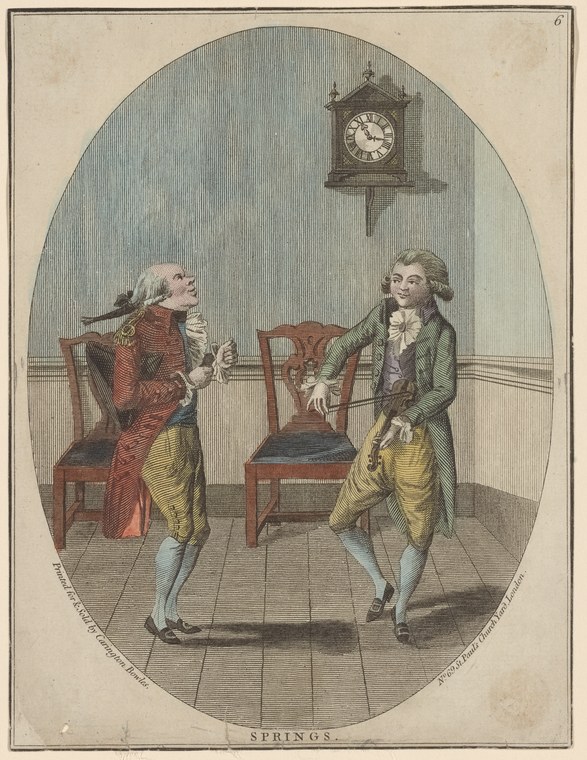
Springs
Unknown artist
- Collection:
- Prints depicting dance
- Source:
- New York Public Library
- Rights:
- Public domain — free to use, share and adapt.
- Recorded as:
- Public Domain
This is a direct window into the pedagogy of 18th-century social dance: it shows us not a performance but a lesson, and it makes explicit what the body was supposed to do. The isolation of two figures against a blank interior, the empty chair, and the directed gaze all reveal the formal, almost mathematical approach to teaching dance in this period—not expression or narrative, but the perfection of line and deportment. For anyone studying how dance was learned and transmitted in the Baroque and early modern periods, this print is primary evidence.
What you are looking at
Two men in 18th-century dress face each other across a modest interior space, poised in what appears to be a social dance or movement exchange. Both wear the formal attire of the period: fitted coats (one red, one green), breeches, stockings, and buckled shoes. The man on the left, seated, wears a red coat with yellow breeches and a tricorn hat; the man on the right stands in a green coat and yellow breeches. Between them sits an empty wooden chair. The setting is austere—plain walls with a horizontal stripe, a wooden floor rendered in perspective, and a wall-mounted clock above indicating the moment of interaction. The engraving's composition emphasizes the precise geometry of their stance and the formal decorum of the encounter, with both figures captured mid-gesture, arms extended or positioned to suggest movement or communication through the body.
The dancing
Both men maintain an upright, formal posture characteristic of courtly deportment. The standing figure on the right extends his arm toward the seated figure with a gesture that suggests instruction, invitation, or demonstration. The seated man's posture is alert and engaged, his body leaning slightly forward. Neither figure displays the closed holds or partnered frames of ballroom dancing; instead, their interaction is one of spatial negotiation and individual control of limbs. The empty chair between them is compositionally significant, suggesting either a pause in activity or a formal spatial protocol.
The dance depicted
This is almost certainly a depiction of a lesson or demonstration in 18th-century social dance, most likely a minuet or similar courtly form given the formal dress and interior setting. The title 'Springs' may refer to the springing or resilient quality of the legs and feet prized in Baroque dance technique—a specific quality of movement rather than the dance form itself. The image documents the pedagogical relationship: one figure appears to be a teacher or more accomplished dancer showing a student the correct deportment and arm position. The careful attention to posture, the isolated gesture, and the stark setting all suggest this is a manual or instructional print intended to demonstrate proper technique.
How it was made
This is an engraving, likely hand-colored after printing given the subtle tints of the coats and breeches. The technique employs fine parallel lines (hatching and cross-hatching) to model form and suggest volume, particularly in the rendering of the coats and the floor's receding perspective. The medium allowed for precise linear definition and wide circulation through printing—this was a teaching tool or reference document meant to be owned, consulted, and possibly copied. The clean lines and legible composition suggest production for a manual or series of instructional plates.
About this work
This engraving is a technical instruction plate on 18th-century social dance deportment, showing two male figures in a lesson or demonstration of proper posture and arm carriage. The title 'Springs' likely refers to the balletic spring or resilience of movement in Baroque dance technique rather than to a specific dance form. It belongs to a tradition of dance notation and instructional imagery that used prints to standardize and disseminate correct technique across a literate, courtly audience. The work is evidence of how dance knowledge was codified and taught in the period, preserved as a visual diagram for reference and study.
How to look at it
Attend to the precise positioning of the arms and the upright spine of both figures—this is not expressive or playful movement, but a demonstration of correct form. The standing figure's extended arm shows the angle and height of arm carriage; the seated figure's alertness demonstrates the readiness required even at rest. Notice the empty chair: it is not incidental but part of the pedagogical setup, marking space and proportion. The clock above measures time, reinforcing that this is a controlled, rational activity rather than an improvised pleasure.
The period
This print belongs to the tradition of instructional dance manuals that flourished in the 17th and 18th centuries, when social dancing (minuets, cotillions, quadrilles, and country dances) was a central accomplishment of the educated elite. The emphasis on 'springs' and the technical isolation of movement reflects the influence of Baroque dance theory, which prized a specific quality of controlled, buoyant legwork and precise geometric positioning of the arms and torso. By the time this print was made, social dance instruction had become increasingly codified and widely distributed through printed images and written notation.
Where it lives
The print is held in the New York Public Library's collection of prints depicting dance. It is catalogued with minimal information—artist, date, and medium are not recorded—suggesting it may be one of many similar instructional plates whose specific origin has not been traced.
Dance in this work
Questions about this work
What does 'Springs' mean in the title?
'Springs' refers to the springing, elastic quality of the legs and feet in Baroque dance technique—a specific bodily quality prized in 18th-century social dance. It is not the name of a dance form but rather a technical term describing how the body should move, with resilience and control in the lower body.
Is this a performance or a lesson?
This is a lesson or demonstration. The empty chair, the stark setting, the positioning of one figure as if instructing the other, and the formal isolation of the movement all indicate this is a teaching moment captured for instructional purposes, not a social dance event or theatrical performance.
Who are the two men?
The figures are generic—they represent a teacher (or more accomplished dancer) and a student, not specific named individuals. The print is a diagram or template showing correct form that could apply to any dancer or student of the period.
What dance style is this?
The formal dress, interior setting, and emphasis on posture and arm carriage suggest this is likely minuet technique or courtly social dance of the 18th century, but the print is focused on isolated technical elements—'springs,' deportment, and position—rather than on a complete dance form.
More dance artwork





