49 works in this view — arrow keys or swipe to move between them.
Dance in Art
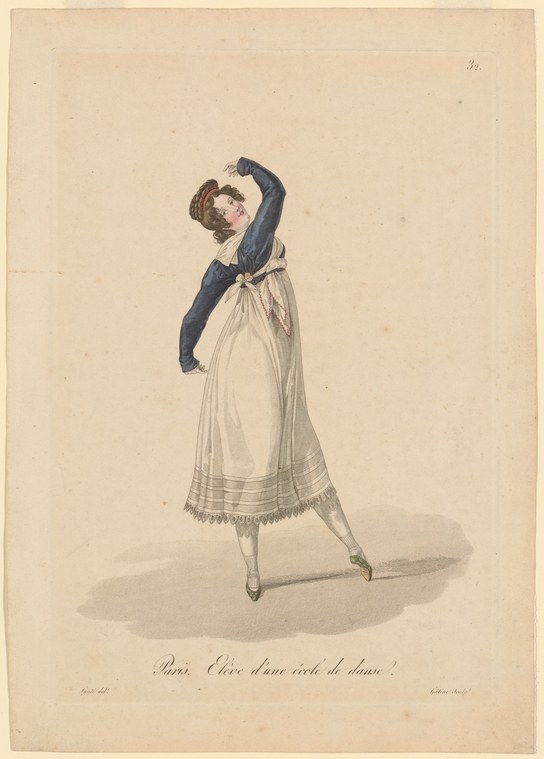
Paris. Elève d'une école de danse
Unknown artist
- Collection:
- Prints depicting dance
- Source:
- New York Public Library
- Rights:
- Public domain — free to use, share and adapt.
- Recorded as:
- Public Domain
This image provides rare direct evidence of how a working ballet student carried herself and was dressed during training in the Napoleonic or early Restoration period—a window into the everyday pedagogy and appearance of the Parisian ballet world before Romantic ballet's great narrative triumphs. It also documents the emergence of the female ballet dancer as a respectable, educated, and aesthetically accomplished figure in polite society.
What you are looking at
A single young woman in a studio or neutral setting, posed in a moment of graceful extension. She wears a high-waisted muslin dress with a fitted bodice and long skirt trimmed with delicate embroidery or lace at the hem, paired with a dark (navy or black) long-sleeved jacket or spencer worn off the shoulder. Her hair is pinned up in the Regency style. She stands on the ball of one foot with a gentle counterbalance, her free leg extended behind her, and her right arm raised to her head in an attitude of ease or adjustment. The figure is rendered in soft watercolour tones against a pale background with minimal shadow cast beneath her feet. The composition is intimate and studious—a single figure study rather than a social scene.
The dancing
The dancer's weight is forward on a supporting leg, with clean posture through the torso and an extended back leg creating a line of lightness. The raised arm to the head suggests either a practical gesture of arranging her hair or a posed attitude—a moment of stillness rather than dynamic movement. Her frame is upright and elongated, the silhouette refined, with no visible tension. The execution shows understanding of the controlled, lifted carriage required of a trained dancer.
The dance depicted
This is an academic study of a ballet student (élève), likely from a Parisian dance school of the early 19th century. The French inscription 'Paris. Élève d'une école de danse' confirms both the city and the institutional context. The figure demonstrates the classical posture and deportment taught in formal ballet training of the period—the turned-out positioning, the lifted torso, the attention to line. This is not a narrative dance scene but a portrait of training itself: the quiet moment between movements, the body held in studied grace.
How it was made
This is a hand-coloured engraving or aquatint, executed with fine detail in the fashion-plate tradition of the early 19th century. The technique allowed for precise rendering of costume and posture, and the hand colouring (visible in the watercolour tones of the dress and jacket) was typical of luxury prints aimed at affluent urban audiences interested in fashion, deportment, and the fashionable accomplishments of young women. The softness of the line and subtlety of shading suggest aquatint; the inscription and signature elements are typical of commercial prints produced for print-sellers and collectors.
About this work
This is a portrait of an unnamed Parisian ballet student, rendered as a fashion and deportment study in the early 19th century. It belongs to a genre of prints documenting the training and appearance of dancers in the classical ballet schools of Paris during the Romantic era—a moment when ballet was becoming a visible and prestigious profession for women, and when the disciplined body of the trained dancer was itself an object of aesthetic interest and fashionable admiration. The work sits at the intersection of dance documentation, fashion illustration, and academic study.
How to look at it
Attend to the subtlety of the pose: this is not a moment of exertion but of demonstrated control and repose. Notice how the artist has caught the figure at a moment of stillness—the hand raised not in movement but in adjustment or rest—which emphasizes the quality of effortlessness prized in classical training. The dress and jacket are rendered with precise attention to fabric and cut, showing that fashion and dance training were inseparable in the perception of cultivated young women. The signature and inscription confirm this is a deliberate study, not a casual sketch.
The period
The early 19th century saw rapid professionalization and feminization of ballet in Paris. By the 1810s–1820s, the Paris Opéra Ballet had become the dominant force in European dance, and ballet training in Paris was codified and prestigious. Young women of bourgeois families increasingly pursued ballet as an accomplishment alongside music and language; dance schools proliferated and became status markers. Simultaneously, the Romantic movement was beginning to reshape ballet aesthetics toward ethereal, otherworldly femininity—the style epitomized by works like La Sylphide (1832). This print belongs to the documentary culture surrounding that world: the fashion press, the print trade, and the celebration of the trained female body.
Where it lives
This print is held in the New York Public Library's collection of prints depicting dance. It is a commercial print of the sort produced in Paris and circulated among urban collectors interested in fashion, dance, and the accomplishments of fashionable society.
Dance in this work
Questions about this work
Who is this dancer?
She is unnamed. The inscription identifies her only as 'élève d'une école de danse' (a student of a dance school) in Paris. She is a type-figure representing the trained young ballet student rather than a named celebrity or named individual.
What is she doing?
She is posed in an attitude of repose, demonstrating the carriage and posture expected of a well-trained ballet student. Her raised arm and extended back leg create a graceful line; the overall effect is one of controlled elegance rather than active performance.
Why would someone print and collect this image?
In the early 19th century, fashion prints and prints celebrating fashionable accomplishments were luxury commodities collected by educated urban audiences. This image documents both the appearance of a ballet student and the aesthetics of Parisian dance training—it was both a fashion plate and a cultural document.
What does this tell us about ballet training in 1810–1830?
It shows that ballet students (especially young women from respectable families) were trained in formal academic methods emphasizing turned-out positions, lifted carriage, and an appearance of effortless grace. The costume—a practical but fashionable day dress and jacket—shows that training was conducted in street clothes rather than specialized dancewear, and that the aesthetic of the trained dancer was inseparable from fashionable dress.
More dance artwork





