49 works in this view — arrow keys or swipe to move between them.
Dance in Art
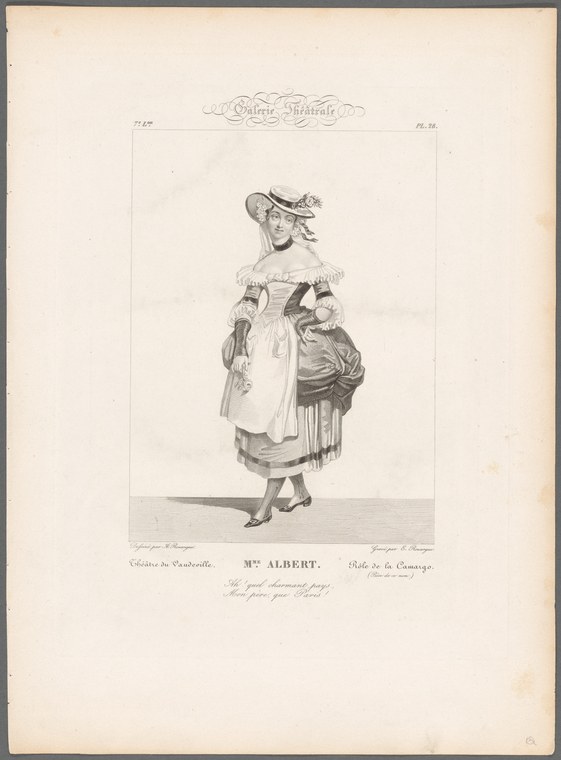
Mme. Albert, rôle de la Camargo (pièce de ce nom), Théâtre du Vaudeville
Unknown artist
- Collection:
- Prints depicting dance
- Source:
- New York Public Library
- Rights:
- Public domain — free to use, share and adapt.
- Recorded as:
- Public Domain
This print documents the survival and adaptation of Camargo—the dancer and the character—into 19th-century theatrical practice, showing how a historic figure from the 18th-century demi-caractère tradition could be reimagined as a modern stage role. For historians of theatrical dance and character dancing, it is evidence of continuity and repertoire; for performance historians, it is a precise record of how a specific role was costumed and presented to an audience.
What you are looking at
A single female figure stands in three-quarter view against a plain background, dressed in early 19th-century stage costume. She wears a white chemise dress with puffed sleeves, a dark bodice or corset vest with horizontal striping or decoration, and a white apron. Her hair is styled up and adorned with a small hat or bonnet. In her right hand she holds what appears to be a small basket or prop; her left arm hangs at her side. Her posture is upright and dignified, weight seemingly centered, with her head turned slightly toward the viewer. The figure is rendered as a finely detailed engraving in black ink on cream paper, with careful attention to the drapery and texture of the costume. This is a theatrical portrait—a costume study of a performer rather than a scene of dancing action.
The dancing
The dancer is depicted standing alone, in a neutral or parade pose rather than in the midst of movement. The body is vertical and composed, the arms relaxed with no partner contact or dramatic extension. The stance suggests a moment of stillness or presentation rather than active choreography. No footwork is visible; the feet are planted and the overall carriage is formal and presentational, as was typical of early Romantic-era stage portraits.
The dance depicted
The inscription identifies this as Mme. Albert performing the role of Camargo (the eponymous piece), most likely at the Théâtre du Vaudeville. This refers to the famous dancer Marie-Anne de Cupis de Camargo (1710–1770), whose reputation as a technical innovator and a performer of wit and charm inspired numerous theatrical vehicles and imitations well into the 19th century. The role of Camargo became a standard repertoire piece for light, clever performers. The engraving captures the character as a costume study: the simple, charming dress and the modest, intelligent bearing reflect the theatrical *Camargo* as a character of esprit and grace rather than of grand tragic gesture. No actual dance is shown.
How it was made
This is a fine engraving, likely created for theatrical distribution or as a souvenir print. The technique allows sharp delineation of costume detail and facial likeness, suggesting that accuracy of representation for audiences and other performers was important. The inscription in French at the bottom (crediting the engraver and the performance venue) indicates this was a commercial theatrical print, circulated to document famous roles and performers. Such prints were standard currency in 19th-century theater, distributed to fans and to the profession itself.
About this work
This is a theatrical costume portrait of Mme. Albert in the celebrated role of Camargo, a comic-sentimental dance role descended from the legend of the 18th-century innovator Marie-Anne de Cupis de Camargo. The engraving is not a representation of dancing, but of the character as she appeared on stage—a study in costume, bearing, and theatrical identity. It belongs in a dance gallery because the role of Camargo was a vehicle for specific kinds of dance performance, and because such prints are primary historical documents of how dancers and their roles were understood and marketed in the Romantic era. The image preserves a moment in the long theatrical afterlife of one of dance history's most influential figures.
How to look at it
Pay attention to the costume and bearing: the simple, charming dress speaks to the character of Camargo as witty and approachable rather than grand. The engraver has taken care to render the face with intelligence and personality, not mere prettiness. This is a theatrical portrait meant to convey both the physical accuracy of the role and something of the performer's own character and appeal. The pose is deliberate—formal enough for a souvenir, but relaxed enough to suggest the liveliness of the character.
The artist
The engraver is not recorded in the catalogue. The style and finish of the engraving suggest a professional Parisian theatrical print workshop of the early-to-mid 19th century. Such prints were typically made by specialist engravers working quickly and in volume for the theater press and the popular market; attribution often went uncredited.
The period
The Romantic era (roughly 1820–1850) saw enormous growth in the documentation and celebrity of individual dancers, especially female performers. Theatrical prints and lithographs were mass-produced and consumed like modern celebrity photographs. The role of Camargo, which played on nostalgia for the technical brilliance and wit of the original dancer, fit perfectly into Romantic taste for character and personality. Light, demi-caractère roles like Camargo were favored alternatives to the grand tragic roles of Romantic ballet, and they remained popular vehicles for actresses and comic dancers throughout this period.
Where it lives
This engraving is held in the New York Public Library as part of its collection of prints depicting dance. The inscription indicates it was created in connection with a performance at the Théâtre du Vaudeville (likely in Paris) and was circulated as a theatrical souvenir. Such prints survive in substantial numbers and are core sources for the study of 19th-century stage costume and casting.
Dance in this work
Questions about this work
Who was the original Camargo?
Marie-Anne de Cupis de Camargo (1710–1770) was one of the most celebrated dancers of the 18th century, famous for technical innovation, expressive wit, and a charming stage presence. She inspired numerous roles and imitations after her death, and the character of Camargo became a standard repertoire piece.
What is a 'rôle de Camargo'?
It is a theatrical vehicle—a play, ballet, or mixed theatrical work—centered on the character or legend of the original Camargo. These roles were designed for light, clever performers who could capture something of the historical Camargo's intelligence and charm.
Why is this print valuable if it shows no dancing?
Theatrical prints like this are primary documents of how roles, characters, and performers were understood and presented. The costume, pose, and facial expression tell us what audiences expected from the role and what a particular performer brought to it. For historians, such prints are often the only visual record of how 19th-century stage works actually looked.
What was the Théâtre du Vaudeville?
The Théâtre du Vaudeville was a Paris theater specializing in light comedies, comic operas, and mixed theatrical entertainments. It was a popular venue for character roles and comic dances, making it a natural home for roles like Camargo.
More dance artwork





