49 works in this view — arrow keys or swipe to move between them.
Dance in Art
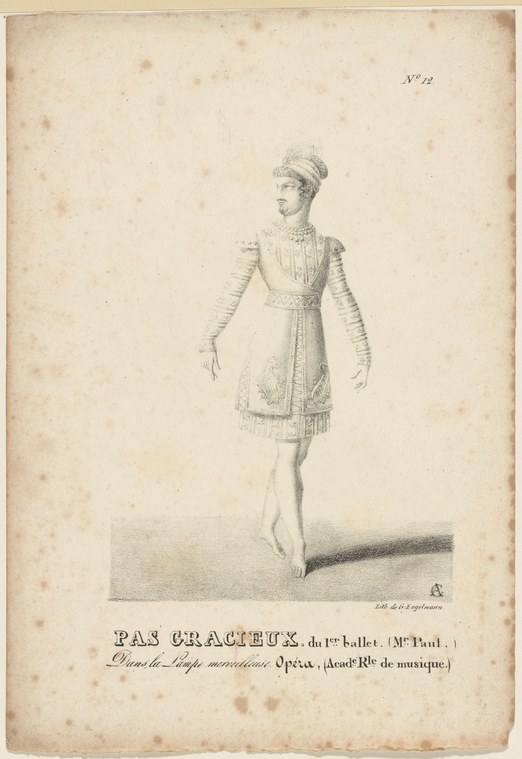
Pas gracieux du 1er ballet. (Mr. Paul.) Dans La lampe merveilleuse. Opera, (Acade. Rle. de Musique)
Unknown artist
- Collection:
- Prints depicting dance
- Source:
- New York Public Library
- Rights:
- Public domain — free to use, share and adapt.
- Recorded as:
- Public Domain
This image documents the appearance and deportment of a male professional dancer in early 19th-century Paris Opera ballet, a subject rarely celebrated in art history. It provides material evidence of the costume, posture, and presentation conventions of operatic ballet before the Romantic era fully established itself, showing a performer in street-clothes elegance rather than the supernatural register associated with Romantic ballet.
What you are looking at
A single female dancer stands in profile against a plain background, wearing a high-waisted Neoclassical or Empire-line dress with long puffed sleeves and what appears to be decorative embellishment at the hem. She wears a small headdress or tiara. Her posture is upright and formal, with one arm extended and the other at her side, her weight evenly distributed and her gaze directed away from the viewer. The figure is rendered in a delicate line engraving technique with fine cross-hatching for shadow, creating a luminous quality against the cream paper. The dancer casts a shadow on the ground plane, anchoring her in space. The image is framed as an isolated study—a portrait of a performer in costume rather than a narrative scene.
The dancing
A single dancer in a standing position with a formal, contained frame. Her extended arm and upright carriage suggest classical training and courtly deportment. There is no visible turnout, no evidence of pointe work, and her feet are shown in soft shoes or slippers. Her silhouette is elongated and graceful, typical of Romantic-era ballet illustrations. The pose is presentational rather than caught mid-movement: this is a portrait of a dancer in her stage costume, not a freeze-frame of a step.
The dance depicted
The title identifies this as a pas gracieux (graceful dance) from the first ballet of the opera *La Lampe merveilleuse*, performed at the Académie Royale de Musique (Paris Opera). The dancer is identified as Mr. Paul, a male performer. Despite the gendered title "Pas gracieux," this is a study of a male dancer in a light, elegant solo. The costume—the Empire waistline, puffed sleeves, and modest headdress—and the formal presentation mode suggest early 19th-century ballet, likely from the 1810s–1820s, when such operatic ballet interludes were standard. The lack of pointe work and the soft shoes confirm this predates the dominance of the female dancer en pointe.
How it was made
This is an engraving (possibly a stipple engraving or fine line engraving), a reproductive print technique that allowed wide distribution of images of famous dancers and performances. The delicate lineWork and attention to the texture of fabric suggest a skilled reproductive engraver working from a painting or drawing. Engravings were the primary medium for disseminating images of stage performers and ballets in the early 19th century, and their relative affordability made them accessible to a broad audience of dance enthusiasts, subscribers to opera houses, and collectors. The technique's precision allowed for reproducible, consistent images.
About this work
This is a documentary image of a professional ballet dancer performing in an operatic ballet at the Paris Opera in the early 19th century. It is one of a numbered series of such prints—the notation "N° 13" at top right suggests a larger album or portfolio of similar studies. The work belongs to a tradition of single-figure ballet prints that served both as souvenirs of performances and as records of the appearance, costume, and deportment of celebrated dancers. The formality of the presentation and the careful rendering of the dress and headdress emphasize the theatrical and courtly conventions of the era.
For dance historians, this image is valuable precisely because it documents what an early 19th-century operatic ballet performer looked like in costume and at rest—how the body was carried, how the costume was proportioned, and what the stage aesthetic was. It is a visual record of a moment before the Romantic ballet transformed the art, before Taglioni made the pointe shoe and the ethereal ballerina the dominant image.
How to look at it
Note the formal, almost heraldic quality of the pose—the dancer is presented as one might present a portrait of a nobleman or theatrical celebrity. The costume shows the influence of Neoclassical fashion (the high waistline, the puffed sleeves), which was still current in early 19th-century stage dress. The soft shoes and the absence of any visible strain or extreme extension tell you that this is a performer of grace and elegance rather than technical virtuosity. Watch how the artist has rendered the fabric—the delicacy of the sleeves and the subtle fall of the skirt—which conveys both the luxury of stage costume and the controlled, upright carriage expected of the era's dancers.
The period
This print dates to the early 19th century, when the Paris Opera (Académie Royale de Musique) was the preeminent institution in European ballet and when ballet was still primarily an entertainment interlude within operatic productions rather than a standalone art form. Male dancers held significant prestige in this era; the ballet d'action was a mixed ensemble form. By the 1830s, the Romantic movement and the ascendancy of the ballerina en pointe would marginalize male dancers and remake ballet as an art centered on the female body. This print captures ballet on the eve of that transformation.
Where it lives
This print is held by the New York Public Library in its collection of dance-related prints. It is part of a numbered series and appears to have been published as part of a portfolio or album documenting performances and performers of the Paris Opera in the early 19th century. Such prints were sold individually and in bound sets to opera subscribers and collectors.
Dance in this work
Questions about this work
Who was Mr. Paul?
The print identifies the dancer only as "Mr. Paul," a performer in the Paris Opera ballet. Without additional archival research, we cannot determine his full name or biographical details. The title page or portfolio cover in which this was originally bound would likely have provided fuller information.
What is *La Lampe merveilleuse*?
This was an opera with an integrated ballet performed at the Académie Royale de Musique (Paris Opera). The title translates as *The Wonderful Lamp*. Early 19th-century opera routinely included ballet interludes; this print documents a solo from the first ballet of that production.
Why is a male dancer wearing a dress?
In early 19th-century ballet, both male and female dancers wore fashionable or fantastic dress appropriate to their roles and the aesthetic of the production. Male performers in light, elegant roles wore tunic-like garments or dresses with soft, naturalistic silhouettes. The distinction between male and female costume had not yet crystallized into the gender-marked divide of the Romantic era (tutus for women, tights and tailcoats for men).
Is he on pointe?
No. The shoes visible in the print are soft slippers. Pointe work did not become standard for female dancers until the late 1820s and after, and male dancers in the early 19th century did not use pointe shoes at all.
More dance artwork





