49 works in this view — arrow keys or swipe to move between them.
Dance in Art
Ballroom dancing on British and American 19th-century music covers
Unknown artist
- Collection:
- Prints depicting dance
- Source:
- New York Public Library
- Rights:
- Public domain — free to use, share and adapt.
- Recorded as:
- Public Domain
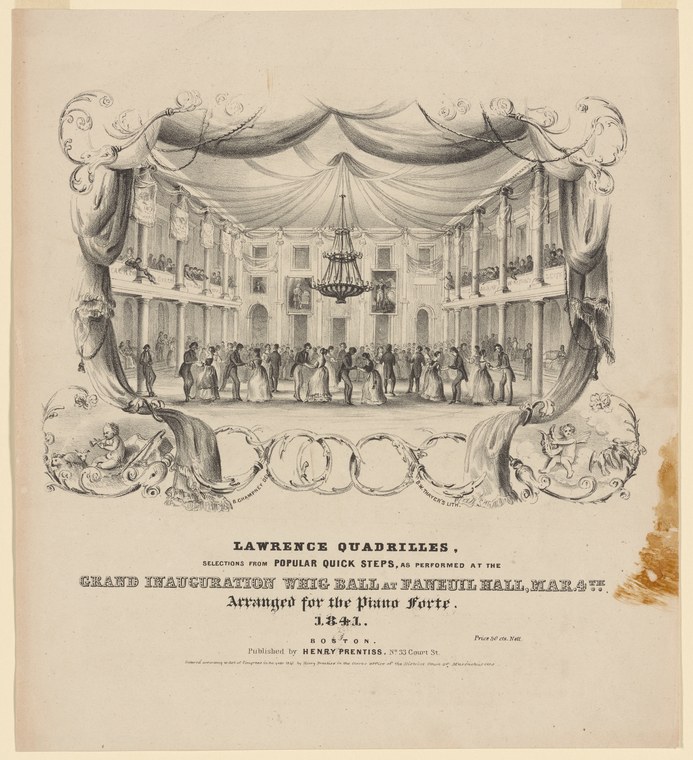
This print provides concrete visual evidence of how ballroom couples held and moved together during a specific moment in dance history, and it shows the architectural and social context in which dances were taught and performed. For historians and dancers, it documents the styling, costume, and gender dynamics of 19th-century partner dancing in its actual social setting rather than through instruction manuals or fictional illustration.
What you are looking at
A grand ballroom filled with formally dressed dancers in 19th-century attire. The space is dominated by a coffered ceiling and columned walls on both sides, suggesting an aristocratic or public assembly hall. Elegant drapery swags heavily across the top of the composition, framing the scene like a theatre within the print itself. The dancers occupy the floor in scattered groupings—couples and small clusters in various phases of movement, their forms rendered as silhouettes or lightly shaded figures creating an atmospheric depth. Gas or candle lighting would have illuminated such a space. The print is bordered by ornamental flourishes: rococo scrollwork and shells at the corners, and an elaborate draped swag frame that emphasizes the theatrical nature of the scene. The overall composition suggests a moment of social festivity, with the framing device giving the impression of viewing the ballroom as a stage performance.
The dancing
The dancers are depicted in the closed ballroom holds characteristic of 19th-century couple dances. Most figures show men and women paired, with the woman's arm raised and the man's posture upright and commanding. The silhouetted treatment of many figures makes precise footwork difficult to discern, but the general distribution of weight and the forward lean of several couples suggest forward-moving progression around the ballroom floor. The scale of the figures varies from detailed foreground couples to smaller background dancers, creating spatial recession and the sense of a crowded social event.
The dance depicted
This depicts a fashionable 19th-century ballroom scene, most likely from Britain or America based on the print's publication and title reference to Janizah Hall. The 'Quick Steps' title and the mixed groupings of couples suggest social dances of the Gilded Age period—possibly waltzes, polkas, or galops. The dancers' formal dress, the orderly spacing, and the architectural grandeur all confirm this as a genteel social dancing event rather than theatrical performance. Without inscribed identifications or clearer detail of specific footwork, the exact dances cannot be definitively separated, though the general velocity and coupling pattern is consistent with the faster dances popular in the 1840s.
How it was made
This is a lithograph or engraving, identifiable by its fine linear technique, tonal gradations achieved through hatching and stippling, and the characteristic printed surface. The decorative frame elements and the theatrical swag border are integral to the composition, suggesting this was a cover design for printed music—explicitly stated in the title as selections from 'Popular Quick Steps.' The medium allowed for mass production and affordable distribution to amateur musicians and dancers of the middle and upper-middle classes. The theatrical framing convention reflects the Romantic-era fashion of treating ballroom dancing as spectacle worthy of artistic attention.
About this work
This is a music cover engraving depicting a grand 19th-century ballroom scene in Britain or America, circa 1844, when waltzes and quick galops dominated fashionable dancing. The composition frames the dancing as theatrical spectacle, using an ornamental swag and rococo borders to present the ballroom as if it were a stage. The print served both as marketing for sheet music and as visual documentation of how the urban gentry danced in their assembly halls—standing evidence of the social rituals and architectural grandeur associated with Gilded Age courtship and social display.
The work belongs to a rich tradition of ballroom imagery that flourished in the 19th century, when dance was increasingly professionalized and commercialized through published music, instruction manuals, and promotional prints. It captures a moment of transition when ballroom dancing was becoming a leisure pursuit for the expanding middle class, not merely an aristocratic privilege.
How to look at it
Note the theatrical framing—the swag border and ornamental corners deliberately present the ballroom as a stage, a convention borrowed from theatre prints and opera scenes. Observe how the couples at the front are rendered in greater detail, while background dancers dissolve into silhouette, creating spatial depth and the sense of an actual crowded room. The formal posture of all the dancers, their controlled spacing, and the absence of exaggerated gestures convey the restraint and decorum expected of genteel dancers, a contrast to earlier folk dance imagery that often emphasized wild motion and abandon.
The artist
The engraver is not recorded in the catalogue. The work was published by Henry Prentiss of 37 Great Pulteney Street, London, a music publisher who issued both compositions and related instructional and promotional prints. The ornamental style and theatrical framing convention are consistent with mid-19th-century commercial music publishing, when cover designs for dance music became opportunities for artistic elaboration.
The period
The 1844 date places this in the height of the Waltz Era, when the waltz and allied quick dances (galop, polka) had displaced the earlier country dances and cotillions from fashionable ballrooms. These were transformative decades for social dance: the closed couple hold was new and still slightly scandalous, professional dancing masters were establishing themselves in London, Paris, and American cities, and sheet music for dance music was a major commercial sector. Lithography and engraving made it economically viable to produce elaborate cover illustrations for popular pieces, turning music into a form of visual entertainment before it was heard.
Where it lives
Held by the New York Public Library as part of its collection of prints depicting dance. This is a commercial printed object—a music cover—rather than a unique artwork, and its survival reflects the collecting practices of music libraries and the gradual recognition of dance imagery as historically significant.
Dance in this work
Questions about this work
What music was this a cover for?
The print is labeled as selections from 'Popular Quick Steps' as performed at the Inauguration of Janizah Hall, Maryatt, and arranged for pianoforte. The specific composers are not legible in this reproduction. The fact that it was a music cover means it was sold as part of a published score, making it both advertisement and instructional aid.
Why does this look like a stage scene?
The theatrical framing—the swag border and ornamental cartouches—was a standard convention in 19th-century commercial prints. By framing the ballroom as a stage and the dancers as performers, the engraver elevated social dancing to the status of spectacle, making a printed music cover feel like a souvenir of an important public event.
What dances are these people doing?
The title specifies 'Quick Steps,' which in 1844 meant waltzes, galops, or polkas—fast, turning dances in closed couple position. The exact identity of individual dances cannot be determined from the silhouetted treatment, but the general posture and spacing is consistent with these Waltz Era dances.
How do I know this was a real place and not imaginary?
The print names Janizah Hall in Maryatt, suggesting a specific venue. Without additional research into London concert halls and dance venues of 1844, we cannot confirm whether this was an actual ballroom or a fictionalized grand space. The specificity of the title implies a real event, and the print would have been more marketable if associated with an actual fashionable venue.
More dance artwork





