49 works in this view — arrow keys or swipe to move between them.
Dance in Art
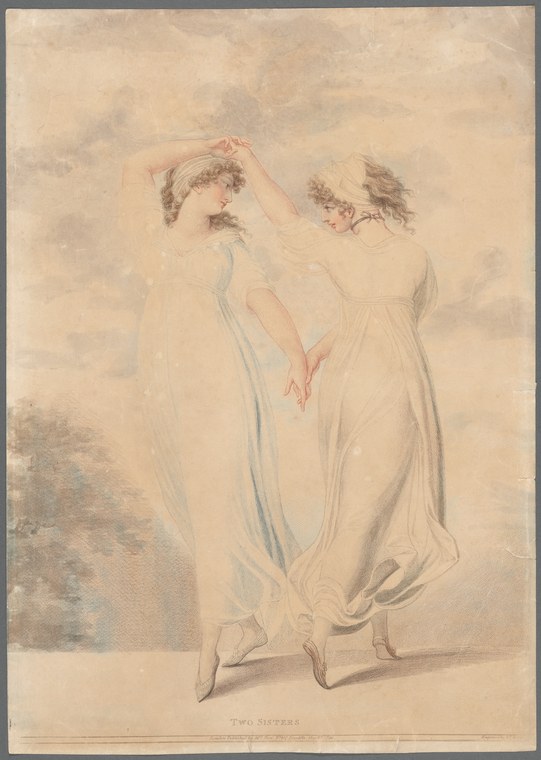
Two sisters
Unknown artist
- Collection:
- Prints depicting dance
- Source:
- New York Public Library
- Rights:
- Public domain — free to use, share and adapt.
- Recorded as:
- Public Domain
This image documents the costume and carriage of Regency-era women at the precise moment when the high-waisted, neoclassical silhouette dominated fashionable dress and dancing. For historians of ballroom culture and social dance, it offers evidence of how women of the period understood their own bodies and presented themselves in spaces where dancing was a central social practice. The tender, private interaction depicted here also counters any assumption that Regency dance culture was purely formal or distant—the image captures genuine affection and ease within the dancing world.
What you are looking at
Two young women in high-waisted, classically draped white or cream muslin gowns stand together against a plain, softly graded background. The figure on the left faces toward the viewer with her head tilted back, her right arm raised to her head in a gesture that suggests adjustment of her hair or headpiece. The figure on the right, positioned behind and slightly to the left, reaches toward the first woman's head or upper body with both arms extended in a graceful arc. Both women wear their hair up in the Regency style, and their poses suggest a moment of intimate, playful interaction—perhaps the arrangement of a hairstyle, the adjustment of a bonnet, or a tender gesture between companions. The composition is intimate and informal, capturing a private moment rather than a formal dance or set piece. The soft modeling of the bodies and the delicate handling of the drapery suggest this is likely a watercolor or colored print rather than a drawing.
The dancing
Both figures stand with upright, graceful posture characteristic of Regency-era deportment. The woman on the left leans her head back slightly, creating a gentle S-curve in her spine, while her companion reaches toward her with extended arms in a curved, almost cradling gesture. Neither figure displays a closed dance hold or standard partnered stance. Their interaction is characterized by lightness and tenderness—the positioning suggests mutual attention and affection rather than the structured frame or weight distribution one would see in a waltz or cotillion. The composition emphasizes the femininity and grace of the bodies over technical foot placement or ballroom positioning.
The dance depicted
This image does not depict formal dance instruction or performance. While the women are posed with the elegant carriage and costume of the Regency dance world, their gesture and interaction suggest a moment of social intimacy—the adjustment of a companion's appearance or a playful, affectionate interaction between sisters or close friends. The title 'Two Sisters' reinforces this reading. The work captures the culture and aesthetics of the Regency ballroom world without depicting an actual dance step or partnered movement. The soft, gestural quality of the poses aligns more closely with the sentimental, domestic imagery popular in Regency-era prints than with technical dance documentation.
How it was made
This work appears to be a hand-colored aquatint or engraving on paper, likely produced in the early 19th century. The soft tonal gradations in the background, the delicate modeling of the figures, and the refined handling of the muslin drapery are characteristic of colored prints of the Regency period. The technique allowed for fine detail and broad distribution—prints like this circulated widely among the middle and upper classes as affordable reproductions of fashionable subjects. The handcoloring adds immediacy and a sense of individual attention to each impression.
About this work
This is a Regency-era print depicting two young women in high-waisted Empire silhouette gowns in a moment of private, affectionate interaction. Though the women are dressed for the ballroom and carry the refined posture of the dancing world, the image itself documents social gesture and feminine companionship rather than formal dance. It belongs in a gallery of dance in art because it captures the material culture, costume, and aesthetic values of the Regency ballroom at the height of their influence—a world in which the ability to move with grace was inseparable from identity and courtship, even in moments away from the dance floor. The work reveals how deeply ballroom aesthetics penetrated Regency visual culture.
How to look at it
Attend to the gesture of the woman on the right: her arms describe a graceful, curved path through space, and her body leans forward slightly in engagement with her companion. This is the artist's primary choice—not a dance step, but a moment of tender care. Note the silhouettes: the high waistline, the narrow sleeves, the way the muslin falls in soft columnar folds. These details place the work precisely in the Regency period and show how the era's aesthetic ideals—simplicity, verticality, neoclassical restraint—shaped even the bodies of women at rest. The soft background focuses attention on the figures themselves and their interaction.
The artist
The artist is not recorded, but the work belongs to a large tradition of Regency-era hand-colored prints documenting fashionable life, costume, and social practice. Such prints were produced by printmakers and publishers throughout London and the provinces and distributed widely as affordable art objects for drawing rooms and modest collections. The style and execution suggest a competent commercial workshop rather than a famous name—the work was made to circulate, not to be signed.
The period
This image dates to the height of Regency neoclassical taste, a period (roughly 1811–1820) when the high-waisted Empire silhouette, inspired by Greco-Roman dress, dominated fashionable women's clothing. The waltz and cotillion were becoming central to ballroom culture, and images of fashionable women in these new, flowing gowns were in high demand. Hand-colored prints depicting fashionable dress, domestic scenes, and social interaction were a major genre of commercial printmaking. The soft, sentimental quality of this image—two sisters in a private moment—reflects the Romantic emphasis on feeling and intimate relationships that increasingly shaped visual culture alongside the formal structures of ballroom dance.
Where it lives
The work is held in the New York Public Library's collection of prints depicting dance. It appears to be an early 19th-century hand-colored engraving or aquatint, typical of the commercial print production that supplied fashionable households with images of contemporary dress and social life.
Dance in this work
Questions about this work
Is this actually a dance image?
Not strictly. The women are not performing a dance step or in a partnered ballroom hold. However, the image is inseparable from Regency dance culture—the costume, posture, and aesthetic are entirely shaped by ballroom fashion and the era's ideals of feminine grace. It documents the world of dancing without depicting dance itself, which makes it valuable for understanding how deeply ballroom culture penetrated everyday life and social identity.
What are they wearing?
High-waisted Empire silhouette gowns in white or pale cream muslin, characteristic of Regency fashion (1811–1820). The style was inspired by Greco-Roman dress and dominated fashionable women's clothing of the period. The narrow sleeves, long straight skirt, and simple form were considered both elegant and suitable for dancing.
Who is the artist?
The artist is not recorded. The work appears to be a commercial print, likely produced by a London-based workshop and distributed widely. Such prints were often published anonymously or under a printer's name rather than an artist's signature, as they were understood as functional fashion documents rather than fine art.
More dance artwork





