49 works in this view — arrow keys or swipe to move between them.
Dance in Art
Female dancer in folk costume
Unknown artist
- Collection:
- Prints depicting dance
- Source:
- New York Public Library
- Rights:
- Public domain — free to use, share and adapt.
- Recorded as:
- Public Domain
This print is evidence of how Romantic-era theaters consumed and presented folk dance and non-European dance forms—not as living cultural practices but as theatrical spectacle and costumed character types. For dance historians, it documents the silhouette, construction technique, and color palette of a mid-nineteenth-century folk character costume worn in European theaters, and raises important questions about cultural appropriation and the transformation of social dance into aesthetic commodity.
What you are looking at
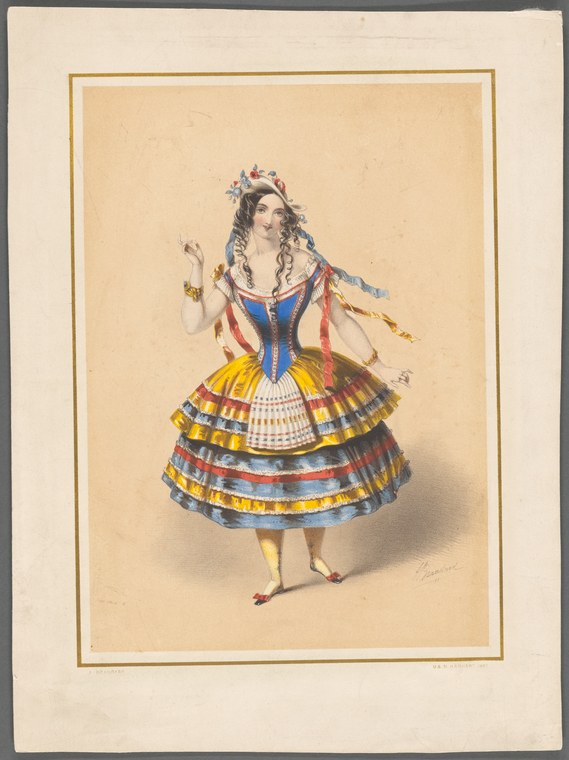
A single female dancer occupies the center of the composition, posed in a frontal stance against a warm, neutral background. She wears a striking folk costume: a white linen chemise with puffed sleeves worn off the shoulder, a fitted blue corset bodice, and a full skirt composed of horizontal bands in contrasting colors—yellow, red, white, and blue—arranged in a tiered, pleated construction. Her dark hair is braided and crowned with a wreath of red and pink flowers, with colored ribbons streaming down her back. She holds her right arm raised at shoulder height with palm forward in a gesture of presentation or blessing, while her left arm hangs naturally at her side. Her posture is upright and dignified, her expression poised and slightly animated. The figure casts a soft shadow on the ground, suggesting light from the upper left, and the entire image is framed by a double-line border in gold and darker brown, typical of nineteenth-century theatrical or costume prints.
The dancing
The dancer's pose is a presentation stance rather than an active movement moment—the body is vertical and symmetrical, the weight evenly distributed on both feet. The raised right arm, with its open palm turned outward, reads as a gesture of display or salutation rather than a balletic or acrobatic position. This is not a body captured mid-motion but rather arrested in formal address to the viewer, a theatrical convention of costume portraiture. The figure fills the frame solitarily with no partner or chorus.
The dance depicted
This appears to be a costume study for a dancer or performer in a folk or national character role, most likely Eastern European or Central European given the specifics of the dress—the construction of the skirt, the braided coronet, and the embroidered detail visible in the bands of color. The style of costume suggests a Romantic era (mid-nineteenth century) theatrical production that incorporated folk or national dances as novelty numbers or character turns. The pose itself—formal, presenting the costume to the viewer—is typical of stage portraiture from this period. Without more information, it is impossible to name the specific dance or its cultural origin, but the garment and styling point toward a repertoire of ethnic or folk dances that circulated in European theaters during the 1840s–1860s.
How it was made
This is a hand-colored lithograph or possibly a hand-tinted engraving, identifiable by the fluid quality of line, the translucent layering of watercolor or gouache over the printed image, and the characteristic texture of the paper. The technique allowed for rapid reproduction and hand-finishing of theatrical costume studies, making multiple copies available to theater companies, dancers, and collectors of theatrical ephemera. The double border and proportions suggest it was issued as part of a series—a common format for mid-nineteenth-century dance and costume prints sold individually or in albums to document contemporary performers and their stage dress.
About this work
This is a hand-colored lithographic costume study of a female dancer in elaborate folk or national character dress, likely from the mid-nineteenth century. The print documents both the precise construction of a theatrical costume—the tiered, multi-colored skirt, the off-shoulder chemise, the floral coronet—and a moment of formal theatrical presentation. It belongs to a large body of nineteenth-century dance imagery that captured the Romantic ballet's and theater's appetite for exotic and folkloric material, presenting dancers and their costumes as objects of visual curiosity and aesthetic appreciation. The work is part of a tradition of costume and character studies that educated audiences about theatrical dress and allowed performers to be recognizable to the public.
How to look at it
The viewer should attend to the precision of the costume detail: the mathematical construction of the tiered skirt, the exact arrangement and count of the colored bands, the texture of the linen, and the specificity of the embroidered borders. These details were not invented but documented—they represent either ethnographic observation or the theater's interpretation of folk dress. The frontal, static pose is not incidental; it is the convention of mid-century costume study, designed to make every element of the garment legible and reproducible. The upward gaze and slightly open mouth also suggest performance convention—a moment of theatrical presence rather than private gesture.
The artist
The artist is not recorded on the catalogue entry. The style and execution suggest a trained theatrical lithographer working in the commercial tradition of Parisian or London print production for the theater market. The hand-coloring may have been executed by the artist or by a workshop specializing in such finishing work.
The period
The 1830s–1860s saw an explosion of interest in folk, ethnic, and national subjects in European ballet and theater, partly driven by Romantic aesthetics and partly by commercial novelty-seeking. Dancers like Fanny Essler and other performers incorporated folk dances into their repertoires—Spanish boleros, Hungarian czardas, Swiss dances—presented within the framework of the ballet. Simultaneously, the theatrical lithograph became the primary means of circulating images of celebrated dancers and their costumes, creating a visual archive of nineteenth-century performance and a market for dance-related prints.
Where it lives
This work is held in the New York Public Library's Prints collection, part of a larger archive of nineteenth-century theatrical and dance-related prints and ephemera. As a commercial theater print, it was produced and distributed to a wide audience and was never a unique or precious object, making it an important survivor of the popular visual culture of dance.
Dance in this work
Questions about this work
What dance does this costume belong to?
The catalogue record does not specify. The costume style—tiered skirt with colored bands, off-shoulder chemise, floral coronet, braided hair—is consistent with Eastern or Central European folk costume or a Romantic-era theater's interpretation of it. Dancers in the mid-nineteenth century wore such costumes for character dances advertised as 'Spanish,' 'Hungarian,' 'Polish,' or other national types, though the actual cultural origin is often unclear and the costume may be a European theatrical invention.
Is this a real costume or a stage fantasy?
It is almost certainly a real costume, documented in this print as evidence of what was actually worn on stage. However, the relationship between the garment and its claimed folk origin is uncertain. Theatrical costumers often invented or adapted folk dress for stage purposes, prioritizing visual effect, durability, and the performer's mobility over historical or cultural accuracy.
Who was this dancer?
The print does not identify the performer. It may be a generic costume study issued as part of a series, or it may document a named performer now unknown. Without a signature, inscription, or title, attribution is impossible.
When was this made?
The style, technique, and costume suggest mid-nineteenth century, probably 1840s–1860s, but the catalogue record gives no date. The hand-coloring technique, the typography of any border text (if present), and the archival provenance would refine the dating.
More dance artwork





