49 works in this view — arrow keys or swipe to move between them.
Dance in Art
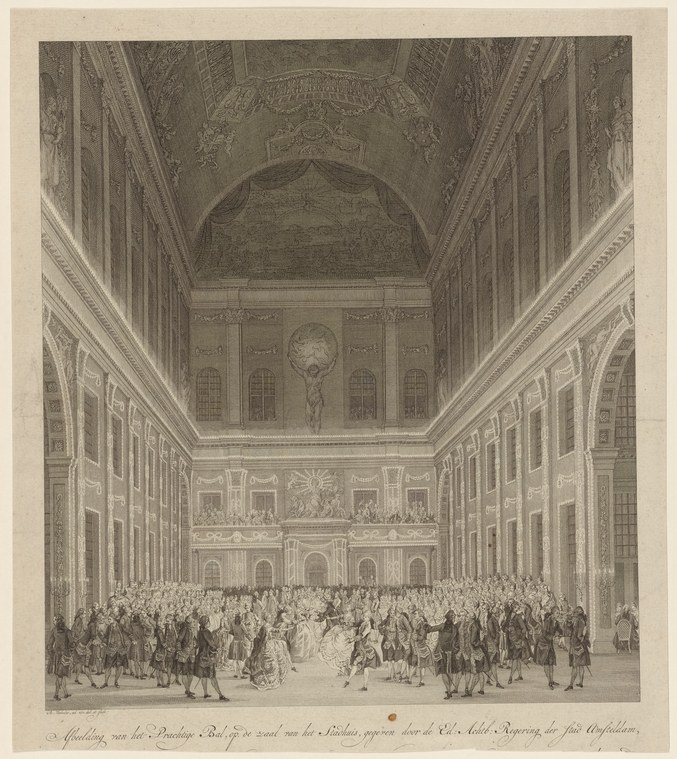
Afbeelding van het prachtige bal, op. de zaal van het Stadhuis, gegenen door de Ed. Achtb. Regering der stad Amsteldam [second line of legend cropped]
Unknown artist
- Collection:
- Prints depicting dance
- Source:
- New York Public Library
- Rights:
- Public domain — free to use, share and adapt.
- Recorded as:
- Public Domain
This is documentary evidence of how formal social dances were staged and experienced in eighteenth-century civic space. It shows that the 'ballroom' was not a neutral container but an architected assertion of order and authority—and that dance was inseparable from that setting. For historians of dance, fashion, and public ceremony, it demonstrates how a major city displayed collective refinement and maintained social hierarchy through dancing.
What you are looking at
A formal ballroom assembly in eighteenth-century Amsterdam, depicted from a vantage point within the grand hall. The vast rectangular room is defined by paired columns along both long walls, their fluted shafts and capitals rendered in precise perspective. The ceiling rises in a barrel vault, its surface decorated with geometric patterns and paintings. Tall arched windows set into the columned walls admit light across the assembly. The floor is crowded with figures in aristocratic dress—men in dark coats and breeches, women in wide pannied skirts—arranged in small clusters and lines. The gathering suggests formal social dancing: some figures stand at the perimeter, others cluster in conversation, and at least one group in the middle distance appears to stand in paired formation facing one another, consistent with a lined country dance or quadrille. The overall impression is one of ordered ceremony within a space of classical grandeur.
The dancing
The dancers and spectators are rendered as small figures distributed across the floor space, which emphasizes the scale of the room rather than the bodies themselves. Those who appear to be dancing maintain upright postures and stand at regular intervals apart, suggesting a progression or line formation rather than close partnering. The dress is consistently formal: men wear coats to the knee with visible breeches, women wear the characteristic wide pannied skirts of the mid-eighteenth century that extend the silhouette horizontally. Arm positions cannot be read in detail at this scale, but the overall frame is composed and architectural rather than expressive or demonstrative.
The dance depicted
This is a formal court or civic ball, most likely a Quadrille, English Country Dance, or Grand March—all standard social dances of eighteenth-century aristocratic Europe. The title's reference to 'Stadhuis' (City Hall) and the civic distinction of the hosts suggests this was a public assembly ball rather than a private court occasion, though the formality and classical setting mirror courtly precedent. The evidence lies in the grouped standing formation of the figures and the neat spacing that suggests ordered progressions or a line dance structure. Without closer detail of footwork or hold, a more specific attribution is not possible, but the architectural framing and formal assembly are entirely consistent with Dutch or Flemish depictions of civic ceremonial dances of the 1750s–1780s.
How it was made
This is an engraving or etching, identifiable from the fine parallel lines of the hatching that model form and shadow, the precise linear framework of the architecture, and the small-scale figure work typical of reproductive printmaking. The technique permits the rendering of architectural space with mathematical accuracy while keeping figures small enough that the vast scale of the ballroom becomes the dominant subject. Such prints were made for circulation among the educated classes and civic institutions—they documented important public events and served as records of civic ceremony. The scale and legibility suggest this was intended for bound publication or mounted display rather than intimate viewing.
About this work
This is a record of a formal civic ball held in Amsterdam's Stadhuis, rendered as an engraving or etching in the Dutch eighteenth-century tradition of ceremonial documentation. The work prioritizes architectural setting and the geometry of assembled figures over the specifics of individual bodies or choreographic detail. It belongs to a category of prints—popular in the Netherlands and the Holy Roman Empire—that commemorated important public dances, civic ceremonies, and aristocratic gatherings. The image is valuable precisely because it captures the scale, decorum, and spatial arrangement of formal social dancing at a moment when such events were understood as displays of civic order and refinement. It shows how dance functioned as a collective social performance within carefully designed settings, where the room itself was part of the spectacle.
How to look at it
Step back from the image first: the real subject is the vast ordered space, not the small figures within it. The room is designed to frame and contain the dance. Notice the precision of the perspective construction—the columns recede into the distance, the vault rises overhead, and the assembly is distributed across an exact grid. The groupings and spacings of the figures are not random; they suggest the structured progressions of a formal line dance where dancers move through prescribed patterns. Look for the distinction between dancers (standing in line or paired formation) and spectators (clustered at the edges). The choice to depict the moment of stillness and assembly rather than active movement is itself informative: this was a dance form organized around precise positioning and collective order, not individual expression or rapid footwork.
The period
The mid-to-late eighteenth century saw the codification and international standardization of formal social dances, particularly the Quadrille, English Country Dance, and Minuet. These dances were central to aristocratic sociability and civic ceremony across Europe. The Netherlands in this period maintained strong civic traditions of formal assembly balls, particularly in major commercial cities like Amsterdam. The print itself reflects the Dutch tradition of documenting civic events through printmaking—a practice that created a visual archive of public life for educated subscribers. The classical architectural aesthetic of the ballroom shown here was conventional for the period and expressed Enlightenment ideals of reason, order, and refined society.
Where it lives
The work is held in the New York Public Library's collection of prints depicting dance. It is a documentary print, likely created in or shortly after the event it depicts, as a record for civic and social circulation.
Dance in this work
Questions about this work
What dance is being shown here?
The specific dance form cannot be determined with certainty from the image alone, but the formal grouping and scale suggest either a Quadrille, English Country Dance, or Grand March—all standard dances of formal eighteenth-century assembly balls. The evidence lies in the neat spacing and paired or linear formations of the figures, which were characteristic of progression dances rather than closed partnering.
Why is the room so emphasized in the image?
The Stadhuis was a civic monument and a statement of municipal power. By depicting the grand classical architecture as the dominant feature, the print emphasizes that the dance took place within an ordered, rational, and refined civic space—the architecture and the dance together expressed the status and virtue of the city and its governing class.
What was the occasion for this ball?
The title indicates it was given by the 'Achtb. Regering' (Noble Government) of Amsterdam in the main hall of the Stadhuis. This suggests either a ceremonial public ball, a civic celebration, or a formal reception. Such events were important occasions for the display of order, refinement, and collective identity.
More dance artwork





