49 works in this view — arrow keys or swipe to move between them.
Dance in Art
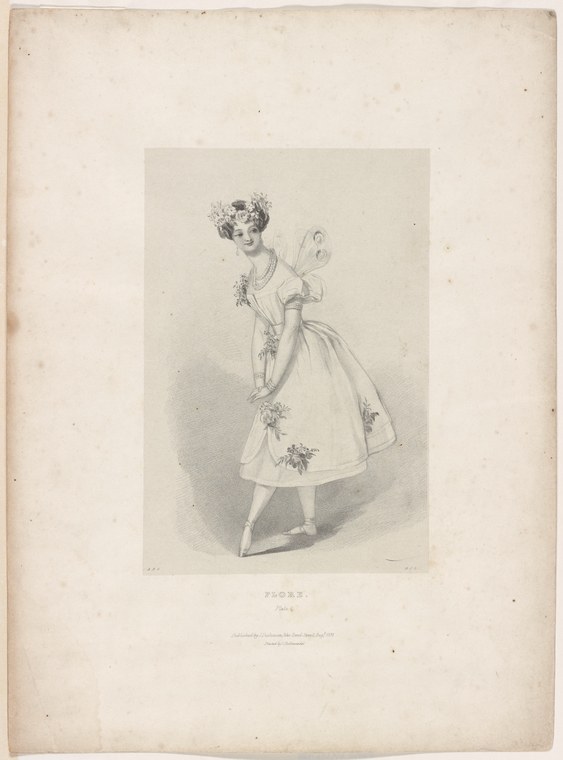
Flore
Unknown artist
- Collection:
- Prints depicting dance
- Source:
- New York Public Library
- Rights:
- Public domain — free to use, share and adapt.
- Recorded as:
- Public Domain
This print is a direct record of what a Regency dancer or actress wore and how she was publicly presented to audiences who could not attend the theatre. It shows how allegorical female roles were costumed and how the female body was framed in the conventions of the period—upright, passive, and ornamented, not as a vehicle for technical virtuosity.
What you are looking at
A young woman in a white muslin dress stands in three-quarter view against a pale ground, her body angled toward the viewer's left. She wears her dark hair gathered up with a floral wreath or crown, and holds a small round mirror in her right hand at shoulder height, gazing into it. Her left arm hangs naturally at her side. The dress is high-waisted in the Regency manner, with short puffed sleeves, a fitted bodice, and a full skirt that falls to mid-calf; the hem and bodice are decorated with sprays of small flowers or leaves. She wears flat slippers. Her posture is upright and graceful, her weight balanced on both feet, her expression serene. The figure occupies the upper two-thirds of the composition; the page is otherwise blank except for the title 'FLORE' printed below in small capitals and what appears to be a publication line in faint text.
The dancing
A single standing female figure, weight evenly distributed, arms relaxed and asymmetrical—one holding the mirror, one at rest. The pose is neither active nor gestural in the modern sense; it is a static, dignified presentation of the body in profile-to-frontal alignment. No evident footwork or dynamic frame. The figure's carriage is upright and self-possessed, consistent with early-nineteenth-century deportment codes for young women of rank.
The dance depicted
This is not a depiction of choreographed dance in motion, but rather a figure study or costume plate. The title 'Flore' (Flora) and the floral wreath suggest an allegorical or theatrical character, possibly from a ballet, pantomime, or masquerade entertainment of the Regency period. The mirror and the self-contemplative pose are iconographic rather than kinetic. If this figure appeared in a theatrical work, she would represent a character type—the Spring goddess, a sylph, or a coquette—rather than demonstrate a specific dance vocabulary.
How it was made
This is a finely executed lithographic or engraved print, likely hand-colored or colored by hand in watercolor wash. The technique allows for precise linear work in the dress and delicate gradations of tone in the flesh and background. The soft shading and the clarity of the costume details suggest a commercial print made for circulation, likely from a London publisher in the 1820s–1830s. Such prints served as souvenir records of celebrated dancers or theatrical roles, costume references, or fashion plates.
About this work
This is a Regency-era figure study, almost certainly a theatrical or fashion print, depicting a woman in the costume of Flora, a stock allegorical character of Spring. The work shows the aesthetics and dress codes of the 1820s–1830s and offers evidence of how female dancers and actresses of the period were represented and circulated to the public—as ideal, static, self-possessed figures rather than as captured motion. The pose and mirror suggest a moment of preparation or self-regard rather than active performance. The work belongs in a dance collection as a document of theatrical costume, character type, and the visual culture surrounding dance and theatre in the Regency era.
How to look at it
Look at the stillness and elegance of the pose: there is no motion here, and that is deliberate. The figure is presenting herself—and the costume—to the viewer's gaze. The mirror is the key detail: it is both a prop of vanity and coquetry and a device that turns the figure into an object of display. The high-waisted silhouette, the floral ornaments, and the pale, weightless fabric are all markers of Romantic-era femininity. The print is a costume reference and a celebrity portrait combined—a way of preserving and selling an image of theatrical beauty.
The period
In the 1820s–1830s, theatrical prints of celebrated dancers and actors were a major form of popular entertainment and fashion reference. London was the centre of European ballet, and dancers from the King's Theatre and other houses became celebrities whose likenesses were mass-produced as hand-colored engravings and lithographs for purchase by the public. At the same time, the Romantic ballet was emerging, with works like La Sylphide (1832) that featured ethereal female characters in white muslin dresses—a silhouette and aesthetic directly reflected here. The character type of Flora, the Spring goddess, was a staple of pantomime and the older tradition of masquerade entertainment, but also appeared in ballet. This print sits at the intersection of those traditions.
Where it lives
Held in the New York Public Library's collection of prints depicting dance. The work is identified as part of a wider print collection recording theatrical figures and dances of the nineteenth century; such prints were typically sold singly or in series at the theatre or by London printsellers.
Dance in this work
Questions about this work
Who is Flora and why would she appear in a dance or theatre context?
Flora is the Roman goddess of spring and flowers, and her character appears across pantomime, masquerade, and ballet as an allegorical female figure. The floral wreath, the flowers on the dress, and the youthful beauty are all attributes of this character type. In the Regency period, allegorical roles of this kind were popular in ballet and theatrical spectacle.
Is this a dancer or an actress?
The print does not identify the performer, and the pose does not make clear whether this character danced or acted. Regency theatrical entertainment often blurred the boundary between speech, song, and dance, so Flora could have appeared in a work that combined all three. The still pose suggests this is a character portrait rather than a captured moment of dance in progress.
What is the mirror for?
The mirror is both a theatrical prop and a symbolic object. It references vanity and self-regard—tropes common in the representation of female characters—and it also frames the face and upper body as objects of beauty and display. For a Regency audience, the mirror was also a fashion accessory that advertised the character's status and elegance.
How was this print made and distributed?
This is a hand-colored engraving or lithograph, a technology that allowed relatively inexpensive mass reproduction. Theatrical prints like this were sold at the theatre, by London print shops, and by subscription, making them accessible to the middle class. They served as souvenirs, costume references, and fashion plates, and made theatrical figures famous beyond those who attended live performances.
More dance artwork





