49 works in this view — arrow keys or swipe to move between them.
Dance in Art
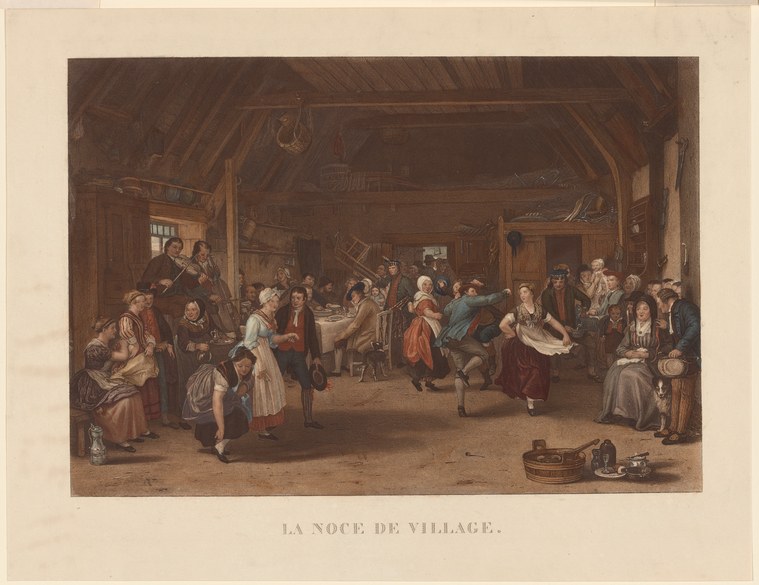
La noce de village
Unknown artist
- Collection:
- Prints depicting dance
- Source:
- New York Public Library
- Rights:
- Public domain — free to use, share and adapt.
- Recorded as:
- Public Domain
This print documents how ordinary people danced at weddings and celebrations in 18th-century rural Europe, offering visual evidence of couple-dance practice outside the court and theatre. It shows the social function of dance as spectacle, community gathering, and celebration—reminding us that dance history cannot be written from technique manuals alone.
What you are looking at
A village wedding celebration fills a timber-frame barn or hall, the space defined by heavy wooden beams visible in the ceiling and walls. The scene is crowded and animated: roughly thirty figures in 18th-century dress occupy the floor and edges of the room. In the centre, a couple dances while musicians play at left; spectators line the walls in small clusters—some seated on benches, some standing. The figures wear dark breeches, waistcoats, and coats typical of rural gentry or prosperous farmers, while women appear in long skirts and caps. Light enters from a small window at the left, creating warm tones that catch folds of fabric and the wooden structure. The composition draws the eye inward toward the dancing couple, though the scene's energy radiates outward through the density of watching figures.
The dancing
The central couple stands in an open, upright posture characteristic of social couple-dancing: the man and woman face one another at a slight distance, arms extended in a light hold. Their bodies are vertical and composed rather than tilted or twisted. Around them, other figures stand or sit in attitudes of attention and social ease—some with arms folded, some gesturing toward the dancers, some engaged in quiet conversation. The postures are naturalistic and relaxed, without the formal alignment of court dance; weight appears evenly distributed, and there is no visible turnout at the hip.
The dance depicted
This is a village or country wedding dance, most likely a contre-danse, reel, or cotillon—the principal social couple-dances of rural northern Europe in the 18th century. The composition shows the moment of active dancing rather than preparation or conclusion, with witnesses arranged to observe. The dance appears to be performed in a closed or semi-closed partnership hold, which rules out some earlier folk forms. The setting—indoors, in a working community space, with music and a mixed social gathering—is consistent with folk-regional or historic-gilded-age ballroom tradition, specifically the contra, reel, or country dance family.
How it was made
This is a hand-coloured engraving or etching, identifiable by the linear cross-hatching visible in the shadows and background, the precision of the compositional lines, and the application of watercolour or gouache over the printed base. The title 'La noce de village' is engraved in italics below the image. The medium allowed wide distribution as a print and suggests the subject held enough popular interest to warrant commercial reproduction. The warm browns and ochres visible in the colouring are consistent with 18th-century hand-finishing practices.
About this work
La noce de village is an 18th-century engraving depicting a rural wedding celebration in which a couple performs a social partner dance before an assembled gathering of villagers and family. The work captures a specific moment of collective festivity—the dance itself—within a crowded domestic interior. It belongs to a substantial tradition of European genre prints documenting rural life, wedding customs, and community celebration, and serves as documentary evidence of how couple-dancing was performed and witnessed in non-courtly settings.
For dance historians, the work is valuable precisely because it shows dance as lived practice rather than as technique to be learned. The casual postures of the onlookers, the informal dress, and the working interior all distinguish this from courtly or theatrical dance imagery. The couple's hold and frame offer visual evidence of how contra or country dances were actually partnered in village contexts—information rarely available from dance manuals of the period, which prescribed technique for trained dancers rather than recording community practice.
How to look at it
Notice the careful positioning of the onlookers: they are not randomly scattered but positioned to frame and witness the dancing couple, establishing the dance as the focal point of the gathering. Observe the couple's hold and posture—upright, composed, at arm's length—and compare it to the relaxed attitudes of the seated spectators. The artist has chosen the moment when the couple is actively dancing, not entering or preparing, which emphasizes the festive action rather than the social negotiation around it. The detail of dress and the specificity of the timber architecture suggest the artist was documenting an observed scene rather than inventing a generic 'village wedding.'
The period
The 18th century saw the codification and European-wide spread of couple-dances such as the contre-danse, minuet, and cotillon, which gradually replaced earlier court forms. These dances penetrated rural and provincial society, though always in adapted or simplified versions. Genre prints depicting rural life, village festivals, and wedding celebrations were a popular commercial category in the 18th century, particularly in the German-speaking territories and France. Such prints served both as documentation and as entertainment for urban audiences curious about provincial customs. The print's title—in French—suggests circulation among educated urban viewers familiar with French cultural vocabulary.
Where it lives
The work is held in the Prints collection of the New York Public Library. It is catalogued under the subject heading 'Prints depicting dance' and dated to an unknown period on the basis of style. The title and engraved inscription are the only information recorded on the catalogue record.
Dance in this work
Questions about this work
What dance are they performing?
The composition does not allow certain identification, but the couple's hold, the indoor setting, and the 18th-century dress suggest a contre-danse, cotillon, or country reel—the most common partner dances at village celebrations across northern Europe at this date. These dances were social rather than theatrical, performed by ordinary people with no professional training.
How do we know this is 18th century?
The style of dress, the hair and caps, the furnishings, and the engraving technique all point to the 18th century. The furniture, window style, and wooden construction of the building are also consistent with rural German or French interiors of that period. However, the catalogue record does not provide a firm date, so this attribution rests on visual analysis.
Who is the artist?
The artist is not recorded in the catalogue. The engraving is unsigned or the signature is not legible in the version held by NYPL. The style and subject matter are consistent with 18th-century German or French commercial print production, but the maker cannot be identified from the image alone.
Why is this relevant to dance history?
Most dance records from the 18th century come from technique manuals, theatrical accounts, or the writings of the wealthy. This print is rare as visual evidence of how ordinary rural people actually danced—how they held their partners, how many participated, what music accompanied them, and what role dance played in community celebration. It documents practice rather than precept.
More dance artwork





