49 works in this view — arrow keys or swipe to move between them.
Dance in Art
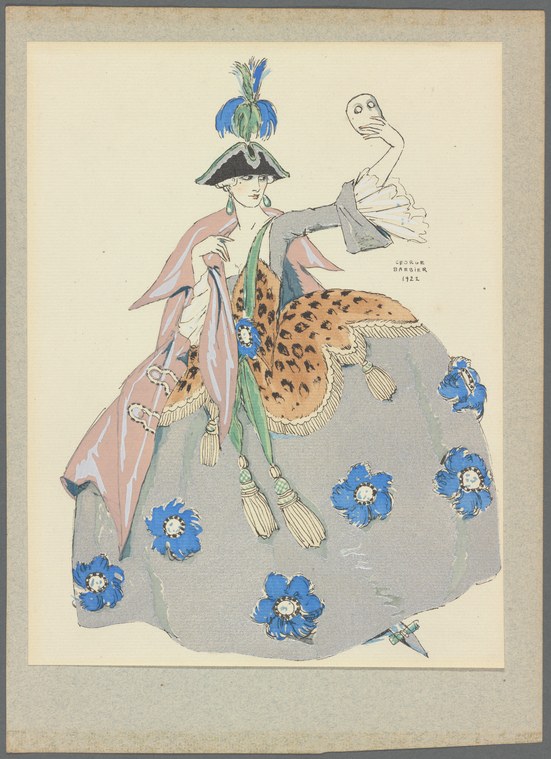
Costume design drawing for Une Ombre in La Derniere Nuit de Don Juan
Unknown artist
- Collection:
- Prints depicting dance
- Source:
- New York Public Library
- Rights:
- Public domain — free to use, share and adapt.
- Recorded as:
- Public Domain
This drawing is evidence of how early twentieth-century theatrical designers understood the dancing body as a vehicle for character and narrative; the pose and costume work together to signal 'shadow' or 'phantom' before the dancer moves. For historians of Ballets Russes and related avant-garde theatre, the design documents the period's appetite for theatrical pastiche—the deliberate mixing of Baroque court dress with modernist formal language. For costume historians, it preserves a detailed record of a specific design concept executed in a standard theatre practice medium.
What you are looking at
A single figure in elaborate costume dominates this design drawing, posed in a theatrical attitude against a pale ground. The dancer wears a dramatic ensemble combining Baroque and fantastical elements: a tall black tricorn hat topped with a tall plume of blue feathers, a pink silk cape lined in contrasting fabric, and a full skirt of grey silk scattered with blue flowers. The figure's right arm extends forward holding a delicate fan or mask-like object rendered in pale tones; the left arm gestures expressively across the body. The proportions and silhouette suggest a female dancer, though the overall presentation mixes masculine court dress (the hat and cape) with feminine skirt and ornament, a common strategy in early twentieth-century theatrical costume design. A small dragonfly or similar insect appears in the lower right corner. The drawing is executed in watercolor and ink with fine linear detail, particularly in the hatching and pattern work of the fabrics.
The dancing
A single standing figure shown in three-quarter view, weight balanced on what appears to be the downstage leg, the torso lifted and angled to face the viewer while the head tilts slightly upward. The right arm is extended at approximately shoulder height, holding an object with delicate precision; the left arm curves across the torso. The pose suggests a moment of theatrical presentation or display rather than active movement—the body is posed rather than in transit. The silhouette and proportions are consistent with a trained dancer of the early twentieth century, capable of holding this kind of sustained, decorative attitude.
The dance depicted
The costume and pose are consistent with early twentieth-century theatrical ballet or pantomime, likely from the Ballets Russes era or similar avant-garde European theatre. The title *La Dernière Nuit de Don Juan* (The Last Night of Don Juan) indicates this design is for a character in a dramatic work with literary or operatic roots; 'Une Ombre' (A Shadow) suggests this figure is a phantom or supernatural presence—possibly the ghost of a woman from Don Juan's past. The combination of Baroque costume elements (the tricorn hat, pink cape) with modernist stylization in the floral skirt and the surreal gesture suggests this is design for a theatrical work that mixed historical reference with contemporary avant-garde aesthetics. Without further documentation, the specific dance vocabulary cannot be determined from the image alone.
How it was made
This is a watercolor and ink costume design drawing on paper, likely executed with pencil underdrawing, watercolor wash, and fine pen detail. The technique allows for rapid exploration of color, fabric texture, and silhouette—essential for communicating a design to costume makers and producers. The treatment of the skirt flowers in particular shows the designer's confidence with watercolor's ability to suggest pattern and volume without rendering every detail. This appears to be a working design document rather than a finished presentation drawing, though it is sufficiently detailed and composed to serve as an archive record. The style and execution are consistent with theatre design practice of the 1910s–1920s.
About this work
This is a costume design drawing for a character in a theatrical work of the early twentieth century, almost certainly a production associated with modern ballet or avant-garde theatre in Europe. The drawing documents both the visual concept of a costume—one that mixes historical pastiche with modernist stylization—and the performer's stance and bearing on stage. The figure is identified as 'Une Ombre' (A Shadow), suggesting a role as a phantom or supernatural presence, likely a female character from the past revisiting the protagonist in a dramatic work centered on the Don Juan legend. The work sits at the intersection of dance history, costume history, and theatre design, offering evidence of how theatrical dance in the early twentieth century engaged with literary sources and how costume functioned as a primary vehicle for character and narrative.
How to look at it
The drawing freezes a moment of stillness and display rather than action. Notice how the extended arm and the tilt of the head create an address to the viewer—a theatrical 'presentation' pose rather than a step or phrase of movement. The costume itself is the primary information: the impossibility of the silhouette (the tricorn hat paired with a full flowered skirt), the careful distinction between pink silk, grey silk, and blue detail work. The dragonfly in the corner is an odd, witty touch, suggesting some narrative or symbolic connection. The pose is stable, almost heraldic, which fits the role of a phantom or memory figure—something to be contemplated rather than danced.
The period
This drawing dates almost certainly to the 1910s–1920s, the era of the Ballets Russes and the emergence of modern dance and theatre design as distinct disciplines. The work reflects the aesthetic priorities of that moment: the collision of historical reference and contemporary style, the dancer as a vehicle for the designer's vision, and the costume as a primary site of meaning. The literary source (the Don Juan legend) was a rich vein for early twentieth-century avant-garde artists; several significant theatrical works drew on it during this period. The style of the drawing itself—the hand-painted watercolor with pen outline, the careful attention to silhouette and textile surface—is typical of theatre design practice in the 1910s, before photomechanical reproduction became standard.
Where it lives
This drawing is part of the New York Public Library's 'Prints depicting dance' collection, a broad category that includes design documents, historical prints, and photographic reproductions related to dance and theatre. It is catalogued only as a costume design drawing with no artist name recorded, though the style and technique are consistent with early twentieth-century European theatre practice.
Dance in this work
Questions about this work
What is 'Une Ombre' in La Dernière Nuit de Don Juan?
'Une Ombre' means 'A Shadow' or 'The Shadow' in French. Based on the title of the work and the theatrical costume shown here, this is likely a phantom character—a woman from Don Juan's past who appears to him in the final night of the drama. The costume's mixture of historical (Baroque) and theatrical (modern, stylized) elements underscores the supernatural or dreamlike quality of the apparition.
Is this a Ballets Russes design?
The style, technique, and aesthetic are entirely consistent with Ballets Russes–era theatre design of the 1910s–1920s, but without artist attribution or other documentation in the NYPL record, a definitive attribution cannot be made. The work's visual language—the mixture of historical costume with modernist abstraction, the emphasis on silhouette, the watercolor medium—all point to that milieu and moment.
Who was the dancer?
The drawing does not record the dancer's name or role assignment. It is a design document produced before or during rehearsal, intended to communicate the visual concept to costume makers and other production staff. The proportions and posture suggest a trained dancer capable of sustained, decorative attitudes in the classical or ballet idiom.
What is the object in the dancer's right hand?
The drawing shows a pale, delicate form held at the end of an extended arm. It may be a mask, a fan, or a symbolic prop specific to the character or narrative. Without additional documentation or context from the production, its exact identity cannot be determined from the image alone.
More dance artwork





