49 works in this view — arrow keys or swipe to move between them.
Dance in Art
La walse, le bal de Vincennes
Unknown artist
- Collection:
- Prints depicting dance
- Source:
- New York Public Library
- Rights:
- Public domain — free to use, share and adapt.
- Recorded as:
- Public Domain
This print is direct documentary evidence of the waltz at the moment of its entry into respectable European society. It shows how the dance was framed visually and commercially for a paying public, and it preserves the specific fashion, posture, and social codes of the Regency waltz before the dance evolved into its later, more energetic forms. For dance historians, it is a primary source for understanding the closed-couple embrace, the formality of early 19th-century ballroom etiquette, and the waltz as an object of social novelty and satire.
What you are looking at
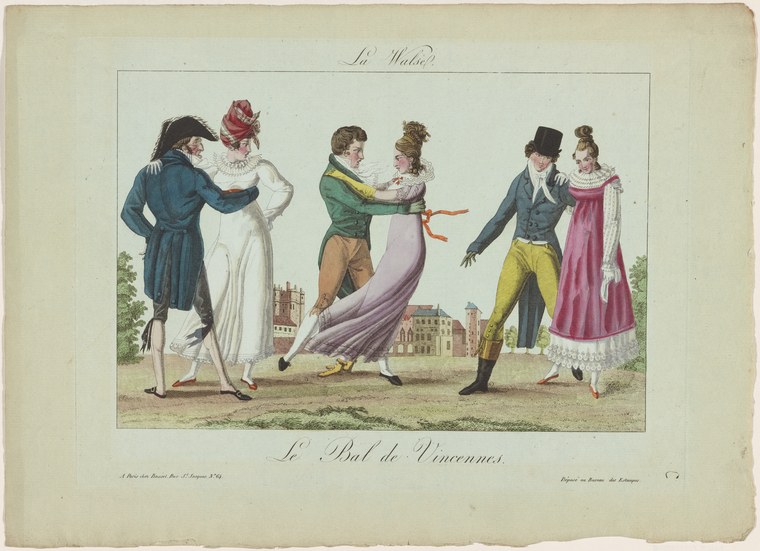
A hand-colored engraving depicting three couples in fashionable early 19th-century dress arranged across an open ground, with architectural structures visible in the background. The scene is titled *La Valse* (The Waltz) with a secondary title *le bal de Vincennes* (the Vincennes Ball), suggesting an outdoor public dance venue. The figures are distributed in a narrative sequence: at left, a man in dark blue coat with arm around a woman in white Empire-waist gown with pink turban; in the center, a young man in green coat with yellow breeches partnering a woman in lavender drapery; at right, a man in dark coat and tall hat with arm extended toward a woman in pink gown with white turban. The composition reads left to right as a social instruction or satire, showing variations of courtship and partnering gesture. The setting appears to be summer daylight with minimal shadow, and the mood is one of fashionable leisure and flirtation rather than energetic movement.
The dancing
The dancers are depicted upright and formally posed rather than captured mid-movement. Each man stands with weight centered, arm extended or encircling the woman's waist in the closed-hold position characteristic of early 19th-century couple dances. The women's postures are relaxed and receiving, their bodies angled toward their partners. Arm positions are high and controlled—the men's free arms extended or gestural, the women's arms draped or held at the side or extended. The footwork is not depicted in detail; the figures appear stationary or in a pause rather than executing steps. The overall frame suggests the formal, upright carriage and restrained contact of Regency-era ballroom etiquette rather than the turning, swaying action that the waltz would develop.
The dance depicted
This is a waltz scene, explicitly titled, from the period when the waltz was establishing itself in European ballrooms—likely 1810–1820s based on dress. The waltz had recently arrived from Vienna and was shocking to London and Paris society for its close partnering and turning action; this image may be documentary, promotional, or satirical in intent. The three couples appear to show variations of the waltz embrace: the closest and most intimate pair at left; more formal and distant versions at center and right. However, the figures are posed and static, not captured in the characteristic turning momentum of actual waltz dancing, which suggests the image is didactic or satirical rather than a snapshot of movement. The setting at Vincennes, a public garden near Paris, places this in a specific social context—the waltz as a fashionable outdoor amusement for the bourgeoisie rather than an aristocratic court dance.
How it was made
This is a hand-colored engraving or aquatint, recognizable from the fine linear hatching, formal composition, and the application of watercolor or gouache pigment to a printed base. The technique allowed for mass reproduction and wide circulation, suggesting this was a commercial print made for sale to a middle-class audience—possibly as fashion satire, instruction, or social commentary. The engraver has used fine parallel lines to model fabric and shadow, and the hand-coloring (in red, pink, yellow, blue, and flesh tones) is applied with restraint, keeping the linear structure legible. This method was standard for European popular prints of the 1810s–1820s and indicates a work intended for the print market rather than fine art commission.
About this work
This is an early 19th-century engraving documenting the emergence of the waltz in European social dance. The work shows three couples in Regency-era fashionable dress arranged as a narrative sequence, illustrating variations of the waltz embrace and partnering at a public ball in Vincennes near Paris. The waltz was new and controversial in this period—it introduced close couple contact and rapid turning that scandalized conservative society—and this image appears designed to circulate commentary on the dance among an educated, fashion-conscious public. The static, posed quality of the figures suggests the artist's interest is less in capturing movement than in documenting the social ritual, the dress codes, and the degrees of intimacy permitted by the waltz embrace. As a popular print, it serves as historical evidence of how the waltz was perceived, taught, and circulated as a subject of public fascination in the 1810s–1820s.
How to look at it
The composition is arranged as a teaching or satirical sequence: read the three couples left to right to see how the waltz embrace could vary in intimacy and formality. Notice the man's arm position in each pair—how it encircles, supports, or gestures—and observe the women's passive, receiving posture in contrast. Look at the fine engraved lines that model the fabric and the carefully applied color (especially the contrast between the men's dark coats and the women's pale, high-waisted gowns, which was the hallmark of Regency fashion). The setting—a public garden with distant architecture—is rendered summarily, emphasizing the figures and their dress. The artist has chosen a moment of pause or greeting rather than active turning, which may be a limitation of the medium or an intentional choice to show the formal structure of the dance rather than its movement.
The period
The waltz arrived in Vienna in the 1780s and spread to aristocratic circles in Paris and London during the Napoleonic Wars and the Congress of Vienna (1814–1815). It was perceived as dangerously informal and sensual because it required close contact between partners and featured turning action that was novel to court-trained dancers. The years 1810–1825 saw intense debate over the waltz's propriety; satirical and instructional prints on the subject flooded European markets. This image dates to the period when the waltz was becoming fashionable among the upper and middle classes but was still sufficiently controversial to warrant commentary. The Vincennes setting places the waltz in a public, outdoor, commercial leisure context rather than in a private aristocratic salon, reflecting the democratization of dancing in post-Napoleonic France. Contemporary critics complained that the waltz encouraged moral looseness and poor posture; this image may be satirizing those anxieties or, conversely, promoting the waltz as a mark of modern style.
Where it lives
This work is held in the Prints collection of the New York Public Library. It is a commercial popular print, likely produced in Paris or London for sale to an urban, educated audience interested in fashion, social satire, and dance.
Dance in this work
Questions about this work
Why does the title say 'La Valse' if the figures aren't actually dancing?
Early 19th-century prints about fashionable dances often prioritized showing the correct posture, dress, and social codes over capturing movement in action. This image appears designed as instruction or social commentary on the waltz as a phenomenon, not as a dynamic record of the dance. The three couples may be shown in sequence to illustrate different modes of partnership or to satirize variations in propriety.
What was controversial about the waltz?
The waltz required close bodily contact between partners and featured rapid turning that was novel and shocking to conservative society. Critics accused the waltz of encouraging moral looseness and unseemly familiarity between men and women. It was seen as foreign (Austrian/German) and vulgar compared to the restrained, linear courtesies of older dances like the minuet or cotillion.
What does the artist's choice to show three couples tell us?
The three pairs may illustrate a spectrum of waltz embraces—from intimate to formal—or may be satirizing different social types' approach to the dance. It could also be a teaching image showing progressive levels of partnering or courtship. The static poses suggest the artist is interested in the social and sartorial dimensions of the waltz rather than its kinetic properties.
Why is this at a place called Vincennes?
Vincennes was a fashionable public garden and leisure destination near Paris. By setting the waltz there rather than in a private aristocratic salon, the artist emphasizes that the waltz was becoming a commercial, public, middle-class entertainment—not an exclusive court practice. This reflects the social democratization of dance after the Napoleonic Wars.
More dance artwork





