49 works in this view — arrow keys or swipe to move between them.
Dance in Art
Campagne et bocage agreable dans L'isle de Naxos
Unknown artist
- Collection:
- Prints depicting dance
- Source:
- New York Public Library
- Rights:
- Public domain — free to use, share and adapt.
- Recorded as:
- Public Domain
This print preserves evidence of how 18th-century elites visualized dance within their cultural fantasy of pastoral leisure, showing the aesthetics and bodily practices of courtly social dancing as embedded in landscape and theatrical design. For dance historians, the image documents the visual conventions of representing the minuet and contredanse during the period of their greatest fashionability, and how dance functioned as a marker of refinement and social rank.
What you are looking at
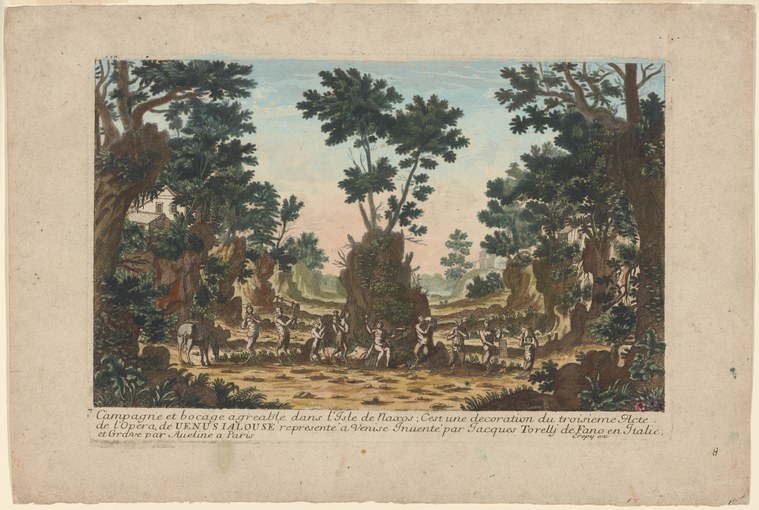
A pastoral landscape opens beneath tall trees to reveal an expansive gathering of figures arranged across the middle ground. The scene depicts what appears to be an aristocratic outdoor entertainment or fête, with dozens of people in 18th-century dress distributed across a clearing. In the foreground, small groups cluster on sandy or dusty ground; the middle distance shows larger assembled crowds, some standing in loose formations, others in pairs or small groups. The background recedes through carefully managed perspective toward distant hills and further woodland. The light is bright and even, suggesting midday, with soft shadows cast by the monumental trees that frame the composition on all sides. The engraver has rendered the foliage with fine parallel lines and careful cross-hatching to convey depth and the play of light through leaves.
The dancing
The figures are minute and rendered with economy, but several pairs in the middle ground appear to be engaged in dancing or formal social movement. Their postures suggest the upright carriage and restrained frame typical of 18th-century courtly dance, with bodies held erect and arms positioned in controlled fashion rather than freely extended. The women wear full skirts, many appearing to be caught in the moment of a turn or glide, while men stand beside them in dark suits. Groups of onlookers—both standing and seated—surround the dancers, indicating this is a formal social event rather than a wild or ecstatic celebration.
The dance depicted
This is likely depicting a French or Italian aristocratic pastoral dance entertainment of the 18th century, possibly a minuet or contredanse in an outdoor garden or country setting. The title references Naxos, the Greek island, suggesting the scene may be drawn from or inspired by classical or pastoral literary sources (such as the Ariadne myth). The restrained posture and paired arrangement of the central figures, combined with the formality of dress and the curated landscape setting, all point to the structured social dances of the baroque and rococo periods. The dance is embedded within a larger ceremony or fête, where the dancing is one element of aristocratic display and courtship rather than the exclusive focus.
How it was made
This is a hand-colored engraving, identifiable by the fine line-work, the carefully controlled tonal range achieved through parallel and cross-hatched lines, and the application of watercolor or gouache tint over the printed surface. The technique was a standard medium for the dissemination of prints in the 18th century, allowing multiple copies to be produced from a single copper plate and then individually colored by hand or in a workshop. This medium indicates the work was intended for a moderately broad audience of educated collectors and those interested in pastoral imagery, theatrical scenes, or contemporary social customs. Engravings of this type often served as records of fashionable entertainments, illustrated literature, or designs for decorative schemes.
About this work
This hand-colored engraving presents a fête galante or pastoral celebration in which aristocratic couples dance in a Naxos-inspired landscape setting. The work captures a moment in the history of European courtly dance during the 18th century, when minuet, contredanse, and other formal social dances were performed as central components of refined entertainment and courtship ritual, set within idealized natural or garden environments. The image is not a documentary record but an imaginative reconstruction of dance as an element of aristocratic leisure and pastoral fantasy—a common theme in rococo art and literature. The dancing figures are secondary to the overall orchestration of the scene, yet their presence is essential: they validate the setting as a place of pleasure, ceremony, and social order.
How to look at it
Notice the careful positioning of the dancers in the middle distance: they are not isolated or spotlit but woven into a larger social assembly, surrounded by onlookers and framed by the architecture of trees. The engraver has chosen a moment of apparent movement—several women's skirts suggest a turn or glide—but the overall mood is restrained and ceremonial rather than exuberant. The eye is drawn first to the opening and the distant landscape, then settles on the human figures only when the viewer scans the middle ground: this compositional choice reflects the period's aesthetic of dance as one element within a larger tableau of civilization and nature in harmony.
The artist
The artist is not recorded in the catalogue. The engraving style and subject matter are consistent with French rococo printmaking of the mid-18th century, a period when pastoral and theatrical scenes were hugely popular and widely circulated as hand-colored engravings. Prints of this kind were often produced by anonymous workshops or journeyman engravers working from designs by recognized history painters or theatrical designers.
The period
The 18th century saw the minuet reach the height of its prestige as the dance of aristocratic refinement across Europe. Simultaneously, rococo art was celebrating pastoral themes, fêtes champêtres, and scenes of aristocratic leisure set in idealized landscapes. The combination of these two currents—the cultural elevation of formal dance and the visual celebration of nature as a setting for refined entertainment—produced a large body of prints and paintings depicting dance in pastoral or garden settings. The engraving medium allowed these fantasies to be widely disseminated and collected.
Where it lives
The work is part of the New York Public Library's collection of prints depicting dance. It is catalogued but with minimal metadata, reflecting the status of rococo pastoral prints as abundant, often anonymous, and sometimes undervalued by earlier scholarship.
Dance in this work
Questions about this work
What dance is being performed here?
The specific dance cannot be identified with certainty from the image alone, but the restrained posture, paired arrangement, and formal dress suggest a minuet or contredanse—the dominant social dances of the European aristocracy in the 18th century. The setting and style place it within the rococo aesthetic of pastoral entertainment.
Is this a record of a real event or a fantasy?
This is an imaginative composition drawing on the pastoral and theatrical conventions of rococo art. While it depicts the kinds of dances and entertainments that aristocrats actually performed, the Naxos setting is classical or literary rather than documentary, and the artist has composed an idealized vision of aristocratic leisure.
Why are the dancers so small and distant in the composition?
This compositional choice reflects rococo taste: the landscape and the overall spectacle of the fête are as important as the dancing itself. The dancers are woven into the broader fabric of social order and civilized pleasure, demonstrating that dance was part of a choreography of refinement that encompassed dress, landscape, and social arrangement.
Who made this print?
The artist is not recorded. The style is consistent with mid-18th-century French rococo printmaking, and the work was likely produced by a professional engraver or workshop, possibly from a design by a known painter or theater designer. Such prints were often unsigned and circulated widely.
More dance artwork





